• HOME
  • NEWS
  • EXPLORE
    • CAREER
      • Companies
      • Jobs
    • EVENTS
    • iGEM
      • News
      • Team
    • PHOTOS
    • VIDEO
    • WIKI
  • BLOG
  • COMMUNITY
    • FACEBOOK
    • INSTAGRAM
    • TWITTER
Saturday, June 27, 2026
BIOENGINEER.ORG
No Result
View All Result
  • Login
  • HOME
  • NEWS
  • EXPLORE
    • CAREER
      • Companies
      • Jobs
        • Lecturer
        • PhD Studentship
        • Postdoc
        • Research Assistant
    • EVENTS
    • iGEM
      • News
      • Team
    • PHOTOS
    • VIDEO
    • WIKI
  • BLOG
  • COMMUNITY
    • FACEBOOK
    • INSTAGRAM
    • TWITTER
  • HOME
  • NEWS
  • EXPLORE
    • CAREER
      • Companies
      • Jobs
        • Lecturer
        • PhD Studentship
        • Postdoc
        • Research Assistant
    • EVENTS
    • iGEM
      • News
      • Team
    • PHOTOS
    • VIDEO
    • WIKI
  • BLOG
  • COMMUNITY
    • FACEBOOK
    • INSTAGRAM
    • TWITTER
No Result
View All Result
Bioengineer.org
No Result
View All Result
Home NEWS Science News

Evaluating cultural value of landscapes using geotagged photos

Bioengineer by Bioengineer
April 12, 2017
in Science News
Reading Time: 2 mins read
0
Share on FacebookShare on TwitterShare on LinkedinShare on RedditShare on Telegram
IMAGE

Credit: Yoshimura N. and Hiura T., Ecosystem Services, February 28, 2017

Researchers have developed a new method for assessing the cultural value of landscapes using geotagged photos shared on a social-networking service. Data obtained with this method could help determine which locations should be used for tourism or targeted for environmental protection.

We all know that nature provides recreational and psychological benefits to us but it is often difficult to assign monetary worth to. This research could help us determine how to strike a balance between the utilization and preservation of nature.

"This type of research has received little attention despite its importance," says Tsutom Hiura of the research team at Hokkaido University. "We wanted to develop a robust and reliable method to evaluate the aesthetic value of landscapes." This is in line with the international agreement, the Aichi Biodiversity Target, which refers to the importance of ecosystem service mapping methodologies.

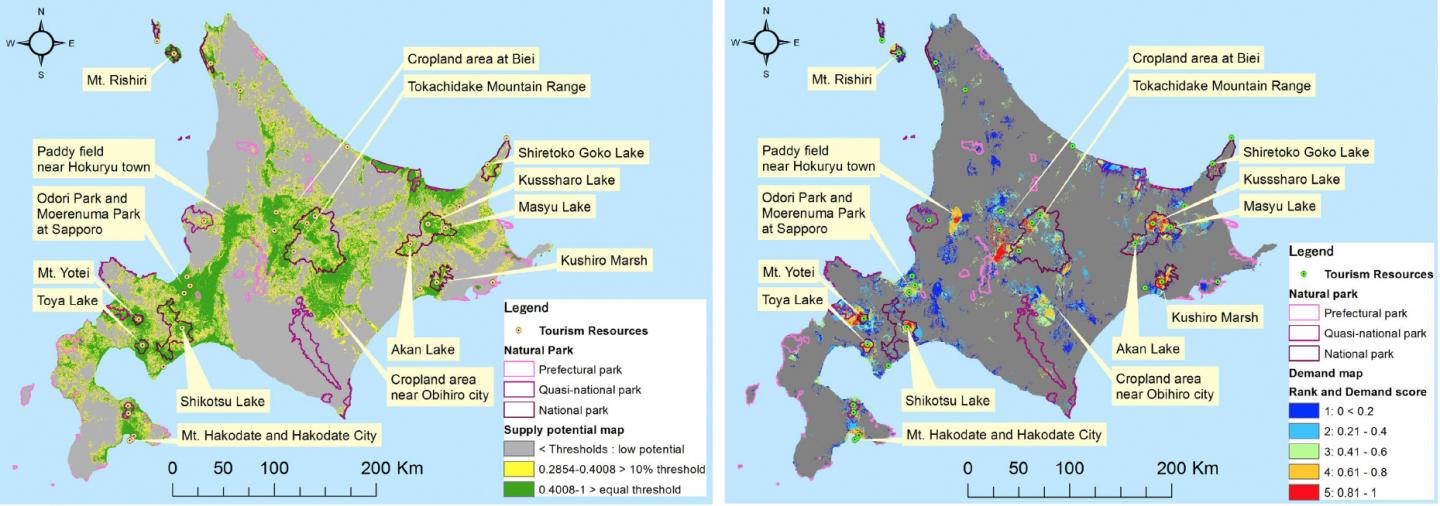
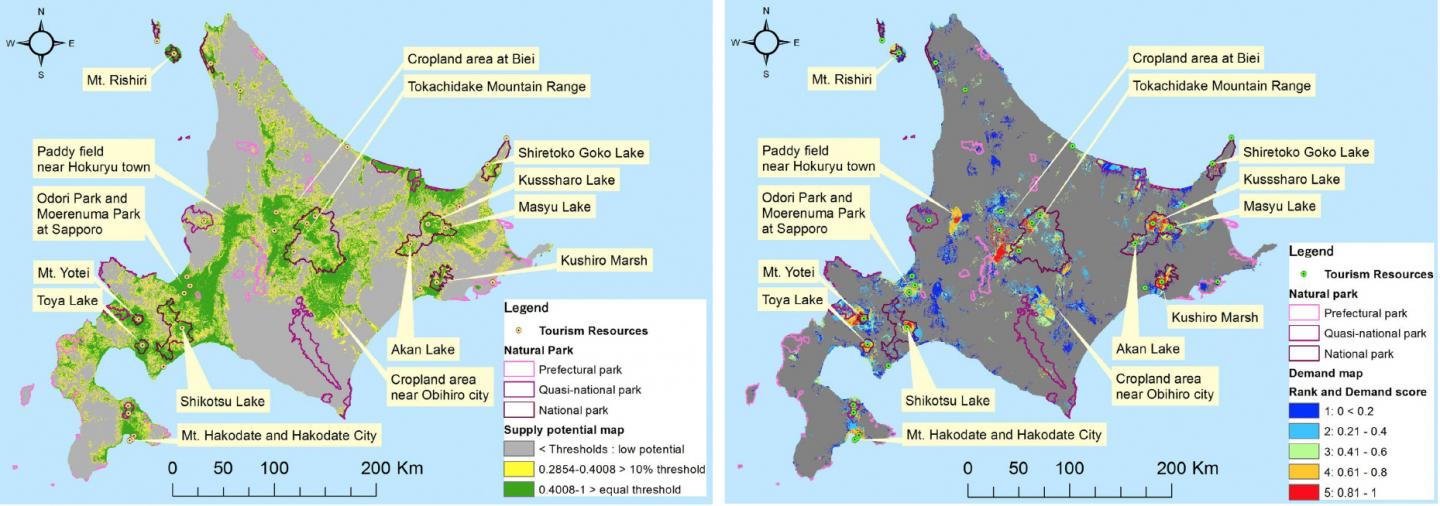
In the study, the researchers used photos that were shared on the photo-sharing service Flickr and tied to a geographic location. The viewshed, or visible area, of each photo was assessed using Geographic Information System software. They identified locations where it appeared that many photos had been taken, and considered these as sites with high landscape "demand," which were then evaluated and given numerical scores.

Next, the team used a modeling method called Maxent to identify locations that appeared to have similar environmental conditions as the locations with high landscape demand. They then evaluated the potential values of these locations, which they called the "potential supply."

This method was applied to locations across Hokkaido in Japan, which indicated that landscape demand is higher in national parks followed by areas of farmland and cities. Comparisons between landscape demand and potential supply showed that, for example, Shikotsu-Toya National Park and Daisetsuzan National Park have greater potential supply than demand, while Kushiro Shitsugen National Park has greater demand than potential supply.

"These kinds of comparisons could enable investigations into whether locations with high landscape demand should be targeted for environmental preservation or whether farmland could be utilized as a tourism resource," says Tsutom Hiura. The researchers plan to further improve the method and test it with other social networks.

###

Media Contact

Naoki Namba
81-117-068-034
@hokkaido_uni

http://www.oia.hokudai.ac.jp/

############

Story Source: Materials provided by Scienmag

Share12Tweet8Share2ShareShareShare2

Related Posts

Tracking Lanthanide-Labeled Microplastics in Plants

June 25, 2026

POSTECH Researchers Slash Cost of Reconstituted Cell-Free Systems by 95%

June 25, 2026

AI and Physics Collaborate to Design Advanced Hydrogen Storage Materials

June 25, 2026

Natural Hallucinogens: Evolution’s Ecological Tools, Not Mere Chemical Byproducts

June 25, 2026
Please login to join discussion

POPULAR NEWS

  • Saying Goodbye to PGY-6: Pediatric Fellowship Realities

    103 shares
    Share 41 Tweet 26
  • Multi-Hospital Study Reveals Long Covid Burden Is Twice as High as Current Estimates

    92 shares
    Share 36 Tweet 23
  • Detection of EDCs in Breast Milk and Infant Urine Up to Six Months Highlights Early Exposure Risks

    77 shares
    Share 31 Tweet 19
  • New Drug Candidate Developed at McMaster Shows Potential for Treating Brain Cancer

    58 shares
    Share 23 Tweet 15

About

We bring you the latest biotechnology news from best research centers and universities around the world. Check our website.

Follow us

Recent News

Tracking Lanthanide-Labeled Microplastics in Plants

POSTECH Researchers Slash Cost of Reconstituted Cell-Free Systems by 95%

AI and Physics Collaborate to Design Advanced Hydrogen Storage Materials

Subscribe to Blog via Email

Success! An email was just sent to confirm your subscription. Please find the email now and click 'Confirm' to start subscribing.

Join 82 other subscribers
  • Contact Us

Bioengineer.org © Copyright 2023 All Rights Reserved.

Welcome Back!

Login to your account below

Forgotten Password?

Retrieve your password

Please enter your username or email address to reset your password.

Log In
No Result
View All Result
  • Homepages
    • Home Page 1
    • Home Page 2
  • News
  • National
  • Business
  • Health
  • Lifestyle
  • Science

Bioengineer.org © Copyright 2023 All Rights Reserved.