Kaspar Valgepea, Associate Professor of Gas Fermentation Technologies at the University of Tartu, will advance understanding of gas-consuming bacteria, supported by European Research Council grant funding. The project will pioneer a novel method for creating a large number of genetically engineered strains and compile a knowledgebase that will accelerate engineering of cell factories and research in the field of biotechnology, as well as knowledge transfer supporting a circular economy.
Acetogen bacteria are microorganisms capable of consuming both exhaust gases and gasified organic waste, including the most common household waste. While bacterial strains present in nature can produce a handful of useful compounds, bioengineering their metabolism would allow gas-fermenting acetogens to produce the necessary compounds for fuels and chemicals more efficiently and in a notably larger range. This process is called gas fermentation. It is a technology that is already in industrial use in the world, but so far mainly for the production of ethanol.
The unsolved mystery of the bacterium
One of the reasons for the current restricted use of acetogens is the lack of knowledge about which genes exactly influence which processes. As these bacteria live in environments without oxygen and consume toxic and explosive gases, studying them is challenging. So far, genetically modified strains have essentially been handmade one-by-one that is very time-consuming. Therefore, it is still unclear what exactly are the functions of the majority of the roughly 4,000 genes in the studied acetogen bacterium (Clostridium autoethanogenum).
For the same reason, there is also a lack of a comprehensive dataset describing how modifications in different genes affect bacterial phenotypes at systems-level. According to Valgepea, such datasets have only been compiled for a few of the most studied microorganisms, such as the bacterium Escherichia coli or baker’s yeast. Even for them, around 160 strains are characterised in the datasets.
Impact on the future of biotechnology
The novelty of Valgepea’s project is that, within five years, it will create nearly 750 modified bacterial strains and consolidate the collected data as well as existing similar information about acetogens in a public knowledgebase (A-BASE). As the method for creating genetically modified strains would also be applicable to other microorganisms, the expected impact of the project is significant for the fields of microbiology, synthetic biology, and biotechnology, both for research and industrial applications.
The distinctiveness of the method being developed by Valgepea is that in addition to creating a large-scale library of strains, it also aims to find a way how to grow and study the strains individually. In selecting the genes for modification, the researchers will focus on three aspects, the exploration of which has had a great impact on other bacterial strains. Thus, they will be exploring genes essential for growth, factors that influence DNA transcription, and proteome “dark matter” that play an important role in engineering of bacterial metabolism. Applying data mining and machine learning on the data collected while focusing on the three aspects will enable to find the best target mutations faster than before, so that acetogen cell factories could more efficiently produce a greater number of compounds, which production would otherwise have a significant environmental footprint in the traditional chemical industry.
“The key issue in reducing the environmental impact of the global economy is how to move from carbon mining to carbon recycling. According to the McKinsey Institute, nearly 60% of the physical inputs to the global economy can be produced via biological systems. My project has a significant impact on the development of one technology contributing to the latter – gas fermentation“, explained Valgepea, who at the Institute of Bioengineering, University of Tartu is the leader of one of the few laboratories in the world that could execute such a project. The amount of the Consolidator Grant from the European Research Council is slightly above two million euros. The project lasts five years.
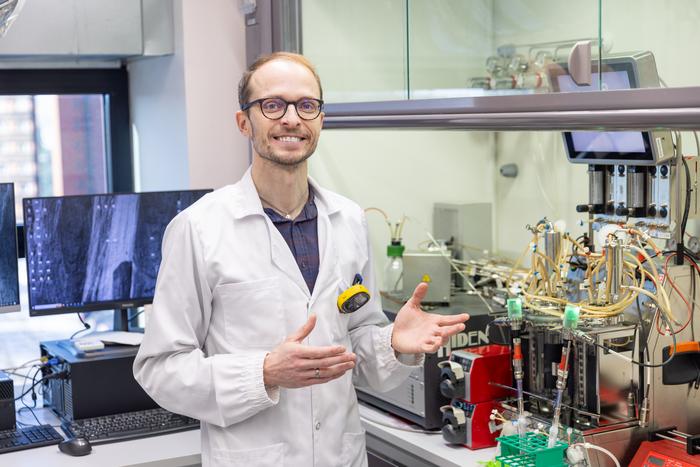
Credit: credit to the author Andres Tennus
Kaspar Valgepea, Associate Professor of Gas Fermentation Technologies at the University of Tartu, will advance understanding of gas-consuming bacteria, supported by European Research Council grant funding. The project will pioneer a novel method for creating a large number of genetically engineered strains and compile a knowledgebase that will accelerate engineering of cell factories and research in the field of biotechnology, as well as knowledge transfer supporting a circular economy.
Acetogen bacteria are microorganisms capable of consuming both exhaust gases and gasified organic waste, including the most common household waste. While bacterial strains present in nature can produce a handful of useful compounds, bioengineering their metabolism would allow gas-fermenting acetogens to produce the necessary compounds for fuels and chemicals more efficiently and in a notably larger range. This process is called gas fermentation. It is a technology that is already in industrial use in the world, but so far mainly for the production of ethanol.
The unsolved mystery of the bacterium
One of the reasons for the current restricted use of acetogens is the lack of knowledge about which genes exactly influence which processes. As these bacteria live in environments without oxygen and consume toxic and explosive gases, studying them is challenging. So far, genetically modified strains have essentially been handmade one-by-one that is very time-consuming. Therefore, it is still unclear what exactly are the functions of the majority of the roughly 4,000 genes in the studied acetogen bacterium (Clostridium autoethanogenum).
For the same reason, there is also a lack of a comprehensive dataset describing how modifications in different genes affect bacterial phenotypes at systems-level. According to Valgepea, such datasets have only been compiled for a few of the most studied microorganisms, such as the bacterium Escherichia coli or baker’s yeast. Even for them, around 160 strains are characterised in the datasets.
Impact on the future of biotechnology
The novelty of Valgepea’s project is that, within five years, it will create nearly 750 modified bacterial strains and consolidate the collected data as well as existing similar information about acetogens in a public knowledgebase (A-BASE). As the method for creating genetically modified strains would also be applicable to other microorganisms, the expected impact of the project is significant for the fields of microbiology, synthetic biology, and biotechnology, both for research and industrial applications.
The distinctiveness of the method being developed by Valgepea is that in addition to creating a large-scale library of strains, it also aims to find a way how to grow and study the strains individually. In selecting the genes for modification, the researchers will focus on three aspects, the exploration of which has had a great impact on other bacterial strains. Thus, they will be exploring genes essential for growth, factors that influence DNA transcription, and proteome “dark matter” that play an important role in engineering of bacterial metabolism. Applying data mining and machine learning on the data collected while focusing on the three aspects will enable to find the best target mutations faster than before, so that acetogen cell factories could more efficiently produce a greater number of compounds, which production would otherwise have a significant environmental footprint in the traditional chemical industry.
“The key issue in reducing the environmental impact of the global economy is how to move from carbon mining to carbon recycling. According to the McKinsey Institute, nearly 60% of the physical inputs to the global economy can be produced via biological systems. My project has a significant impact on the development of one technology contributing to the latter – gas fermentation“, explained Valgepea, who at the Institute of Bioengineering, University of Tartu is the leader of one of the few laboratories in the world that could execute such a project. The amount of the Consolidator Grant from the European Research Council is slightly above two million euros. The project lasts five years.