• HOME
  • NEWS
  • EXPLORE
    • CAREER
      • Companies
      • Jobs
    • EVENTS
    • iGEM
      • News
      • Team
    • PHOTOS
    • VIDEO
    • WIKI
  • BLOG
  • COMMUNITY
    • FACEBOOK
    • INSTAGRAM
    • TWITTER
Tuesday, October 6, 2026
BIOENGINEER.ORG
No Result
View All Result
  • Login
  • HOME
  • NEWS
  • EXPLORE
    • CAREER
      • Companies
      • Jobs
        • Lecturer
        • PhD Studentship
        • Postdoc
        • Research Assistant
    • EVENTS
    • iGEM
      • News
      • Team
    • PHOTOS
    • VIDEO
    • WIKI
  • BLOG
  • COMMUNITY
    • FACEBOOK
    • INSTAGRAM
    • TWITTER
No Result
View All Result
Bioengineer.org
No Result
View All Result
Home NEWS Science News

ETRI develops optical communications technology to double data transfer speed

Bioengineer by Bioengineer
February 24, 2020
in Science News
Reading Time: 2 mins read
0
IMAGE
Share on FacebookShare on TwitterShare on LinkedinShare on RedditShare on Telegram

IMAGE

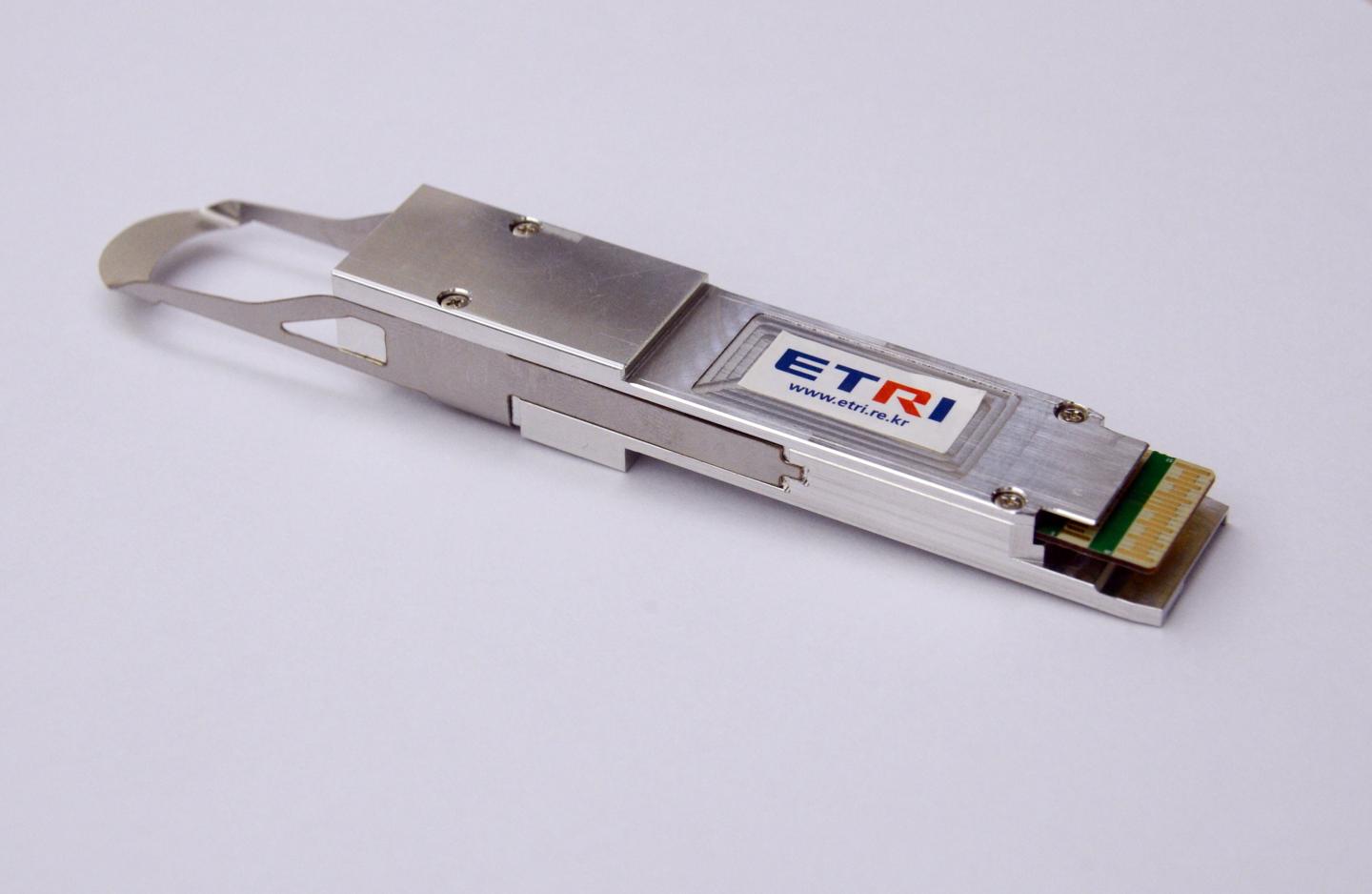
Credit: Electronics and Telecommunications Research Institute (ETRI)

Researchers in South Korea have developed a new optical communications technology that can transfer data in lightning speed. The new technology sends and receives twice as much data than conventional methods. It is expected to contribute to solving data traffic congestion in 5G networks.

The Electronics and Telecommunications Research Institute (ETRI) in South Korea has succeeded to develop a compact 200Gbps optical transceiver in the QSFP-DD (Quad Small Form-factor Pluggable Double Density) form factor. It would take about four seconds to transfer an ultra-high-definition 4K film which is about 100 gigabytes.

The new technology significantly improved data transfer speed by adopting a four-stage high-order modulation method, which is PAM-4 modulation with direct detection. While previous two-stage modulation technology sends one bit a time, the new technology sends two bits. Moreover, it allows efficient data transfer between telecom nodes to other local networks as far away as 80 kilometers.

The new technology, 200Gbps QSFP-DD transceiver provides a cost effective alternative to the other coherent modulation for the metro-access network (such as inter-data center network or mobile back-haul network).

The merit of the new technology is the minor sensitivity to changes in wavelength and temperature and its simple manufacturing process. Hence the power consumption is 1.5 times lower and the density is 4 times higher, thereby reducing the communications equipment investment cost.

ETRI has designed and developed a unique PAM-4 DSP algorithm. The new technology combined with the PAM-4 DSP algorithm has been proven their idea with real-time demonstration, which is a world-best record. The research outcome was published in the journal, Optics Express, a renowned journal in optical communications research sector.

###

About Electronics and Telecommunications Research Institute (ETRI)

ETRI is a non-profit government-funded research institute. Since its foundation in 1976, ETRI, a global ICT research institute, has been making its immense effort to provide Korea a remarkable growth in the field of ICT industry. ETRI delivers Korea as one of the top ICT nations in the World, by unceasingly developing world’s first and best technologies.

Media Contact
Jyung Chan Lee
[email protected]
82-428-601-215

Related Journal Article

http://dx.doi.org/10.1364/OE.382194

Tags: Electrical Engineering/ElectronicsTechnology/Engineering/Computer ScienceTelecommunications
Share12Tweet8Share2ShareShareShare2

Related Posts

Dynamic MRI Reveals How the Young Pelvic Floor Moves From Rest to Strain to Squeeze

Dynamic MRI Reveals How the Young Pelvic Floor Moves From Rest to Strain to Squeeze

October 6, 2026
Soil bacterium's genome reveals how it unlocks phosphorus to boost maize growth

Soil bacterium’s genome reveals how it unlocks phosphorus to boost maize growth

October 6, 2026

Wrist-Worn Sleep Trackers May Mislead: Researchers Flag Statistical Cracks in Landmark Actigraphy Study

October 6, 2026

Eggshell Membrane Turned Zinc Oxide Nanohybrid Protects Sperm and Restores Fertility in Rats

October 6, 2026
Please login to join discussion

POPULAR NEWS

  • Alloys That Shrink Their Own Grains: New PIX Mechanism Refines Metals With Heat Alone

    Alloys That Shrink Their Own Grains: New PIX Mechanism Refines Metals With Heat Alone

    29 shares
    Share 12 Tweet 7
  • Endurance Exercise Reshapes the Liver in Males and Females Through Distinct Molecular Routes

    29 shares
    Share 12 Tweet 7
  • Single Transcription Factor PU.1 Rapidly Converts Fibroblasts into Macrophage-Lineage Cells

    29 shares
    Share 12 Tweet 7
  • New Scale Measures How Ready Nurse Educators Really Are for the AI Era

    29 shares
    Share 12 Tweet 7

About

We bring you the latest biotechnology news from best research centers and universities around the world. Check our website.

Follow us

Recent News

Alloys That Shrink Their Own Grains: New PIX Mechanism Refines Metals With Heat Alone

Endurance Exercise Reshapes the Liver in Males and Females Through Distinct Molecular Routes

Single Transcription Factor PU.1 Rapidly Converts Fibroblasts into Macrophage-Lineage Cells

Subscribe to Blog via Email

Success! An email was just sent to confirm your subscription. Please find the email now and click 'Confirm' to start subscribing.

Join 85 other subscribers
  • Contact Us

Bioengineer.org © Copyright 2023 All Rights Reserved.

Welcome Back!

Login to your account below

Forgotten Password?

Retrieve your password

Please enter your username or email address to reset your password.

Log In
No Result
View All Result
  • Homepages
    • Home Page 1
    • Home Page 2
  • News
  • National
  • Business
  • Health
  • Lifestyle
  • Science

Bioengineer.org © Copyright 2023 All Rights Reserved.