


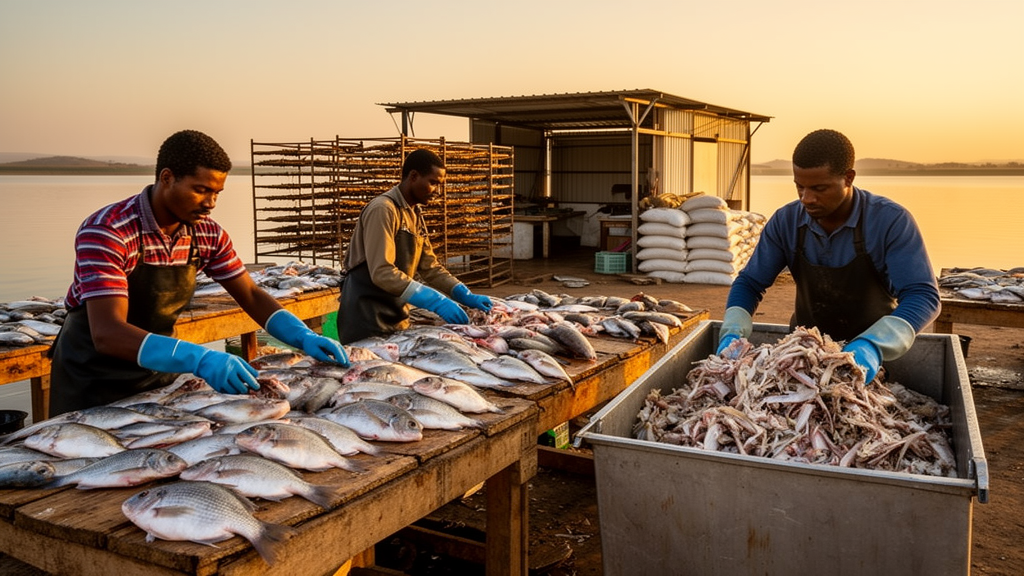
Ethiopia throws away or downgrades a large share of the fish it processes, even though those discarded heads, frames, viscera, skin, scales and trimmings can make up between 30 and 70 percent of the total fish biomass. A new comprehensive review argues that this underused stream represents one of the country’s most accessible opportunities for building a circular fisheries economy, provided that investments in collection, preservation, processing and markets arrive alongside the technology itself.
The review, published in the journal Discover Life, synthesizes published scientific literature, technical reports and fisheries documents to assess, for the first time in an integrated way, the state of fish-processing by-products in Ethiopia. Its author, Solomon Tesfay, screened 430 records gathered through a systematic search of databases including Web of Science, Scopus, PubMed, Google Scholar and the FAO’s institutional repository, ultimately including 82 publications: 62 peer-reviewed articles, 12 FAO and government reports, and 8 book chapters and conference proceedings. The search covered publications from 2003 to 2024 and was conducted between January and March 2024.
The central finding is sobering but constructive. Fish-processing by-products in Ethiopia are predominantly disposed of or used in low-value applications, such as direct livestock feeding or traditional fertilizer production, despite containing valuable proteins, lipids, minerals, collagen and other bioactive compounds. The review identifies fishmeal and fish oil, organic fertilizers, collagen and gelatin, protein hydrolysates and other bio-based products as the principal valorization pathways, but finds their adoption constrained by inadequate processing infrastructure, limited cold-chain facilities, fragmented supply chains, insufficient technical capacity, weak market linkages and limited policy and institutional support.
The environmental stakes are considerable. Because fish residues are highly biodegradable and rich in organic matter and nutrients, improper disposal can degrade water quality through oxygen depletion and nutrient enrichment, generate unpleasant odors, attract insects and rodents, and create public-health concerns for nearby communities. The review frames these problems not merely as waste-management failures but as symptoms of underdeveloped resource-recovery systems: the same material that pollutes waterways when dumped could instead become feed, fertilizer or industrial raw material.
Ethiopia’s fisheries context shapes what is realistically achievable. The country holds roughly 7,500 square kilometers of lake area and 7,000 kilometers of rivers, anchored by Lake Tana, the largest lake at about 3,150 square kilometers, and the Rift Valley lakes including Ziway, Hawassa, Abaya, Chamo and Langano. Reported capture fisheries production grew from approximately 15,000 tons in 1995 to about 45,000 tons in 2015, with aquaculture adding an estimated 2,000 to 5,000 tons in recent years, though these figures likely underestimate actual output because of underreporting by artisanal fishers and limited monitoring capacity. The estimated sustainable potential ranges from 80,000 to 120,000 tons annually, suggesting substantial room for growth.
The sector is dominated by a handful of species: Nile tilapia, the most widely distributed and commercially important fish; African catfish, valued for its yield and adaptability; and the endemic Labeobarbus species flock of Lake Tana. Processing spans a wide technological spectrum. Artisanal fishers and small-scale processors, who handle the majority of production, rely on gutting, salting, smoking, sun-drying and fermentation, while larger enterprises, including plants operated by the Ethiopian Fisheries and Aquaculture Development Corporation at Lake Ziway, Lake Hawassa and Lake Tana, produce frozen fillets and headed-and-gutted products for domestic and regional export markets.
A key analytical contribution of the review is its distinction between short-term and long-term opportunities. Fishmeal and fish oil production emerge as the most realistic entry points because they rely on mature technologies, can absorb mixed by-product streams and serve established demand in livestock, poultry and emerging aquaculture industries. Composting and fish-based fertilizer production offer similarly practical options for small-scale fisheries, requiring relatively low capital investment while directly supporting local agriculture. By contrast, collagen, gelatin, bioactive peptides and nutraceutical ingredients demand advanced processing technologies, stringent quality-control systems, specialized expertise and access to premium markets, making them medium- to long-term goals as technical capacity develops.
The compositional evidence reinforces this phased logic. Different by-product fractions have distinct characteristics: skin and trimmings are protein-rich and suited to fishmeal, protein concentrates and peptide extraction; viscera carry relatively high lipid content favorable for fish oil; and heads, frames and scales contain substantial mineral fractions, particularly calcium and phosphorus tied to bone tissue, alongside collagen that supports gelatin extraction. The review stresses that by-products should not be treated as a single homogeneous waste stream. Effective valorization will require segregation at the source rather than mixed disposal, so that each fraction flows toward its highest practical use.
The barriers identified are notably interconnected rather than independent. Infrastructure limitations reduce storage capacity, poor storage accelerates spoilage, spoilage degrades product quality, and poor-quality raw materials undermine market competitiveness. Logistics compound the problem because fish residues are highly perishable, making rapid collection and preservation essential. The review also cautions, drawing on earlier international literature, that technical feasibility does not automatically translate into commercial viability: realistic assessments must weigh collection efficiency, processing costs, energy requirements, market demand and product quality rather than simply multiplying the volume of by-products generated. Fisheries dispersed across lakes, reservoirs, rivers and landing sites further complicate collection and transport, suggesting that centralized processing may suit high-production areas while decentralized systems fit remote, small-scale fisheries.
The review concludes with a strategic recommendation: a phased valorization pathway that begins with established, accessible applications and progressively expands toward higher-value products as infrastructure, technology and market conditions improve. With an estimated 25,000 to 40,000 tons of by-products generated annually, the potential value is substantial, spanning fishmeal and fish oil through to collagen, gelatin and bioactive peptides. Realizing it, the author argues, requires coordinated improvements in by-product collection, preservation, processing, quality assurance, market development, technical capacity and institutional support, embedding by-product valorization within broader fisheries and agro-industrial development strategies. Environmental regulation alone, the review warns, is unlikely to succeed unless affordable collection and utilization options are available to processors. As a review synthesizing existing literature rather than presenting new field measurements, its conclusions describe the current evidence base and identify priorities for future techno-economic research, rather than demonstrating outcomes already achieved on the ground.
Subject of Research: Sustainable valorization of fish processing by-products in Ethiopia
Article Title: Opportunities and challenges for the sustainable valorization of fish processing byproducts in Ethiopia
Article References: Tesfay, S. (2026). Opportunities and challenges for the sustainable valorization of fish processing byproducts in Ethiopia. Discover Life, 56(1), Article 49. https://doi.org/10.1007/s11084-026-09770-4
Image Credits: AI Generated
DOI: 10.1007/s11084-026-09770-4
Keywords: fish processing, by-products, Ethiopia, valorization, circular economy, fishmeal, fish oil, collagen, organic fertilizer, Lake Tana, Nile tilapia, fisheries
News Source: Benjamin Clark. (October 28, 2026). Ethiopia’s Fish Waste Could Fuel a Circular Economy, Review Finds. Scienmag.



