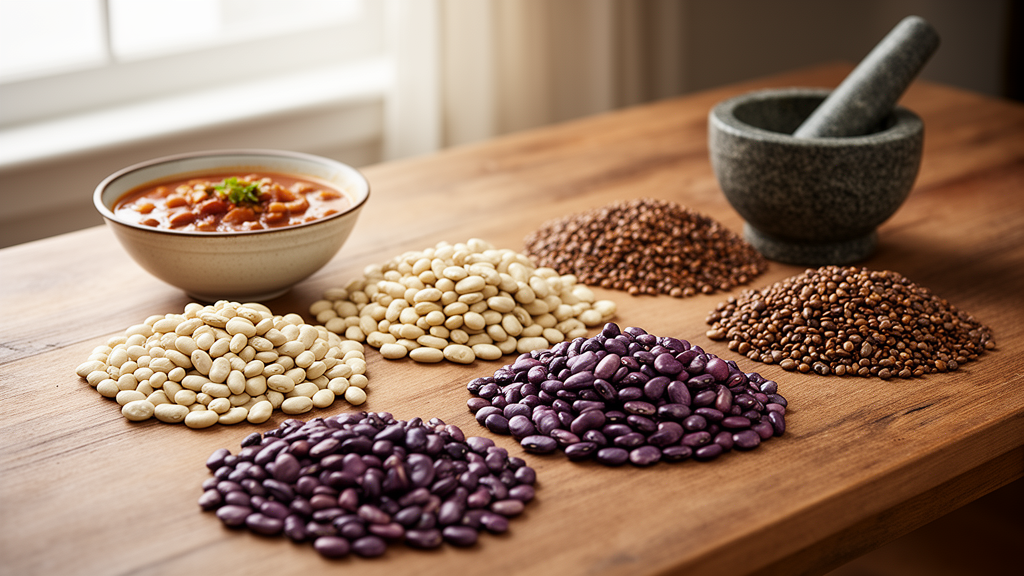
Faba bean (Vicia faba L.) is a staple pulse in Ethiopia, central to traditional dishes and increasingly of interest for food processing and industrial uses. A new study published in Discover Food evaluated ten Ethiopian faba bean varieties for their physical and functional properties, chemical composition, and anti-nutritional factors, using standard analytical methods. The researchers analyzed their data with one-way analysis of variance followed by Tukey’s post hoc test at a significance threshold of p < 0.05, and they report significant varietal differences across essentially every parameter measured.
The physical measurements revealed meaningful variation among the varieties. Bulk density ranged from 1.13 to 1.24 g/mL, with Degaga showing the highest value and Hachalu the lowest. Particle size, expressed as the median diameter Dx50, ranged from 21.8 to 32.2 micrometers: Bulga 70 and Walki produced the finest particles, while Ashebeka yielded the coarsest. Water absorption capacity spanned 0.55 to 0.96 g/g, highest in Walki and lowest in CS20DK, and oil absorption capacity ranged from 1.03 to 1.63 g/g, with Ashebeka highest and Didia lowest. Foaming capacity varied from 60 to 72%, with Tumsa performing best, while foam stability was highest in Bulga 70 and Hachalu.
Pasting behavior, a key indicator for processing applications, also differed sharply. Peak viscosity ranged from 154 to 431 RVU, with Moti and Bulga 70 showing the highest values and, according to the authors, strong paste-forming potential.
Nutritional composition varied as well. Protein content ranged from 20.09 to 25.73%, with Numan recording the highest level and Hachalu the lowest. Phytate content ranged from 319.08 to 375.31 mg/100 g, with Tumsa lowest and Bulga 70 highest. Tannin content ranged from 0.02 to 0.45 mg/g, with Degaga showing the lowest and Numan the highest levels, meaning the variety richest in protein also carried the most tannins.
The authors conclude that the differences translate into practical recommendations: Moti and Bulga 70 showed strong potential for thickening and paste-based applications, while Bulga 70 and Hachalu were promising candidates for foamed products. Overall, they argue, the findings support targeted selection of faba bean varieties for specific food-processing and industrial applications rather than treating the crop as a uniform raw material. The study is currently available as a peer-reviewed accepted manuscript shared early for faster access, a citable version that will be replaced by the final Version of Record after further edits.
Subject of Research: Physicochemical, nutritional, and anti-nutritional properties of ten Ethiopian faba bean varieties evaluated for food applications.
Article Title: Physicochemical and nutritional properties of Ethiopian faba bean varieties evaluation for food applications
Article References: Erena, Y. A., & Woldu, E. A. (2026). Physicochemical and nutritional properties of Ethiopian faba bean varieties evaluation for food applications. Discover Food. https://doi.org/10.1007/s44187-026-01292-2
Image Credits: AI Generated
DOI: 10.1007/s44187-026-01292-2
Keywords: faba bean, Ethiopia, food processing, protein content, bulk density, peak viscosity, phytate, tannins, foaming capacity, varietal evaluation, Physicochemical, nutritional
News Source: Alan Morgan. (October 30, 2026). Ethiopian Faba Bean Varieties Show Distinct Traits for Food Processing. Scienmag.