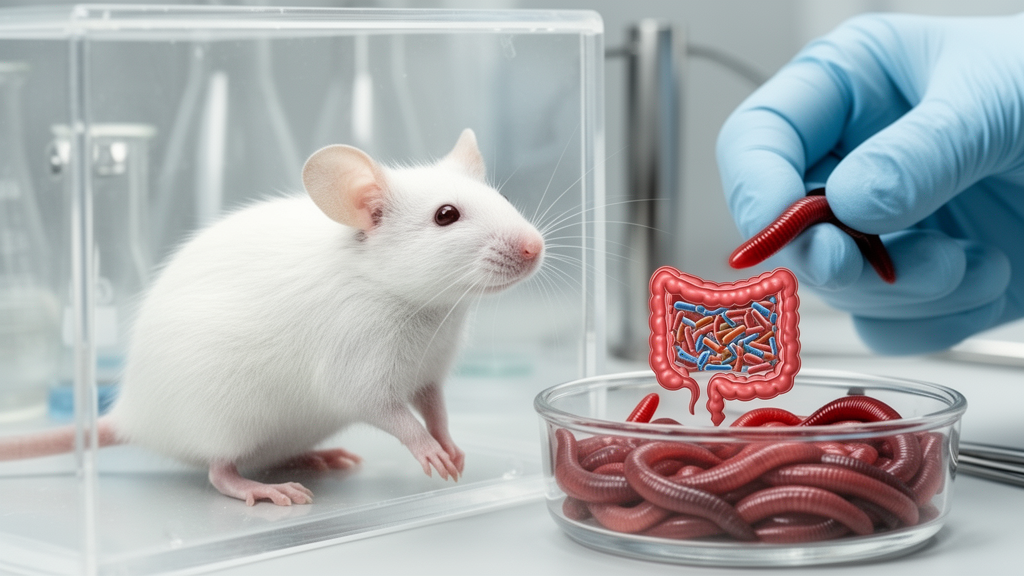
A 14-day feeding study in male ICR mice found that adding 5% Eisenia nipponica powder to a high-sucrose, low-fibre diet increased caecal phenolic content and antioxidant activity while substantially changing gut bacterial communities. A version washed with 70% ethanol to remove soluble phlorotannins produced a different microbial profile, including a larger increase in bacteria resembling Bacteroides uniformis and Akkermansia muciniphila. The findings suggest that the algal fibre and polyphenol components of this brown seaweed can exert separable effects, although the short mouse experiment did not establish human health benefits and identified features that require further safety investigation.
Researchers prepared the two algal materials from dried E. nipponica, a traditional edible brown alga harvested in Mie Prefecture during summer, when it contains high levels of laminaran and phlorotannins. To reduce soluble phenols and low-molecular-weight compounds, the dried seaweed was shaken in 20 times its volume of 70% ethanol, centrifuged, washed again with the same solvent and dried. The washed preparation, designated WEN, therefore differed compositionally from untreated E. nipponica, designated EN. Twenty-four five-week-old male ICR mice were assigned to four groups for 14 days: a control diet containing cellulose, a high-sucrose no-fibre diet, and no-fibre diets in which cellulose was replaced with 5% by weight of either EN or WEN.
Both algal diets increased faecal output and the amount of material in the caecum. Mice receiving the no-fibre diet produced 28 pellets per day weighing 0.41 g per mouse, compared with 45 pellets weighing 0.78 g in the control group. The EN and WEN groups produced 41 and 44 pellets per day, with respective weights of 0.70 and 0.77 g per mouse. Caecal content in the EN group weighed 1.70 g per 100 g of body weight and in the WEN group 1.17 g per 100 g, compared with 0.58 g per 100 g in the no-fibre group. The researchers regarded these changes as consistent with a prebiotic-like effect of algal dietary fibre, although precise feed intake could not be measured because wire-bottom cages prevented reliable collection.
Chemical assays showed that both preparations raised caecal antioxidant measures. Total phenolic content was 8.5 µmol phloroglucinol equivalents per gram in the no-fibre group, increasing to 31 µmol per gram with EN and 24 µmol per gram with WEN. Superoxide anion radical-scavenging capacity, which was not clearly detectable in the control and no-fibre groups, reached 19 µmol catechin equivalents per gram with EN and 15 µmol per gram with WEN. Fe-reducing power rose from 1.1 µmol catechin equivalents per gram in the no-fibre group to sevenfold higher levels with EN and fivefold higher levels with WEN. Total caecal bile acid content fell from 1.2 µmol equivalents per gram in the no-fibre group to 0.1 µmol per gram with either alga.
Amplicon sequencing of the V3-V4 region of bacterial 16S rDNA showed that dietary algae shifted caecal community structure at both phylum and amplicon-sequence-variant levels. Principal coordinate analysis separated the no-fibre animals from the EN and WEN groups, and also distinguished EN from WEN. The algal diets reduced several Gram-positive groups, including Erysipelotrichaceae, Lachnospiraceae and bacteria resembling Allobaculum and Faecalibacculum rodentium. Bacteroidota and Pseudomonadota became more abundant, while Bacillota fell to 5.6% in the EN group and 10% in the WEN group, compared with 44% in the no-fibre group. Bacteroidaceae rose to 50% with EN and 43% with WEN, from 16% in the no-fibre group.
The clearest taxonomic difference favouring the washed material was its expansion of bacteria associated with mucin and complex-polysaccharide use. Bacteroides intestinalis-like organisms, capable of fermenting laminaran but not alginate in earlier work cited by the researchers, were the most common relevant amplicon variants in both algal groups. B. uniformis-like bacteria, which also ferment laminaran but not alginate, became dominant specifically in the WEN group, while laminaran- and alginate-degrading B. acidifaciens-like bacteria were suppressed by EN. Akkermansia muciniphila-like bacteria increased with WEN but not EN, reaching 14% of the caecal community in the washed-alga group, compared with 6.8% Verrucomicrobiota in the EN group. A. muciniphila is considered a next-generation probiotic because it inhabits the intestinal mucus layer and has been associated with mucosal immune regulation and metabolic homeostasis.
The treatment also narrowed microbial diversity rather than producing a uniformly richer microbiome. The control and no-fibre groups contained approximately 300 amplicon sequence variants, compared with 39 in the EN group and 60 in the WEN group. Chao-1, Simpson, Fisher and Shannon diversity measures were correspondingly lower after algal supplementation, with the Shannon index particularly low for EN. The authors proposed that the strong antibacterial effect associated with phlorotannins may have selected against some beneficial Gram-positive organisms and narrowed the community, while removal of soluble phlorotannins from WEN created conditions allowing a broader set of laminaran-degrading taxa to flourish. The fact that antioxidant activity remained high after washing also suggests that some seaweed phenolics, potentially those associated with cell-wall material, were released during passage through the digestive tract.
Functional profiles inferred from the 16S data pointed toward a shift in predicted microbial metabolism, although these results were computational predictions rather than direct measurements of microbial or host biochemical activity. Among 142 detected Kyoto Encyclopedia of Genes and Genomes pathways, both algal diets were associated with reduced cysteine and methionine metabolism, purine metabolism and glycolysis or gluconeogenesis. Glycan degradation, galactose metabolism, sphingolipid metabolism and flavonoid degradation were more highly expressed in the EN and WEN groups. These patterns were consistent with enrichment of Bacteroides organisms able to use complex polysaccharides, while changes in predicted sphingolipid pathways may have reflected altered host-microbiota interactions. The researchers said metabolomic and other direct analyses would be needed to verify the inferred pathways and their physiological consequences.
Several findings complicate the otherwise promising prebiotic interpretation. The relative abundance of Enterobacteriaceae increased to 24% with EN and 15% with WEN, and sequence matches resembling Klebsiella oxytoca and Escherichia coli were prominent. Prior research cited in the paper links increased Enterobacteriaceae with intestinal inflammation and endotoxaemia, although the present experiment did not demonstrate either outcome. Reduced spleen weights were observed in both algal groups and interpreted as consistent with anti-inflammatory effects, but the study did not directly measure inflammation. Body-weight gain was 10.8 g in the no-fibre group, 7.9 g with EN and not significantly different with WEN. The mouse model, short exposure period, small sample size and inability to quantify food intake limit conclusions about weight, immune effects or the causes of the microbial changes.
Overall, the experiment indicates that both untreated and phlorotannin-lowered E. nipponica can increase caecal antioxidant measures and reshape gut microbial communities in mice, while WEN more strongly enriched B. uniformis-like and A. muciniphila-like bacteria. The result does not mean that ethanol washing necessarily improves every algal component or that either preparation is beneficial in humans. In addition to the expansion of potentially concerning Gram-negative groups and the reduction in overall diversity, the 5% dose has not been shown to be optimal. The authors therefore called for dose-response experiments that could balance prebiotic effects against antimicrobial pressure. For now, the study provides a mechanistic mouse-model signal that removing soluble phlorotannins may allow the fibre in E. nipponica to support a broader group of carbohydrate-fermenting bacteria, but it also shows why dosage, microbial balance and safety must be examined before translating the finding into a functional food or dietary recommendation.
Subject of Research: Effects of phlorotannin-lowered Eisenia nipponica on caecal antioxidants and gut microbiota in mice
Article Title: Dietary supplementation with phlorotannin-lowered Eisenia nipponica increases caecal antioxidant activity and promotes Akkermansia in mice
Article References: Sato, M., Nakamura, M., Azuma, S., Tomoda, Y., Nakamura, A., Takaahashi, H., & Kuda, T. (2026). Dietary supplementation with phlorotannin-lowered Eisenia nipponica increases caecal antioxidant activity and promotes Akkermansia in mice. Molecular Biology Reports, 53(1), Article 1492. https://doi.org/10.1007/s11033-026-12669-y
Image Credits: AI Generated
DOI: 10.1007/s11033-026-12669-y
Keywords: gut microbiota, Eisenia nipponica, Akkermansia muciniphila, Bacteroides uniformis, phlorotannins, caecal antioxidants, prebiotics, brown algae, mouse diet, 16S rRNA sequencing, Dietary, supplementation
News Source: Morgan Morrow. (October 24, 2026). Ethanol-washed Eisenia boosts antioxidants and Akkermansia in mice. Scienmag.