• HOME
  • NEWS
  • EXPLORE
    • CAREER
      • Companies
      • Jobs
    • EVENTS
    • iGEM
      • News
      • Team
    • PHOTOS
    • VIDEO
    • WIKI
  • BLOG
  • COMMUNITY
    • FACEBOOK
    • INSTAGRAM
    • TWITTER
Sunday, May 10, 2026
BIOENGINEER.ORG
No Result
View All Result
  • Login
  • HOME
  • NEWS
  • EXPLORE
    • CAREER
      • Companies
      • Jobs
        • Lecturer
        • PhD Studentship
        • Postdoc
        • Research Assistant
    • EVENTS
    • iGEM
      • News
      • Team
    • PHOTOS
    • VIDEO
    • WIKI
  • BLOG
  • COMMUNITY
    • FACEBOOK
    • INSTAGRAM
    • TWITTER
  • HOME
  • NEWS
  • EXPLORE
    • CAREER
      • Companies
      • Jobs
        • Lecturer
        • PhD Studentship
        • Postdoc
        • Research Assistant
    • EVENTS
    • iGEM
      • News
      • Team
    • PHOTOS
    • VIDEO
    • WIKI
  • BLOG
  • COMMUNITY
    • FACEBOOK
    • INSTAGRAM
    • TWITTER
No Result
View All Result
Bioengineer.org
No Result
View All Result
Home NEWS Science News Biology

Essential amino acid in humans, methionine, controls cell growth programs

Bioengineer by Bioengineer
January 4, 2019
in Biology
Reading Time: 3 mins read
0
IMAGE
Share on FacebookShare on TwitterShare on LinkedinShare on RedditShare on Telegram

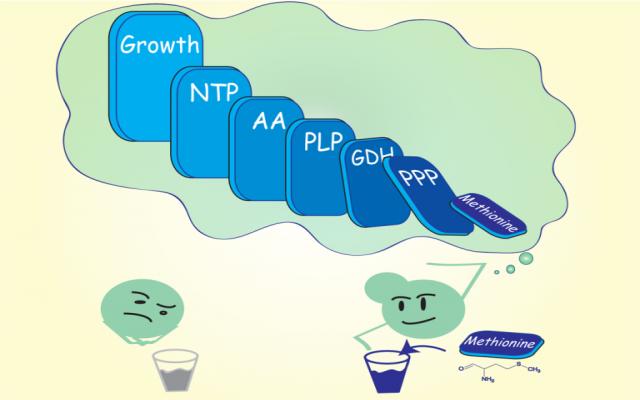
A recent study from the Laxman lab at inStem, Bangalore, elucidates how a small metabolite and amino acid, methionine, acts as a growth signal for cells, by setting into motion a metabolic program for cell proliferation
IMAGE

Credit: Adhish Walvekar and Sunil Laxman, Institute for Stem Cell Science and Regenerative Medicine (inStem), Bangalore, India


A recent study from the Laxman lab elucidates how a small metabolite and amino acid, methionine, acts as a growth signal for cells, by setting into motion a metabolic program for cell proliferation.

For cells to grow and then divide, they must be in an anabolic state, where there is sufficient production of all necessary building blocks. It was earlier thought that as long as enough nutrients are present, cells would continue to grow under the control of different internal signalling programs. However, recent studies show that many small intermediates and products of biological metabolism commonly termed as metabolites can themselves act as signalling molecules and control cell growth programs.

Several studies, particularly from cancer researchers, have hinted that methionine might be a signalling metabolite. Many cancers appear to be dependent on methionine for growth. However, how methionine controls growth is still a mystery. We used a very simple model system (budding yeast cells), to address how methionine might regulate growth. To understand the logic of such a growth program, we analysed gene expression profiles as well as measured the new synthesis of necessary building blocks. By piecing together this network, we constructed the organization of a core anabolic program triggered by methionine. This anabolic program relies on a few specific nodes in metabolism and is sufficient to orchestrate an entire cascade of transcriptional and metabolic events that can sustain growth.

Our findings on how cells perceive methionine as a growth cue are illustrated in the simple cartoon (see banner image). When methionine is limited, cells do not grow (the unhappy cell without a bud, on the left). On the other hand, when methionine is abundant, it acts as a growth signal and triggers a cascade of biochemical events, ultimately leading to cell growth (the happy yeast with a bud, on the right). Analogous to the butterfly effect, methionine leads to a series of larger metabolic events, controlling an entire cellular program. Methionine activates three key nodes in metabolism: the pentose phosphate pathway, the production of glutamine, and the formation of pyridoxal phosphate (the PPP-GDH-PLP node). These nodes produce a set of critical substrates and co-factors that fuel the production of all other amino acids, as well as make nucleotides, which are critical for growth. In the cartoon, the dominoes of increasing size show this chain of events and capture how methionine eventually has a significant impact on cell growth.

This is a fundamental study, which advances our understanding of how some metabolites can act as signalling molecules and play a critical role in controlling cell growth. This study provides a much-awaited explanation on the role of methionine in sustaining cell growth, and it might clarify why cancer cells are addicted to methionine for their growth. However, a long-term methionine study could provide strategies to control the growth of many types of cancer.

###

Media Contact
Sunil Laxman
[email protected]

Original Source

https://www.molbiolcell.org/doi/10.1091/mbc.E18-08-0515

Related Journal Article

http://dx.doi.org/10.1091/mbc.E18-08-0515

Tags: BiologycancerCell Biology
Share12Tweet8Share2ShareShareShare2

Related Posts

Ancient Plant Populations Reveal Fresh Insights into Climate Resilience — Biology

Ancient Plant Populations Reveal Fresh Insights into Climate Resilience

May 8, 2026
Rare Brain Disorders in Children Linked to Mutations in Lesser-Known Protein Complex — Biology

Rare Brain Disorders in Children Linked to Mutations in Lesser-Known Protein Complex

May 8, 2026

From Odd Insect to Underwater Predator: The Remarkable Evolution of a Bloodthirsty Fruit Fly

May 8, 2026

SNU Professor Sangwoo Seo’s Team Develops Next-Generation CRISPR Biocontainment Technology to Control Microbial Survival Without DNA Cleavage

May 8, 2026
Please login to join discussion

POPULAR NEWS

  • Research Indicates Potential Connection Between Prenatal Medication Exposure and Elevated Autism Risk

    840 shares
    Share 336 Tweet 210
  • New Study Reveals Plants Can Detect the Sound of Rain

    727 shares
    Share 290 Tweet 181
  • Scientists Investigate Possible Connection Between COVID-19 and Increased Lung Cancer Risk

    68 shares
    Share 27 Tweet 17
  • Salmonella Haem Blocks Macrophages, Boosts Infection

    61 shares
    Share 24 Tweet 15

About

We bring you the latest biotechnology news from best research centers and universities around the world. Check our website.

Follow us

Recent News

Evaluating Digoxin Use in Patients with Symptomatic Rheumatic Heart Disease

Evaluating the Effectiveness and Safety of Digitalis Glycosides in Treating Heart Failure

Urdu Fall Risk Questionnaire Adapted for Elderly

Subscribe to Blog via Email

Enter your email address to subscribe to this blog and receive notifications of new posts by email.

Join 82 other subscribers
  • Contact Us

Bioengineer.org © Copyright 2023 All Rights Reserved.

Welcome Back!

Login to your account below

Forgotten Password?

Retrieve your password

Please enter your username or email address to reset your password.

Log In
No Result
View All Result
  • Homepages
    • Home Page 1
    • Home Page 2
  • News
  • National
  • Business
  • Health
  • Lifestyle
  • Science

Bioengineer.org © Copyright 2023 All Rights Reserved.