In the 2022 allocation round for the award of the prestigious Consolidator Grants of the European Research Council, researchers of Karlsruhe Institute of Technology (KIT) have been successful. For their projects in the fields of photovoltaics and medical sensor technology, physicist Ulrich W. Paetzold and chemist Frank Biedermann will receive approximately two million euros over the next five years.
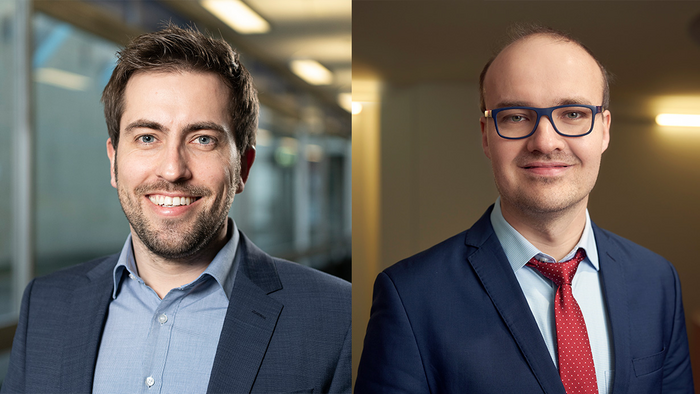
Credit: Markus Breig, Amadeus Bramsiepe, KIT
In the 2022 allocation round for the award of the prestigious Consolidator Grants of the European Research Council, researchers of Karlsruhe Institute of Technology (KIT) have been successful. For their projects in the fields of photovoltaics and medical sensor technology, physicist Ulrich W. Paetzold and chemist Frank Biedermann will receive approximately two million euros over the next five years.
“Researchers from KIT have been successfully applying for the coveted funding from the European Research Council for years. I am very pleased that Ulrich W. Paetzold with his project in the topic of photovoltaics and Frank Biedermann with his work in the field of sensor technology were able to continue this series of successes right at the beginning of the new year through receiving the ERC Consolidator Grant,” says KIT Vice President for Research Professor Oliver Kraft.
Efficient and More Cost-effective Production of Perovskite Solar Cells
Photovoltaic technologies are cornerstones of all future scenarios for a sustainable energy supply. Developing innovative cost-effective and highly efficient materials for next-generation solar modules is therefore of utmost urgency. Currently, the material class of perovskite semiconductors in particular is considered extremely promising for the solar cells of the future. However, the economic breakthrough of this technology is currently prevented by the still insufficient stability and the challenge of producing high-quality perovskite thin films over a large area. With the LAMI-PERO project, tenure-track professor Ulrich W. Paetzold aims to develop a radically new manufacturing process that has the potential to overcome these difficulties. The goal of the project is to establish a fundamental understanding of how perovskite thin films are formed under high pressure, and also to discover more stable and novel compositions of perovskite semiconductors and thus to fabricate highly efficient perovskite solar cells and tandem solar cells.
Supersensors for Medical Diagnostics
In the SupraSense project, Emmy Noether junior research group leader Dr. Frank Biedermann aims to develop highly specific yet easy-to-manufacture sensors for medical diagnostics. These “SupraSensors” are based on completely novel materials that mimic enzyme pockets. The desired molecular recognition and signal generation is to take place in them. The aim is to use the sensors directly in health centers or hospitals and in private households for molecular diagnostics of urine, saliva, and blood. The focus is on the detection of metabolites, e.g. neurotransmitters and amino acids, that indicate the 24-hour rhythm (circadian rhythmicity) and are important disease indicators. For the development of these sensors, the principles of molecular recognition through materials science are combined with chemistry-based deep learning. Thanks to their high sensitivity and selectivity, the sensors produced in this way could open up a novel approach to the design of artificial receptors and, if successful, could significantly improve the early detection of cardiovascular diseases, inflammation, sepsis, and other metabolic or age-related diseases in the future.
ERC Consolidator Grants 2022
With the ERC Consolidator Grants, the European Research Council (ERC) funds projects of outstanding scientists whose doctorate dates back seven to twelve years and whose own, independent research group is in the consolidation phase. In the 2022 allocation round, Consolidator Grants were awarded for a total of 321 projects in 21 countries with a total funding volume of 657 million euros. 62 projects were awarded to German universities and research institutions. 2222 applications were submitted; the approval rate is slightly below 14,4 percent. (rli)
Read more: https://erc.europa.eu/news-events/news/erc-2022-consolidator-grants-results
Details on KIT Materials Center
Contact for This Press Releases:
Regina Link, Pressereferentin, Tel.: +49 721 608-41158, E-Mail: [email protected]
Being “The Research University in the Helmholtz Association”, KIT creates and imparts knowledge for the society and the environment. It is the objective to make significant contributions to the global challenges in the fields of energy, mobility, and information. For this, about 9,800 employees cooperate in a broad range of disciplines in natural sciences, engineering sciences, economics, and the humanities and social sciences. KIT prepares its 22,300 students for responsible tasks in society, industry, and science by offering research-based study programs. Innovation efforts at KIT build a bridge between important scientific findings and their application for the benefit of society, economic prosperity, and the preservation of our natural basis of life. KIT is one of the German universities of excellence.
This press release is available on the Internet at: https://www.kit.edu/kit/press_releases.php