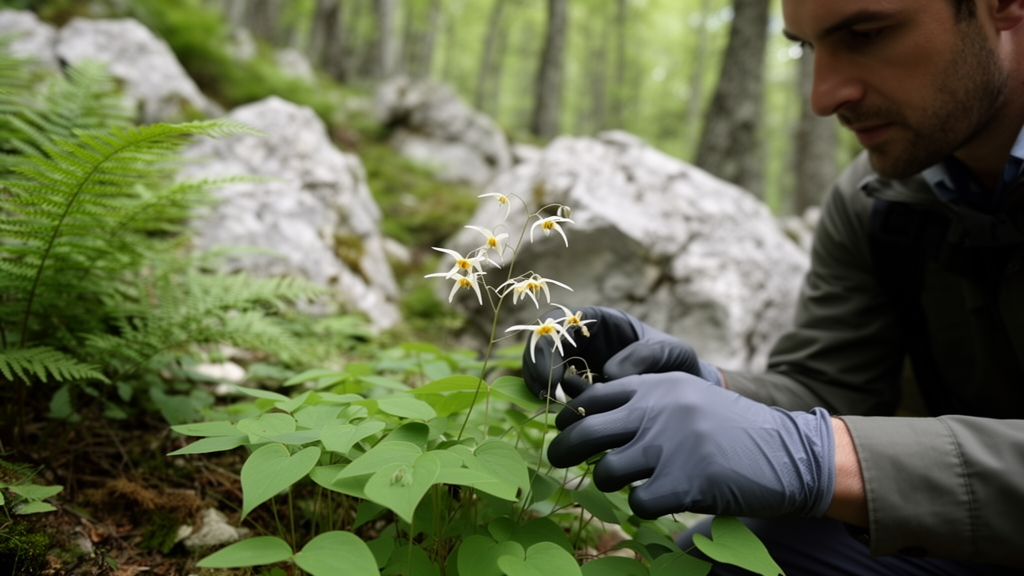
Epimedium alpinum subsp. albanicum has been recorded for the first time in Kosovo, according to a botanical study based on field observations, collected specimens, photographs and a review of regional floristic literature. Researchers documented the subspecies in the hilly areas of Devë and Qafë Prush in the Municipality of Gjakova, along the Morina Pass near the Albanian border. The plants occurred on serpentine substrates at elevations of 650 and 750 metres.
The authors concluded that the taxon should be considered new to the flora of Kosovo and that its small extent of occurrence, together with surface mining and overgrazing, warrants assessment as a threatened species in the country. The study grew out of expeditions to parts of Kosovo with high plant diversity. The authors describe the country as having a small territorial area but substantial floristic and vegetation richness, associated with its continental and modified sub-Mediterranean climate, topography, geology and position among the mountain massifs of the Balkan Peninsula, including Mali Sharr and the Albanian Alps.
During botanical collecting, the team recognized Epimedium alpinum subsp. albanicum and subsequently checked local and regional literature before continuing additional expeditions. Serpentine substrates formed an important focus of the field work because these soils support distinctive plant diversity in the central and northern serpentine massifs of the western Balkans. The study notes that many plants growing on serpentine have adaptations that permit them to tolerate high concentrations of chromium, nickel, iron, aluminium, cobalt, magnesium or manganese.
It also describes how isolation on these soils has contributed to a rich assemblage of local endemic species, including the monotypic genera Halacsya , Bornmuellera and Paramoltkia . Epimedium is a genus of perennial herbs in the barberry family, Berberidaceae. Most members bear four-parted, spider-like flowers in spring, according to the study.
The authors also note that the genus has received attention in Chinese ethnopharmacology and remains comparatively little studied in terms of phytochemistry and molecular aspects, while Epimedium grandiflorum is used as a dietary supplement. These broader characteristics provided context for the plant, but the reported finding concerns its botanical distribution rather than any tested medicinal effect. The Kosovo observations consisted of a new country record, habitat documentation and the collection of herbarium material.
Plant material was collected and herbarized using the classical botanical technique during expeditions in 2018 and 2022. The investigated localities were Devë at 650 metres, with coordinates 42°20′7.296″N, 20°22′12.5148″E, and Qafë Prush at 750 metres, with coordinates 42°19′0.7104″N, 20°21′44.6976″E. Field records included the type of vegetation and habitat, substrate composition and the direction in which the plants occurred.
Researchers also took digital photographs along transects. Identification was based on Flora Europaea , the Red Book of Vascular Flora of Kosovo , and publications concerning the endemic flora of the Balkans and Albania. The collected specimens were deposited in the National Herbarium of Tirana under the identifier TIR-0021475.
The first reported observation in the study area was made on 10 May 2018 near Devë village, on the right side of the road toward Albania. At that time, the plants were growing on serpentine substrate at about 650 metres and remained in the vegetative stage, shortly before flowering. A later observation on 19 May 2020 found the subspecies in the same general locality along the hillside of Morina Pass, this time at approximately 750 metres and in full flower.
The chronology presented in the results therefore includes observations from 2018, 2020 and 2022, although the methods specify that the collected and herbarized material was gathered during the 2018 and 2022 expeditions. In early August and September 2022, the taxon was also recorded within the boundaries of Qafë e Prushit. In Kosovo, the subspecies grows from an underground rhizome in shaded places and can dominate the ground layer.
Other plants recorded with it included Lilium albanicum , Centaurea kosaninii , Genista hassertiana , Sanguisorba minor , Ranunculus millefoliatus , Ornithogalum umbellatum , Doronicum columnae and Primula veris . The plants flower from May into the beginning of June and fruit during June and July, with timing varying according to exposure and altitude. The 2018 observation near Devë was made immediately before the flowering phase, whereas the May 2020 plants at 750 metres were in full bloom.
At Qafë Prush, the subspecies formed carpets on the ground beneath Quercus pubescens and Fraxinus ornus . The associated flora included Eryngium palmatum , Linum elegans , Polygala doerfleri , Sanguisorba albanica , Aster albanicus , Galatella linosyris , Tulipa sylvestris , Genista hassertiana , Allium albanicum , Centaurea kosaninii , Satureja montana , Bolanthus spergulifolius , Potentilla rupestris var. mollis , Rosa arvensis , Rosa gallica , Betonica scardica , Betonica officinalis , Allium moschatum , Potentilla recta , Campanula glomerata , Achillea millefolium , Plantago argentea , Prospero autumnale , Erythronium dens-canis and Saponaria sicula subsp. intermedia . The herbarium specimen and photographs document the plant’s leaves, flowers and fruits, while the field notes provide information on its occurrence, vegetation and substrate at the two Kosovo localities.
Comparison with the known distribution outside Kosovo showed that the subspecies is not newly described in the study; it had previously been established from northeastern Albania, with a specimen collected near Livadhet e Laskit in Kukësi municipality at about 1,300 metres. That specimen, dated 14 May 2010, was identified as the holotype. The Kosovo observations therefore extend the documented country-level distribution of an existing taxon rather than introduce a new species or subspecies to science.
The source also lists numerous other endemic or serpentine-associated plants in the wider distribution area, including Aristolochia merxmuelleri , Forsythia europaea , Minuartia baldaccii , Sanguisorba albanica , Sedum album subsp. serpentine , Tulipa albanica and Tulipa kosovarica , placing the new country record within a broader western Balkan flora. The conservation conclusion is based on the limited known extent of the subspecies and the pressures affecting its habitat. The study states that it is known only in steppe and rocky serpentine substrates and notes the potentially harmful effects of surface mining, chiefly chromium excavation, as well as overgrazing.
On that basis, the authors state that Epimedium alpinum subsp. albanicum should be assessed as a threatened species in Kosovo. The evidence presented is a set of field records and habitat observations, not a formal population estimate or a long-term monitoring study, so the article does not quantify the number, size or stability of individual colonies. Nevertheless, the documented locality in Gjakova municipality provides a concrete record for assessment and clarifies where the subspecies was observed.
Subject of Research: First documentation of Epimedium alpinum subsp. albanicum in Kosovo through botanical fieldwork and herbarium collection
Article Title: Epimedium alpinum subsp. albanicum new subspecies for the flora of Kosovo
Article References: Hashani, Z., Mala, X., Maxhuni, Q., & Zeneli, L. (2023). Epimedium alpinum subsp. albanicum new subspecies for the flora of Kosovo. Italian Botanist, 15, 1-8. https://doi.org/10.3897/italianbotanist.15.91193
Image Credits: AI Generated
DOI: 10.3897/italianbotanist.15.91193
Keywords: Epimedium alpinum, Kosovo flora, botanical survey, serpentine habitats, Devë, Qafë Prush, Morina Pass, Gjakova municipality, herbarium collection, plant distribution, endemic subspecies, floristic records
News Source: Margaret Porter. (October 20, 2026). Epimedium alpinum subspecies newly recorded in Kosovo. Scienmag.