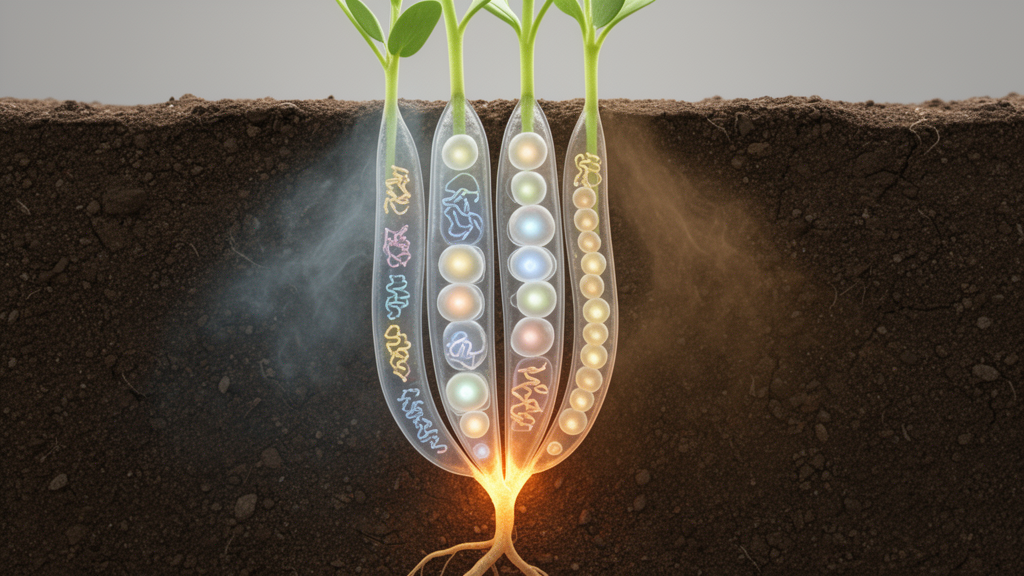
Arabidopsis roots do not develop through a single, uniform path in which every cell follows the same transcriptional route. A study combining single-cell RNA sequencing with spatial imaging found that most root cell lineages above the meristematic region split into two reproducible branches. One branch carried a distinctive transcriptional program shared across several cell types, including genes associated with environmental responses and abscisic acid signalling.
The researchers named this condition the environmentally regulated state, or ERS. It occurred in a subset of cells irrespective of developmental lineage, indicating that root cell identity reflects not only the tissue to which a cell belongs and its stage of development, but also whether it occupies this additional transcriptional state. The work focused on the model plant Arabidopsis thaliana and combined complementary molecular and spatial approaches.
The researchers generated a reference atlas of root-tip cells using 10x Genomics single-cell RNA sequencing, then compared lineage-specific developmental trajectories with methods including PAGA, Monocle 3 and RNA velocity. They also used whole-mount hybridization chain reaction imaging, or HCR, to locate selected transcripts in intact roots and determine whether patterns inferred from dissociated cells also existed in tissue. This distinction mattered because protoplast isolation can introduce transcriptional changes, making spatial confirmation important for a state detected through single-cell sequencing.
The experiments used Arabidopsis seedlings and reported cellular associations and responses to experimental growth conditions; they did not establish a function for the ERS in whole plants. Across the principal root lineages, including the epidermis, cortex, endodermis, pericycle, phloem, xylem and procambium, trajectory analysis indicated a stereotyped bifid structure rather than a single developmental progression. The ERS branch appeared alongside the expected developmental branch and was populated by a subset of cells from multiple cell types at multiple stages.
Because the same state cut across established lineages, it did not simply represent an intermediate stage between one mature cell identity and another. Instead, the authors describe it as an additional layer of identity superimposed on lineage and developmental stage. The finding also showed that cells within a named root tissue were not transcriptionally uniform, a level of heterogeneity that bulk measurements had largely concealed.
The ERS was distinguished by specific sets of coexpressed genes identified through gene co-expression network analysis of the reference atlas. Some genes in the ERS-specific modules were enriched across all ERS-positive cells, while others occurred only in particular lineages. The shared core therefore points to a coordinated transcriptional program, although the lineage-specific components indicate that the state is not identical in every cell type.
Differences in the regulatory networks of different tissues, or in their sensitivity and capacity to respond to abscisic acid, could contribute to that variation, but the study did not determine which explanation applies. The authors also reported that analyses suggested the circadian clock might influence ERS formation; that possibility was presented as an avenue for further investigation rather than a demonstrated mechanism. Spatial imaging supported the existence of bifurcated populations.
Marker genes associated with the two branches produced distinguishable signals in cells across multiple root layers, including the epidermis and cortex, rather than being confined to a single tissue. Analysis of segmented cells supported the bimodal pattern by fitting two distributions to measurements of two branch-associated markers. The ERS signature was enriched for genes associated with abscisic acid signalling, and its prevalence was reduced in the aba2-3 mutant, which is deficient in abscisic acid, and in the pyl11458 mutant, which is insensitive to the hormone.
These genetic findings associate the state with abscisic acid signalling, but they do not establish whether the hormone directly drives cells into the ERS or instead changes the proportion of cells capable of adopting it. The experiments also do not rank abscisic acid against other potential environmental regulators. Instead, they support a specific relationship between altered hormone availability or responsiveness and the frequency of the ERS in Arabidopsis root tissue.
Water shortage increased the prevalence of ERS-positive cells. The researchers simulated water deficit by growing seedlings on agar with reduced water content, including conditions containing 50% and 20% of the control water level, and compared them with plants grown at 100%. Roots that penetrated agar directly were also examined to test whether exposure to both agar and air influenced the result, while statistical analyses accounted for biological replication and, where appropriate, transcript abundance.
This was an experimental association between a growth condition and cell-state frequency, not evidence that the ERS causes drought resistance or improves plant survival. The pattern was not limited to a single Arabidopsis background or a particular disruption of developmental identity. The ERS and associated gene modules were recovered across the tested ecotypes, Col-0, Ws-2, Cvi-0, c24 and Ler, and persisted despite major perturbations of developmental cell identity, including the scr-3 mutant.
The researchers also reanalysed three published Arabidopsis root single-cell datasets and a previously published single-nucleus chromatin-accessibility dataset. Together, these analyses indicate that the dichotomy was not simply an artefact of one library, one computational workflow or one Arabidopsis accession, while the reanalysis of earlier data does not constitute a new experiment conducted by this team. Several questions remain before the biological meaning of the ERS can be settled.
Single-cell RNA sequencing provides a snapshot, so it cannot show how quickly individual cells enter or leave the state, whether they can switch repeatedly, or whether the higher proportion observed during water shortage reflects coordinated induction rather than independent responses by scattered cells. Live imaging of ERS marker genes would be needed to follow transitions directly. It is also unclear how ERS-positive cells are arranged across the root and whether their occurrence reflects a coordinated tissue-wide response.
The authors note that epidermal cells can sense and absorb water and nutrients, while the vasculature distributes them, making a response spanning these tissues conceivable, but the spatial coordination and physiological function of the state remain unproven. Future work must distinguish a transient transcriptional state from a stable cell fate and determine whether it contributes to, or results from, a broader physiological response. The discovery nevertheless establishes environmental regulation as a major component of root cellular diversity.
Conventional views of plant cell types often treat members of a tissue as broadly similar populations moving through a single developmental trajectory. The ERS reveals a more dynamic picture: within the same lineage and at comparable developmental stages, cells can occupy alternative transcriptional states, and the frequency of those states changes with the environment. By comparing ERS occurrence with established pathways and functional markers, researchers can test whether the program helps roots respond to water limitation or reflects another physiological consequence of stress.
The study provides a framework for identifying comparable environmentally regulated states in other plant tissues and species, without yet establishing a specific function for the Arabidopsis ERS or translating the finding into a practical means of improving crop resilience.
Subject of Research: Environmental regulation of alternative transcriptional states across Arabidopsis root cell lineages
Article Title: An environmentally regulated dichotomy in cell lineages of the root
Article References: Oliva, M., Stuart, T., Tang, D., Khan, A., Clement, O., Makosa, D., Poppe, D., Pflueger, J., Jabbari, J. S., Gigante, S., Dragwidge, J. M., Petterson, M., Whelan, J., Lewsey, M. G., & Lister, R. (2026). An environmentally regulated dichotomy in cell lineages of the root. Nature. https://doi.org/10.1038/s41586-026-11179-y
Image Credits: AI Generated
DOI: 10.1038/s41586-026-11179-y
Keywords: Arabidopsis, root cell identity, single-cell RNA sequencing, spatial transcript mapping, abscisic acid signalling, water deficit, plant development, transcriptional heterogeneity, root lineages, cellular differentiation, environmentally, regulated
News Source: Juliet Wilcox. (October 22, 2026). Environmentally regulated cell state splits Arabidopsis root lineages. Scienmag.