A research team has reviewed the mechanisms of inorganic phosphorus (Pi) uptake, transport, and signaling in woody plants based on the backbone of model and crop plants. Their findings emphasize the importance of Pi in photosynthesis, respiration, and genetic information transfer. The research underscores the need for strategies to increase soil Pi content and develop high phosphorus use efficiency (PUE) plants. These advancements could significantly enhance forest productivity and resilience by addressing Pi deficiency, a major limiting factor in natural ecosystems.
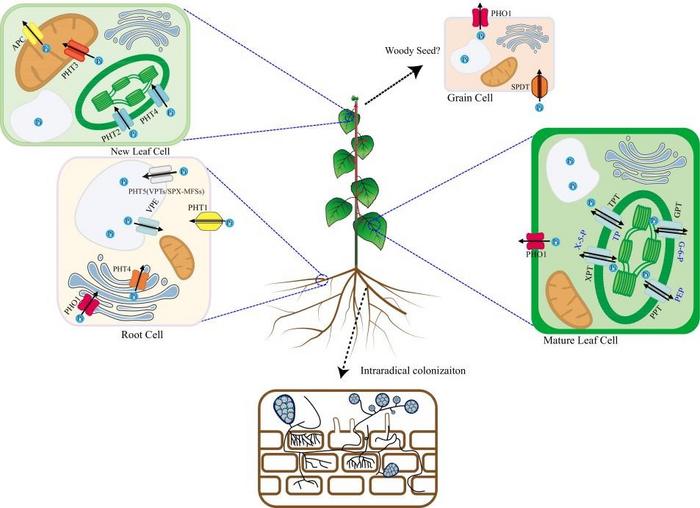
Credit: The authors
A research team has reviewed the mechanisms of inorganic phosphorus (Pi) uptake, transport, and signaling in woody plants based on the backbone of model and crop plants. Their findings emphasize the importance of Pi in photosynthesis, respiration, and genetic information transfer. The research underscores the need for strategies to increase soil Pi content and develop high phosphorus use efficiency (PUE) plants. These advancements could significantly enhance forest productivity and resilience by addressing Pi deficiency, a major limiting factor in natural ecosystems.
Inorganic phosphorus (Pi) is an essential macronutrient for plant growth, playing a key role in numerous physiological processes, such as root development, early shoot growth, and fruit quality control. However, the low amount of Pi concentration, a slower Pi diffusion rate, and precipitation of Pi with cations in soils lead to continuous Pi deficiency for woody plant growth and development. Given the increasing availability of woody plant genomes, there is an imperative to comprehend the molecular mechanisms underlying the absorption, transportation, and developmental regulation mediated by Pi starvation signaling.
A study (DOI: 10.48130/forres-0024-0014) published in Forestry Research on 06 May 2024, addresses the need to understand the molecular and physiological responses of plants to Pi deficiency, especially in forest ecosystems where Pi fertilization is not economically feasible.
The review details the processes of Pi uptake and transport, which occur primarily through root systems. These processes encompass intracellular transport, long-distance transport, Pi remobilization in mature leaves, and Pi transport in grains. The review highlights the significant role of mycorrhizal fungi in enhancing Pi uptake by forming symbiotic relationships with plant roots. Furthermore, the research discusses the molecular signaling pathways that are activated in response to Pi deficiency, leading to adjustments in root architecture and other physiological responses to optimize Pi acquisition. This review also summarizes the interactions between Pi and other mineral nutrients such as nitrogen (N) and iron (Fe). It points out the challenges and future directions of Pi research in woody plants, including the need to characterize woody-specific regulatory mechanisms of Pi signaling and evaluate the regulatory roles of Pi on traits specific to woody plants, such as wood formation.
According to the study’s lead researcher, Liuyin Ma, “Understanding how the Pi signaling functions in the formation of woody-specific traits such as wood formation or seasonal growth is the foundation of Pi research in woody plants.”
In summary, the research team’s comprehensive review provides a detailed understanding of Pi uptake, transport, and signaling in woody plants. This knowledge is crucial for developing strategies to improve PUE in forestry, potentially leading to more sustainable forest management practices. The insights gained from this review could guide future research aimed at engineering high PUE woody plants, thereby enhancing productivity and resilience in forest ecosystems.
###
References
DOI
10.48130/forres-0024-0014
Original Source URL
https://doi.org/10.48130/forres-0024-0014
Authors
Xingyan Fang1,2# , Deming Yang3# , Lichuan Deng1,2# , Yaxin Zhang4 , Zhiyong Lin5 ,Jingjing Zhou6 , Zhichang Chen2 , Xiangqing Ma1 , Meina Guo7* , Zhaohua Lu3* and Liuyin Ma1,2*
Affiliations
1 Center for Genomics, School of Future Technology, College of Forestry, Fujian Agriculture and Forestry University, Fuzhou 350002, Fujian Province, PR China
2 Haixia Institute of Science and Technology, Fujian Agriculture and Forestry University, Fuzhou 350002, Fujian Province, PR China
3 Research Institute of Tropical Forestry, Chinese Academy of Forestry, Guangzhou 510520, Guangdong Province, PR China
4 College of Landscape Architecture, Guangdong Eco-engineering Polytechinic, Guangzhou 510520, Guangdong Province, PR China
5 Fujian Academy of Forestry, Fuzhou 350012, Fujian Province, PR China
6 College of Horticulture and Forestry Sciences, Huazhong Agricultural University, Wuhan 430070, Hubei Province, PR China
7 State Key Laboratory of Efficient Production of Forest Resources, National Engineering Research Center of Tree Breeding and Ecological Restoration, College of Biological Sciences and Technology, Beijing Forestry University, Beijing 100083, PR China
# Authors contributed equally: Xingyan Fang, Deming Yang, Lichuan Deng
About Forestry Research
Forestry Research (e-ISSN 2767-3812) is an open access, online-only journal devoted to publishing original research articles, methods, reviews, and perspectives in forest science. Forestry Research focuses on major forest species, including but not limited to timber, ornamental, economic, and ecological trees. Economic trees include those that bear fruit, nuts, oilseeds, and various biomaterials, while ecological trees include those that serve various ecological functions, such as windbreaks in farm fields, soil erosion prevention, and anti-desertification. However, only highly impactful research on ornamental, economic, and ecological trees will be considered.
Journal
Forestry Research
DOI
10.48130/forres-0024-0014
Method of Research
Experimental study
Subject of Research
Not applicable
Article Title
Phosphorus uptake, transport, and signaling in woody and model plants
Article Publication Date
6-May-2024
COI Statement
The authors declare that they have no competing interests.