• HOME
  • NEWS
  • EXPLORE
    • CAREER
      • Companies
      • Jobs
    • EVENTS
    • iGEM
      • News
      • Team
    • PHOTOS
    • VIDEO
    • WIKI
  • BLOG
  • COMMUNITY
    • FACEBOOK
    • INSTAGRAM
    • TWITTER
Sunday, May 24, 2026
BIOENGINEER.ORG
No Result
View All Result
  • Login
  • HOME
  • NEWS
  • EXPLORE
    • CAREER
      • Companies
      • Jobs
        • Lecturer
        • PhD Studentship
        • Postdoc
        • Research Assistant
    • EVENTS
    • iGEM
      • News
      • Team
    • PHOTOS
    • VIDEO
    • WIKI
  • BLOG
  • COMMUNITY
    • FACEBOOK
    • INSTAGRAM
    • TWITTER
  • HOME
  • NEWS
  • EXPLORE
    • CAREER
      • Companies
      • Jobs
        • Lecturer
        • PhD Studentship
        • Postdoc
        • Research Assistant
    • EVENTS
    • iGEM
      • News
      • Team
    • PHOTOS
    • VIDEO
    • WIKI
  • BLOG
  • COMMUNITY
    • FACEBOOK
    • INSTAGRAM
    • TWITTER
No Result
View All Result
Bioengineer.org
No Result
View All Result
Home NEWS Science News Chemistry

Engineering single-molecule fluorescence with asymmetric nano-antennas

Bioengineer by Bioengineer
April 23, 2021
in Chemistry
Reading Time: 2 mins read
0
IMAGE
Share on FacebookShare on TwitterShare on LinkedinShare on RedditShare on Telegram

IMAGE

Credit: by Wenqi Zhao, Xiaochaoran Tian, Zhening Fang, Shiyi Xiao, Meng Qiu, Qiong He, Wei Feng, Fuyou Li, Yuanbo Zhang, Lei Zhou, and Yan-Wen Tan

Single-molecule fluorescence detection (SMFD) is able to probe, one molecule at a time, dynamical processes that are crucial for understanding functional mechanisms in biosystems. Fluorescence in the Near-infrared (NIR) offers improved Signal to Noise Ratio (SNR) by reducing the scattering, absorption and autofluorescence from biological cellular or tissue samples, therefore, provides high imaging resolution with increased tissue penetration depth that are important for biomedical applications. However, most NIR-emitters suffer from low quantum yield, the weak NIR fluorescence signal makes the detection extremely difficult.

Plasmonic nanostructures are capable of converting localized electromagnetic energy into free radiation and vice versa. This capability makes them efficient nano-antennas for modulating molecular fluorescence. The plasmonic nano-antenna generally enhances the fluorescence of a nearby molecule by enhancing the excitation rate and the quantum yield of the molecule. In order to optimally enhance the fluorescence, the plasmonic mode of the nano-antenna has to 1) couple strongly to the molecule and 2) radiate strongly to free space. Simultaneously satisfying the two requirements poses a challenge that is impossible to overcome in conventional, symmetric plasmonic nanostructures.

In a new paper published in Light Science & Application, scientists from the State Key Laboratory of Surface Physics, Physics Department of Fudan University, China, establishes a novel, universal approach to enhance single-molecule fluorescence in the NIR regime without compromising the molecule’s photostability.

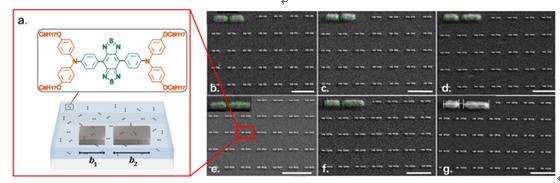
They construct asymmetric nano-antennas consisting of two bars with unequal lengths (Fig. 1) that provide multiple plasmonic modes with tunable resonance frequencies matching both excitation and emission frequencies of the fluorophore. The added tuning parameter, i.e., the ratio of the bar lengths, in such asymmetric structures offers new possibilities to modulate the near-field and far-field properties of the plasmonic modes, thereby further improving both excitation and emission processes. As a result, they experimentally acquire a single-molecule fluorescence enhancement factor up to 405 (Fig. 2), and the corresponding theoretical calculations indicate the quantum yield can be as high as 80%. Because the quantum yield plays a major role in this setup, this enhancement is achieved without sacrificing the molecules’ survival time under laser irradiation.

In addition, compared with reference groups of molecules located on glass substrate, the authors have observed a significantly increased photobleaching time in molecules located around asymmetric double-bar nano-antennas (Fig. 3), indicating a much higher number of fluorescence photons emitted by those molecules. The nano-antennas are, therefore, able to drastically suppress photobleaching. Because the local field enhancement does not improve photostability, the suppression comes mainly from the increased quantum yield as a result of competition between photobleaching rate and energy transfer rate to antenna.

###

Media Contact
Yan-Wen Tan
[email protected]

Related Journal Article

http://dx.doi.org/10.1038/s41377-021-00522-9

Tags: Chemistry/Physics/Materials SciencesOptics
Share12Tweet8Share2ShareShareShare2

Related Posts

Study Reveals How Valproate Affects Early Brain Development: Insights into the Antiepileptic Drug’s Impact — Chemistry

Study Reveals How Valproate Affects Early Brain Development: Insights into the Antiepileptic Drug’s Impact

May 22, 2026
Sustainable Chemistry: Iron Replaces Noble Metals in Catalytic Reactions — Chemistry

Sustainable Chemistry: Iron Replaces Noble Metals in Catalytic Reactions

May 22, 2026

Advancing Thin-Film Device Manufacturing with Imaging Ellipsometry for Enhanced Process Control

May 22, 2026

Simple Adjustment in 3D Printing Enhances Fit of Dental Crowns

May 22, 2026
Please login to join discussion

POPULAR NEWS

  • ESMO 2025: mRNA COVID Vaccines Enhance Efficacy of Cancer Immunotherapy

    314 shares
    Share 126 Tweet 79
  • New Study Reveals Plants Can Detect the Sound of Rain

    734 shares
    Share 293 Tweet 183
  • Research Indicates Potential Connection Between Prenatal Medication Exposure and Elevated Autism Risk

    847 shares
    Share 339 Tweet 212
  • Common Food Preservatives Associated with Elevated Blood Pressure and Increased Heart Disease Risk

    56 shares
    Share 22 Tweet 14

About

We bring you the latest biotechnology news from best research centers and universities around the world. Check our website.

Follow us

Recent News

AI Insights Uncover Causes of Injury Deaths

Comparing Robust Intelligent Controls for 3-DOF Robots

Predicting Flashover on Polluted Insulators with CNN-LSTM

Subscribe to Blog via Email

Enter your email address to subscribe to this blog and receive notifications of new posts by email.

Join 83 other subscribers
  • Contact Us

Bioengineer.org © Copyright 2023 All Rights Reserved.

Welcome Back!

Login to your account below

Forgotten Password?

Retrieve your password

Please enter your username or email address to reset your password.

Log In
No Result
View All Result
  • Homepages
    • Home Page 1
    • Home Page 2
  • News
  • National
  • Business
  • Health
  • Lifestyle
  • Science

Bioengineer.org © Copyright 2023 All Rights Reserved.