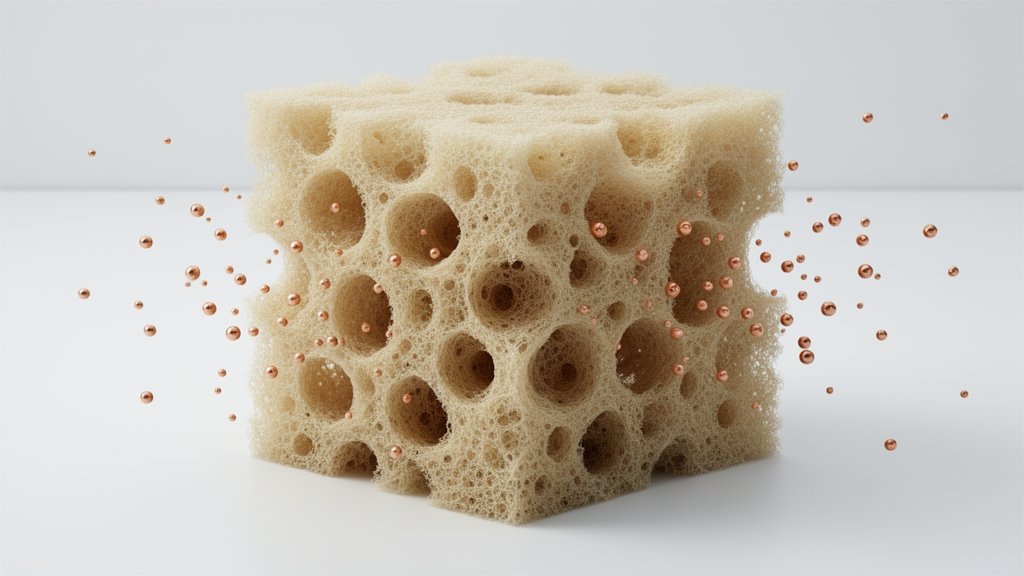
Researchers have developed bio-based polyurethane foams incorporating eugenol-derived polyol and ferulic acid functional moieties that achieve tunable copper ion capture and controlled dynamic release. In conventional ion adsorption systems, increasing active site density effectively enhances ion adsorption capacity, but it inevitably raises the activation energy barrier required for desorption, rendering the subsequent release of captured divalent copper ions kinetically unfavorable. Through a combined approach uniting coordination chemistry and pore structure engineering, the newly synthesized material resolves this kinetic bottleneck while maintaining appropriate adsorption performance alongside outstanding dynamic desorption capabilities.
The material design relies on the incorporation of eugenol-based polyol, designated as EM, alongside ferulic acid, designated as FA, to ensure efficient coordinative capture of divalent copper ions. Beyond providing specific chemical coordination sites, the introduction of these bio-based components fundamentally alters the physical structure of the foam during formation. The functional moieties simultaneously increase the foam expansion ratio and reduce the bulk density of the matrix, producing an engineered polymer network characterized by expanded cell volume and substantially lower mass density.
This structural adjustment and reduction in bulk density induces a pronounced cell wall thinning effect throughout the polyurethane foam network. The resulting cell wall thinning effect fundamentally redirects the ion mass transfer pathway away from deep physical entrapment within a dense bulk matrix. Instead, the altered structural pathway directs ion accumulation toward shallow enrichment located directly at the solid-liquid interface. By relocating the captured copper ions to this shallow surface layer, the material substantially lowers the diffusion resistance associated with ion desorption.
Concurrently, the incorporation of poly(propylene glycol) soft segments, designated as PPG, preserves the intrinsic hydrophilicity of the polyurethane matrix during synthesis. Experimental measurements confirmed that this hydrophilic composition afforded a maximum water uptake capacity of 62 percent. This substantial water uptake provides open, unobstructed channels across the cellular matrix, permitting rapid transmembrane water permeation and supporting the counter-directional migration of ions that is necessary for effective fluid movement and dynamic ion exchange during desorption.
Benefiting from the synergistic interplay between coordination chemistry and structural pore engineering, the resulting formulation, designated as PU-EM-FA-2, demonstrated outstanding dynamic desorption performance under moderate exposure conditions. In evaluations conducted under a moderate 100 milligram per liter copper ion adsorption condition, the material maintained appropriate adsorption capacity alongside efficient ion release. Specifically, PU-EM-FA-2 achieved a 24-hour cumulative release ratio of 63.38 percent, a desorption rate that is approximately 3.18 times that of unmodified polyurethane foam.
In addition to measuring dynamic ion capture and release behavior, the investigation confirmed the environmental degradation characteristics of the modified foam through enzymatic testing. Standard papain degradation experiments revealed that PU-EM-FA-2 achieved an enzymatic degradation rate exceeding 40 percent within a 72-hour evaluation window. This extent of enzymatic breakdown indicates considerable environmental biodegradability, establishing that the incorporation of bio-based eugenol and ferulic acid components promotes material breakdown without sacrificing functional ion management capabilities.
Together, these structural and chemical findings establish the modified polyurethane foam as a high-performance, environmentally benign carrier material for industrial and environmental use. By lowering desorption barriers, facilitating aqueous ion diffusion, and enhancing enzymatic degradability, the material provides a versatile platform suited for resource recovery and controlled-release applications. The foam demonstrates particular value in operational settings where the precise regulation of copper ion release kinetics is paramount to process efficiency and environmental safety.
Subject of Research: Tunable copper ion capture and release using bio-based polyurethane foams
Article Title: Eugenol/ferulic acid-based polyurethane foams for tunable Cu2⁺ release
Article References: Shen, J., Zhang, M., Wang, L., Deng, D., & Wang, Z. (2027). Eugenol/ferulic acid-based polyurethane foams for tunable Cu2⁺ release. Polymer Bulletin, 84(1), Article 20. https://doi.org/10.1007/s00289-026-06788-6
Image Credits: AI Generated
DOI: 10.1007/s00289-026-06788-6
Keywords: polyurethane foam, copper ion release, eugenol, ferulic acid, ion adsorption, pore structure engineering, biodegradability, resource recovery, ferulic, acid-based, polyurethane, foams
News Source: Bethany Barker. (November 9, 2026). Engineered Polyurethane Foams Enable Tunable Copper Ion Release and Biodegradation. Scienmag.