Self-assembled peptides, when aligned, show great promise for electricity generation.
Credit: Sawsan Almohammed
WASHINGTON, September 15, 2020 — Nanogenerators capable of converting mechanical energy into electricity are typically made from metal oxides and lead-based perovskites. But these inorganic materials aren’t biocompatible, so the race is on to create natural biocompatible piezoelectric materials for energy harvesting, electronic sensing, and stimulating nerves and muscles.
University College Dublin and University of Texas at Dallas researchers decided to explore peptide-based nanotubes, because they would be an appealing option for use within electronic devices and for energy harvesting applications.
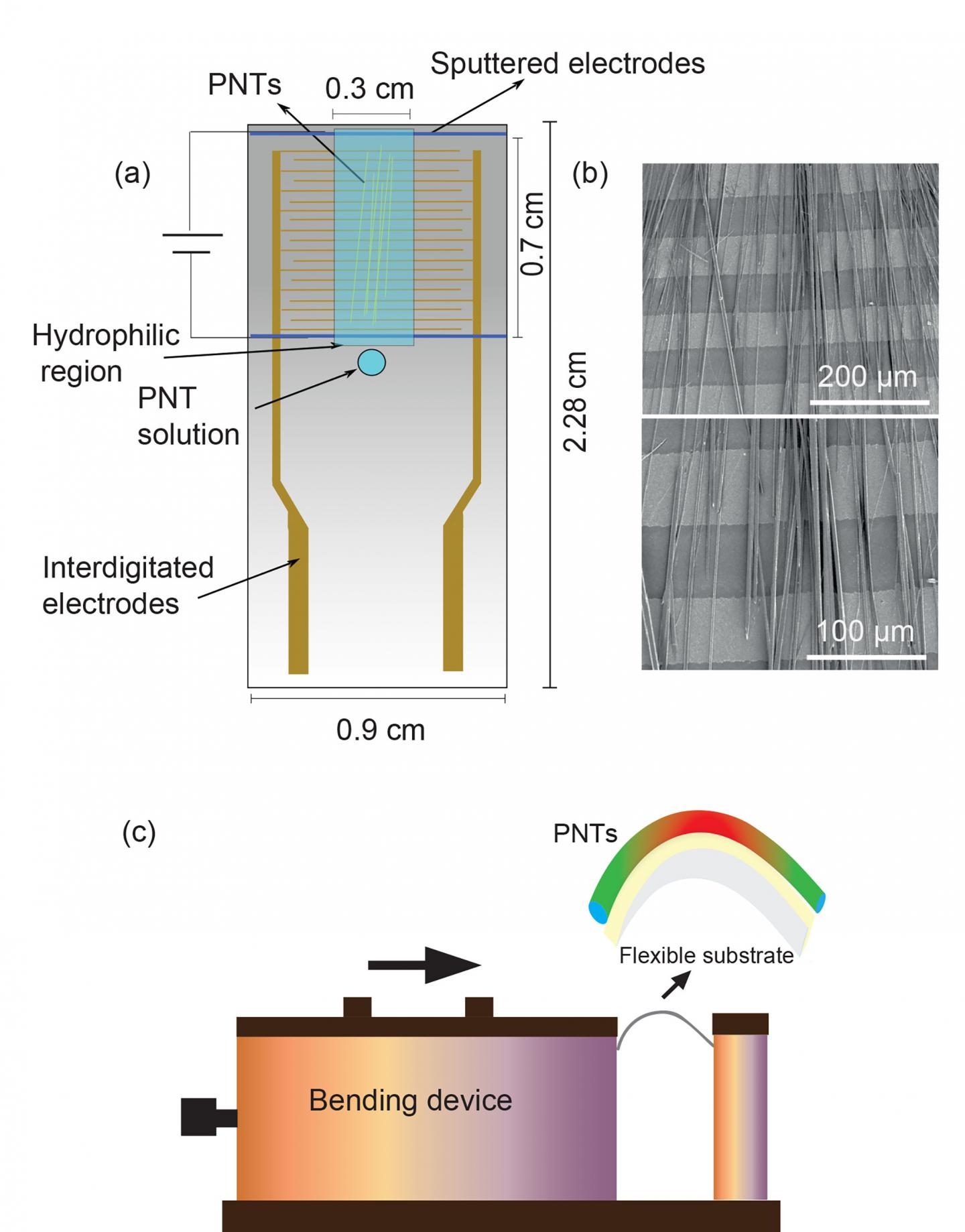
In the Journal of Applied Physics, from AIP Publishing, the group reports using a combination of ultraviolet and ozone exposure to generate a wettability difference and an applied field to create horizontally aligned polarization of nanotubes on flexible substrates with interlocking electrodes.
“The piezoelectric properties of peptide-based materials make them particularly attractive for energy harvesting, because pressing or bending them generates an electric charge,” said Sawsan Almohammed, lead author and a postdoctoral researcher at University College Dublin.
There’s also an increased demand for organic materials to replace inorganic materials, which tend to be toxic and difficult to make.
“Peptide-based materials are organic, easy to make, and have strong chemical and physical stability,” she said.
In the group’s approach, the physical alignment of nanotubes is achieved by patterning a wettability difference onto the surface of a flexible substrate. This creates a chemical force that pushes the peptide nanotube solution from the hydrophobic region, which repels water, with a high contact angle to the hydrophilic region, which attracts water, with a low contact angle.
Not only did the researchers improve the alignment of the tubes, which is essential for energy harvesting applications, but they also improved the conductivity of the tubes by making composite structures with graphene oxide.
“It’s well known that when two materials with different work functions come into contact with each other, an electric charge flows from low to high work function,” Almohammed said. “The main novelty of our work is that controlling the horizontal alignment of the nanotubes by electrical field and wettability-assisted self-assembly improved both the current and voltage output, and further enhancement was achieved by incorporating graphene oxide.”
The group’s work will enable the use of organic materials, especially peptide-based ones, more widely within electronic devices, sensors, and energy harvesting applications, because two key limitations of peptide nanotubes — alignment and conductivity — have been improved.
“We’re also exploring how charge transfer processes from bending and electric field applications can enhance Raman spectroscopy-based detection of molecules,” Almohammed said. “We hope these two efforts can be combined to create a self-energized biosensor with a wide range of applications, including biological and environmental monitoring, high-contrast imaging, and high-efficiency light-emitting diodes.”
###
The article, “Energy harvesting with peptide nanotube-graphene oxide flexible substrates prepared with electric field and wettability assisted self-assembly,” is authored by Sawsan Almohammed, Abi Thampi, Arwa Bazaid, Fengyuan Zhang, Salvador Moreno, Kevin Keogh, Majid Minary-Jolandan, James H. Rice, and Brian J. Rodriguez. It will appear in the Journal of Applied Physics on Sept. 15, 2020 (DOI: 10.1063/5.0017899). After that date, it can be accessed at https:/
ABOUT THE JOURNAL
The Journal of Applied Physics is an influential international journal publishing significant new experimental and theoretical results in all areas of applied physics. See https:/
Media Contact
Larry Frum
[email protected]
Related Journal Article
http://dx.