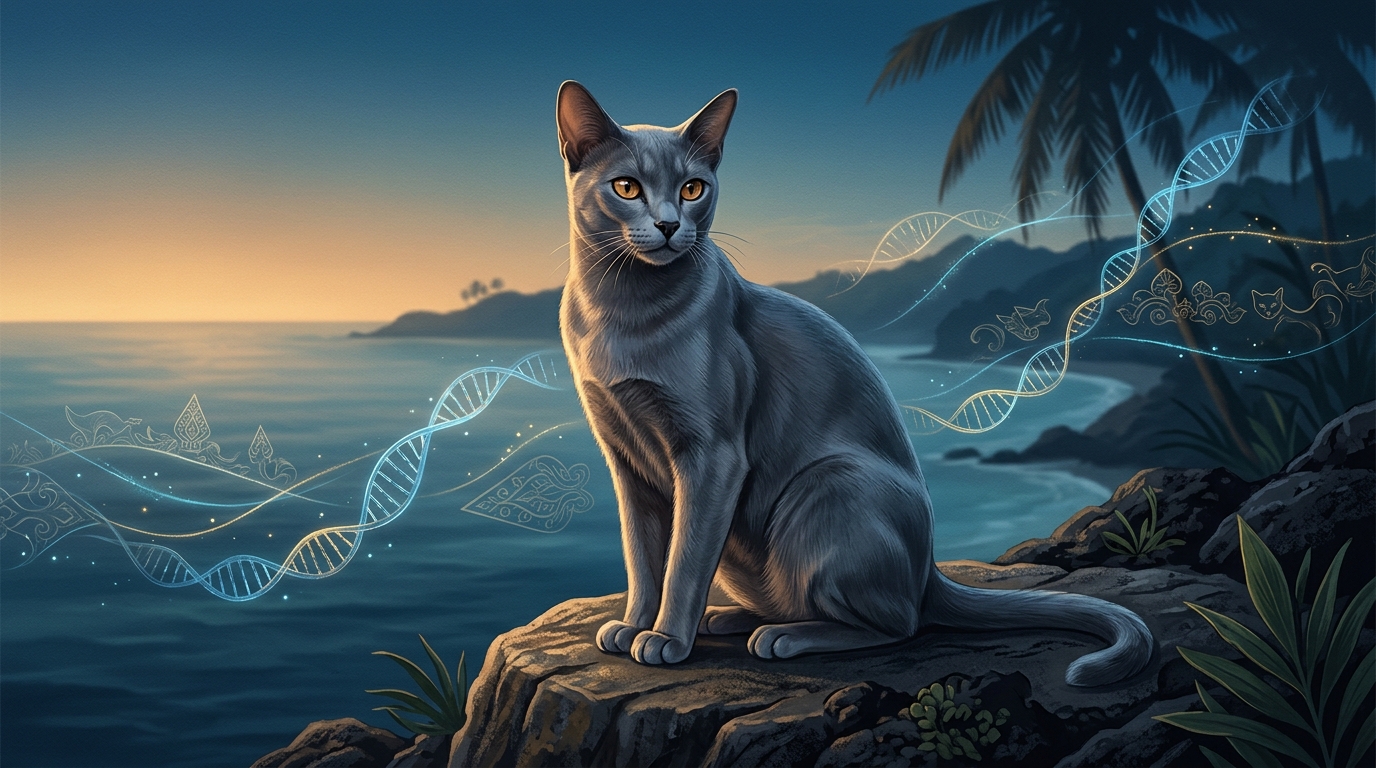
The endangered Busok cat, a rare blue-gray, short-tailed landrace from Ra’as Island in Indonesia, carries no unique maternal lineage, according to the first genetic study of the breed. Researchers sequenced the mitochondrial DNA control region of three Busok cats and found two maternal haplotypes, mitotypes A and B, both among the most common domestic cat lineages worldwide. The finding, published in the journal Molecular Genetics and Genomics, indicates that the breed descends from the same globally dispersed gene pool as ordinary house cats, consistent with human-assisted dispersal rather than an isolated island origin.
The Busok cat, also known as the Ra’as or Madura cat, comes from Ra’as Island in the Sumenep Regency of Madura, East Java. It has a dense blue-gray, black, chocolate, or lilac coat, lemon to oval non-blue eyes, and a distinctive short tail that is often kinked at the tip. Breeders grade the tail from rumpy, with no visible tail at all, through stumpy to a longer form called longy. The World Cat Federation recognized the breed in November 2022, and the Indonesian Busok Ra’as Association was established to coordinate breeding and conservation. Despite its considerable economic value, the breed remains scarce, with fewer than 100 phenotypically pure cats and few registered catteries. Until now, no genetic data on the Busok cat had been published.
Domestic cats descend from the Near Eastern wildcat Felis silvestris lybica and became associated with humans in the Fertile Crescent about 10,000 years ago as farming villages emerged. Genetic data indicate at least five maternal founder lineages from this region. The earliest evidence of a close cat-human relationship is a cat buried beside a human roughly 9,500 years ago on Cyprus, an island the animal could only have reached aboard a human boat. Cats then spread across the Old World along human trade routes by sea and land, with both Near Eastern and Egyptian maternal populations contributing and maritime dispersal gaining momentum in the Classical period. The expansion reached East Asia relatively late, and ancient DNA evidence indicates that Silk Road merchants introduced domestic cats to China after more than three millennia of commensalism between people and the native leopard cat. Indonesian domestic cats are therefore likely recent, human-introduced members of this globally dispersed, maritime-borne gene pool.
Island populations are especially informative for geneticists, because each founding event captures only part of the source gene pool, and the maternal lineages that persist reflect both the founders’ ancestry and later introductions. Many island cat populations have never been evaluated genetically. The mitochondrial control region, or displacement loop, is a non-coding, maternally inherited, rapidly evolving segment widely used to investigate maternal ancestry and population structure in domestic cats. A 402 base-pair non-repetitive segment underpins an international forensic database in which cats worldwide are assigned to major haplogroups, called mitotypes, labeled A through L. Across 1,394 cats from 25 populations and 26 breeds, twelve major mitotypes account for roughly 83 percent of individuals, with an overall diversity of 0.88 and a random-match probability of 11.8 percent.
In the new study, a team led by Widya Pintaka Bayu Putra of the National Research and Innovation Agency in Indonesia sampled three adult Busok cats held at the Animalium Animal Science Center in Bogor, West Java, and one unrelated Maltese-type blue-gray domestic cat from Bekasi, West Java, as a non-Busok comparison. Pedigree relationships among the three Busok cats were not documented, and because the animals came from a managed collection rather than directly from Ra’as Island, inferences about the island population are bounded. Blood samples were drawn following feline blood collection guidelines, and genomic DNA was extracted and amplified using primers targeting the non-repetitive control region between the flanking tandem-repeat arrays. Both strands of the amplified product were sequenced for each individual to confirm accuracy.
After trimming to the high-confidence region of 349 base pairs covered on both strands across all four cats, the researchers found four substitutions distinguishing two maternal haplotypes. Two Busok cats shared one haplotype, and the third shared the second with the Bekasi cat. Both Busok haplotypes were identical, over the full 349 base pairs, to global reference mitotypes: the two-cat lineage matched mitotype A and the one-cat lineage matched mitotype B, two of the most frequent domestic cat mitotypes worldwide. The researchers compared the sequences with 66 reference sequences from six countries, the A through L mitotype panel, and two wild felid outgroups, aligning all 72 sequences with the MAFFT software.
Phylogenetic and network analyses reinforced the picture of cosmopolitan ancestry. In the median-joining network, the two most frequent central nodes were occupied by the Busok haplotypes, which were also shared with cats from Thailand, Poland, Sweden, Türkiye, and other global references. Both the maximum-likelihood and neighbor-joining trees showed that the Busok cats grouped within large clusters of identical or nearly identical cosmopolitan haplotypes, with short and weakly supported internal branches indicating limited control region variation among globally dispersed cats rather than a unique island lineage. Mean pairwise distances showed the mitotype-A lineage closest to the Thai panel and the mitotype-B lineage nearest the Swedish panel, but the authors caution that these distances reflect the haplotype makeup of each panel rather than actual geographic origins. Among the 14 Thai sequences, five are identical to the Busok mitotype-A haplotype, whereas only one sequence in each of the other panels matches, so the distances do not reveal any specific geographic source.
The study also measured maternal diversity. Across the 70 domestic cats analyzed, the 349 base-pair region contained 23 segregating sites and 26 haplotypes. Haplotype diversity among the three Busok cats was 0.67, compared to 0.82 to 1.00 in the reference panels. However, with only three individuals, haplotype diversity can only take the values 0, 0.67, or 1, so the researchers rarefied each reference panel to three sequences. Among all possible three-sequence subsamples, 45.1 percent of the Thai, 14.7 percent of the Turkish, and 7.1 percent of the Polish panels fell at or below 0.67, while none of the Swedish did. A random three-cat sample typically showed 2.5 to 3.0 haplotypes across these panels. The Busok value fits within the range of three-cat samples from the reference panels, especially the Thai one, and does not indicate reduced diversity. Regardless of sample size, the two divergent lineages confirm at least two founder dams.
The practical consequences are significant for registry and conservation practice. The Bekasi cat, an ordinary non-Busok Maltese-type domestic cat, carried the same maternal haplotype as one of the Busok cats and was indistinguishable from it across the analyzed region. The mitochondrial control region therefore cannot by itself authenticate a cat as Busok. Because a single maternally inherited locus provides no information about paternal contributions, admixture, or breed-specific nuclear traits, verifying breed identity requires nuclear loci that the study did not test. The authors propose specific candidates: the short tail could be checked at the HES7 gene, associated with the Asian kinked-tail phenotype, and at the T-box gene, which carries the Western-origin Manx variants, while the blue-gray coat results from a single-base deletion in the MLPH gene and the chocolate coat arises from recessive TYRP1 alleles. Nuclear microsatellites are preferable for individual identification and parentage because they differentiate more effectively than mitochondrial DNA.
The authors also note an untested historical hypothesis: that the Busok phenotype was introduced into Java via cats gifted from Siam to Javanese and Madurese elites. King Rama V of Siam reportedly gave cats to French and British diplomats around 1884 and 1885, and other animals were exchanged as gifts between courts, but there are no records of a cat being sent specifically to Java, Madura, or Ra’as. The new data cannot test this hypothesis, since the presence of mitotypes A and B, shared by Thai breeds and cats worldwide, is equally consistent with descent from Thai cats, arrival before or after the Madurese settlement of Ra’as, or recent human introduction. The dilute blue-gray coat, uncommon among domestic cats in Ambon, Tangerang, and Surabaya, aligns with an introduced phenotype but does not pinpoint its source. The study presents the first maternal DNA reference for the breed, and the authors recommend whole-mitogenome sequencing of the archived samples, nuclear marker analysis, sampling directly from Ra’as Island, and comparison with Thai and regional populations to clarify the breed’s origin. Genetic management is advisable, they add, to prevent future bottlenecks if breeding remains restricted to fewer than 100 phenotypically pure cats.
Subject of Research: Mitochondrial DNA analysis of the endangered Busok cat from Ra'as Island, Indonesia
Article Title: Mitochondrial DNA control region of the endangered Busok cat (Felis catus) from Ra’as Island, Indonesia
Article References: Putra, W. P. B., Sutikno, Khaerunnisa, I., Nugraha, R. T. P., Subagyo, V. N. O., Wirdateti, Asrawijaya, E., Warman, A. T., Safitri, G. N., Gusti, C. R. K., Kristanto, A., Yamada, C., & Ophinni, Y. (2026). Mitochondrial DNA control region of the endangered Busok cat (Felis catus) from Ra’as Island, Indonesia. Discover Genetics and Evolution, 72(1), Article 6. https://doi.org/10.1007/s00294-026-01340-5
Image Credits: AI Generated
DOI: 10.1007/s00294-026-01340-5
Keywords: Busok cat, mitochondrial DNA, control region, Ra'as Island, Indonesia, haplotypes, domestic cat, maternal lineage, conservation genetics, island population, Mitochondrial, control
News Source: William Thompson. (November 4, 2026). Endangered Busok cat carries common maternal lineages, first DNA study finds. Scienmag.