Credit: Courtesy of Alan Cowen.
The Emoji Movie, in which the protagonist can't help but express a wide variety of emotions instead of the one assigned to him, may have gotten something right.
A new study from the University of California, Berkeley, challenges a long-held assumption in psychology that most human emotions fall within the universal categories of happiness, sadness, anger, surprise, fear and disgust.
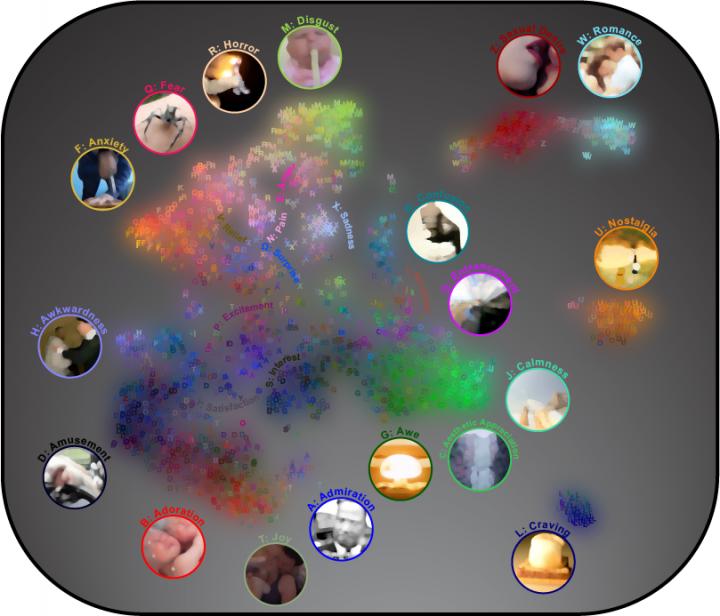
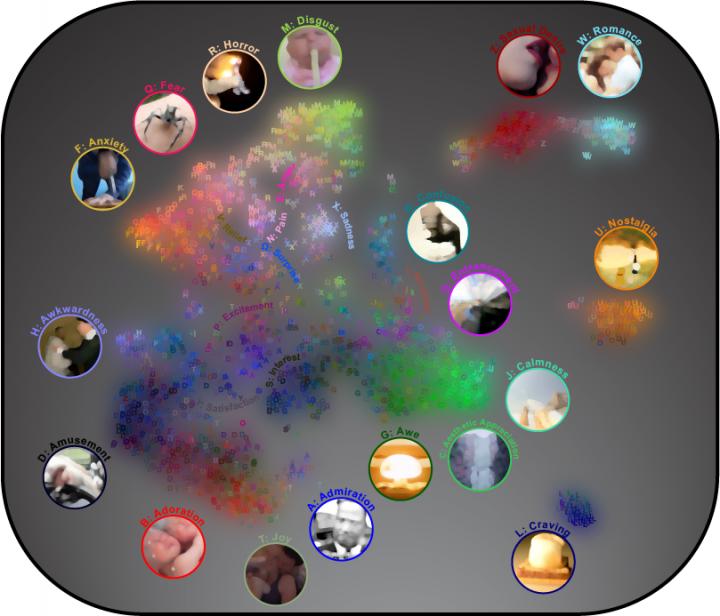
Using novel statistical models to analyze the responses of more than 800 men and women to over 2,000 emotionally evocative video clips, UC Berkeley researchers identified 27 distinct categories of emotion and created a multidimensional, interactive map to show how they're connected.
Their findings are published this week in the early edition of the Proceedings of the National Academy of Sciences journal.
"We found that 27 distinct dimensions, not six, were necessary to account for the way hundreds of people reliably reported feeling in response to each video," said study senior author Dacher Keltner, a UC Berkeley psychology professor and expert on the science of emotions.
Moreover, in contrast to the notion that each emotional state is an island, the study found that "there are smooth gradients of emotion between, say, awe and peacefulness, horror and sadness, and amusement and adoration," Keltner said.
"We don't get finite clusters of emotions in the map because everything is interconnected," said study lead author Alan Cowen, a doctoral student in neuroscience at UC Berkeley. "Emotional experiences are so much richer and more nuanced than previously thought."
"Our hope is that our findings will help other scientists and engineers more precisely capture the emotional states that underlie moods, brain activity and expressive signals, leading to improved psychiatric treatments, an understanding of the brain basis of emotion and technology responsive to our emotional needs," he added.
For the study, a demographically diverse group of 853 men and women went online to view a random sampling of silent 5- to-10-second videos intended to evoke a broad range of emotions.
Themes from the 2,185 video clips — collected from various online sources for the study — included births and babies, weddings and proposals, death and suffering, spiders and snakes, physical pratfalls and risky stunts, sexual acts, natural disasters, wondrous nature and awkward handshakes.
Three separate groups of study participants watched sequences of videos, and, after viewing each clip, completed a reporting task. The first group freely reported their emotional responses to each of 30 video clips.
"Their responses reflected a rich and nuanced array of emotional states, ranging from nostalgia to feeling 'grossed out,'" Cowen said.
The second group ranked each video according to how strongly it made them feel admiration, adoration, aesthetic appreciation, amusement, anger, anxiety, awe, awkwardness, boredom, calmness, confusion, contempt, craving, disappointment, disgust, empathic pain, entrancement, envy, excitement, fear, guilt, horror, interest, joy, nostalgia, pride, relief, romance, sadness, satisfaction, sexual desire, surprise, sympathy and triumph.
Here, the experimenters found that participants converged on similar responses, with more than half of the viewers reporting the same category of emotion for each video.
The final cohort rated their emotional responses on a scale of 1 to 9 to each of a dozen videos based on such dichotomies as positive versus negative, excitement versus calmness, and dominance versus submissiveness. Researchers were able to predict how participants would score the videos based on how previous participants had assessed the emotions the videos elicited.
Overall, the results showed that study participants generally shared the same or similar emotional responses to each of the videos, providing a wealth of data that allowed researchers to identify 27 distinct categories of emotion.
Through statistical modeling and visualization techniques, the researchers organized the emotional responses to each video into a semantic atlas of human emotions. On the map, each of the 27 distinct categories of emotion corresponds to a particular color.
"We wanted to shed light on the full palette of emotions that color our inner world," Cowen said.
###
Media Contact
Yasmin Anwar
[email protected]
510-643-7944
@UCBerkeleyNews
Original Source
http://news.berkeley.edu/2017/09/06/27-emotions/