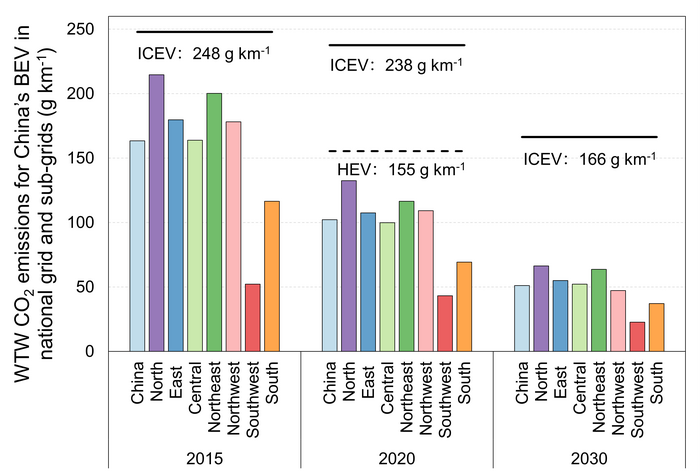
Chinese electric vehicles (EVs) drive larger emissions reductions over time, due to increased operating efficiency and a greener electricity mix, according to a study. More than 10% of Chinese car sales are now electric, but the full life cycle of EVs still creates carbon emissions. Shaojun Zhang and colleagues conducted “cradle-to-grave” life cycle assessments for EVs in 2015 and 2020, including fuel-cycle and material-cycle phases, and compiled life-cycle projections for 2030. The authors considered factors including sources of electricity, vehicle fuel economy, major automotive metals, and battery technologies. In 2020, battery electric vehicles created approximately 40% less emissions over their full life cycle than internal combustion engine vehicles, whereas in 2015 battery electric vehicles created just 23% less emissions than internal combustion vehicles. This drop in emissions was associated with multiple factors, but dominated by increased operating efficiency. Looking forward to 2030, the authors find that shifting to a nickel-cobalt-manganese battery, along with the increasing cleanness of the electricity mix, could increase the reduction of emissions of EVs over their full life cycle to 53% less than internal combustion vehicles. Regional differences complicate the picture; for example, more coal is used to produce electricity in the north of China than in other regions. But even in the North, EVs can provide considerable emissions reductions benefits, according to the authors.
Credit: Wang et al.
Chinese electric vehicles (EVs) drive larger emissions reductions over time, due to increased operating efficiency and a greener electricity mix, according to a study. More than 10% of Chinese car sales are now electric, but the full life cycle of EVs still creates carbon emissions. Shaojun Zhang and colleagues conducted “cradle-to-grave” life cycle assessments for EVs in 2015 and 2020, including fuel-cycle and material-cycle phases, and compiled life-cycle projections for 2030. The authors considered factors including sources of electricity, vehicle fuel economy, major automotive metals, and battery technologies. In 2020, battery electric vehicles created approximately 40% less emissions over their full life cycle than internal combustion engine vehicles, whereas in 2015 battery electric vehicles created just 23% less emissions than internal combustion vehicles. This drop in emissions was associated with multiple factors, but dominated by increased operating efficiency. Looking forward to 2030, the authors find that shifting to a nickel-cobalt-manganese battery, along with the increasing cleanness of the electricity mix, could increase the reduction of emissions of EVs over their full life cycle to 53% less than internal combustion vehicles. Regional differences complicate the picture; for example, more coal is used to produce electricity in the north of China than in other regions. But even in the North, EVs can provide considerable emissions reductions benefits, according to the authors.
Journal
PNAS Nexus
DOI
10.1093/pnasnexus/pgad123
Article Title
Multi-sectoral drivers of decarbonizing battery electric vehicles in China
Article Publication Date
16-May-2023