Researchers from Osaka University developed equations for quantifying electromagnetic interference (EM noise) and elucidated its origin, allowing for the best circuit configuration to reduce EM noise.
Credit: Osaka University
Most common devices are driven and controlled by electric power. Signals and power can be sent by transferring electricity through an electric circuit made up of conductors that conduct electrical current. However, interactions between a circuit and its environment, such as the ground and the earth, generate EM noise, causing malfunctions and generating heat. The equations developed in this study theoretically verified that EM noise was caused not only by the interference between transmission lines, but also by conditions of elements connected to the electric circuit.
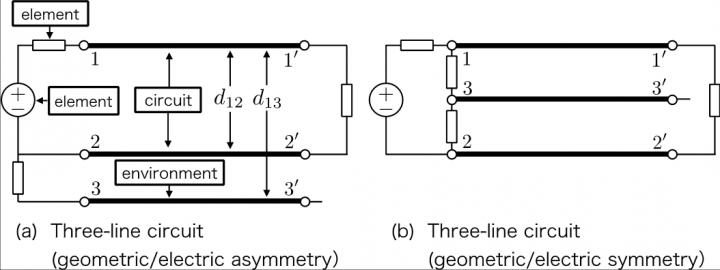
Since it is difficult to find causes of invisible EM noise, various measures based on experience and know-how of trained engineers have been taken to reduce it. To describe EM noise, the researchers used a three-line (multi-conductor transmission line (MTL)) circuit, to which lumped-parameter circuits were connected. In addition to a conventional two-line circuit configuration, another conductor line was connected on the source side as the ground. (Fig. 1)
Thus, this team of researchers derived telegraphic equations, wave equations, and reflection coefficients in the normal mode (NM) that represents circuit signals and the common mode (CM) that is generated by interaction with the environment and causes various noise. Considering the noise mode conversion in the MTL, they derived equations that describe behaviors of the NM and CM.
As a result, they theoretically demonstrated that the CM converted to the NM due to (a) the geometrical relation between the circuit and the environment and (b) the electrical connections between the MTL and the elements connected to the MTL, generating EM noise.
Their method has enabled theoretical calculations of electric circuits with various configurations and electrical connections, confirming that a symmetrical configuration of three transmission lines together with lumped circuits was the only solution to eliminate EM noise. (Fig. 2)
This method enables quantification of behavior of EM noise and time-domain analysis, allowing one to intuitively understand EM noise. This method has the potential to fundamentally eliminate the root cause of EM noise.
Prof. Abe says, “In addition to the improvement of device performances, we aim to develop an ‘EM noise-less infrastructure’ to create a society in which people can use high value-added devices, devices with ultra-low power consumption and ultra-low waste heat.”
###
The article “Mechanism of common-mode noise generation in multi-conductor transmission lines” was published in Scientific Reports at DOI: https:/
About Osaka University
Osaka University was founded in 1931 as one of the seven imperial universities of Japan and now has expanded to one of Japan’s leading comprehensive universities. The University has now embarked on open research revolution from a position as Japan’s most innovative university and among the most innovative institutions in the world according to Reuters 2015 Top 100 Innovative Universities and the Nature Index Innovation 2017. The university’s ability to innovate from the stage of fundamental research through the creation of useful technology with economic impact stems from its broad disciplinary spectrum.
Website: https:/
Media Contact
Saori Obayashi
[email protected]
81-661-055-886
Original Source
https:/
Related Journal Article
http://dx.