• HOME
  • NEWS
  • EXPLORE
    • CAREER
      • Companies
      • Jobs
    • EVENTS
    • iGEM
      • News
      • Team
    • PHOTOS
    • VIDEO
    • WIKI
  • BLOG
  • COMMUNITY
    • FACEBOOK
    • INSTAGRAM
    • TWITTER
Friday, April 17, 2026
BIOENGINEER.ORG
No Result
View All Result
  • Login
  • HOME
  • NEWS
  • EXPLORE
    • CAREER
      • Companies
      • Jobs
        • Lecturer
        • PhD Studentship
        • Postdoc
        • Research Assistant
    • EVENTS
    • iGEM
      • News
      • Team
    • PHOTOS
    • VIDEO
    • WIKI
  • BLOG
  • COMMUNITY
    • FACEBOOK
    • INSTAGRAM
    • TWITTER
  • HOME
  • NEWS
  • EXPLORE
    • CAREER
      • Companies
      • Jobs
        • Lecturer
        • PhD Studentship
        • Postdoc
        • Research Assistant
    • EVENTS
    • iGEM
      • News
      • Team
    • PHOTOS
    • VIDEO
    • WIKI
  • BLOG
  • COMMUNITY
    • FACEBOOK
    • INSTAGRAM
    • TWITTER
No Result
View All Result
Bioengineer.org
No Result
View All Result
Home NEWS Science News Health

Elephant trunks form joints to pick up small objects; research could translate to robotics

Bioengineer by Bioengineer
October 24, 2018
in Health
Reading Time: 2 mins read
0
Share on FacebookShare on TwitterShare on LinkedinShare on RedditShare on Telegram
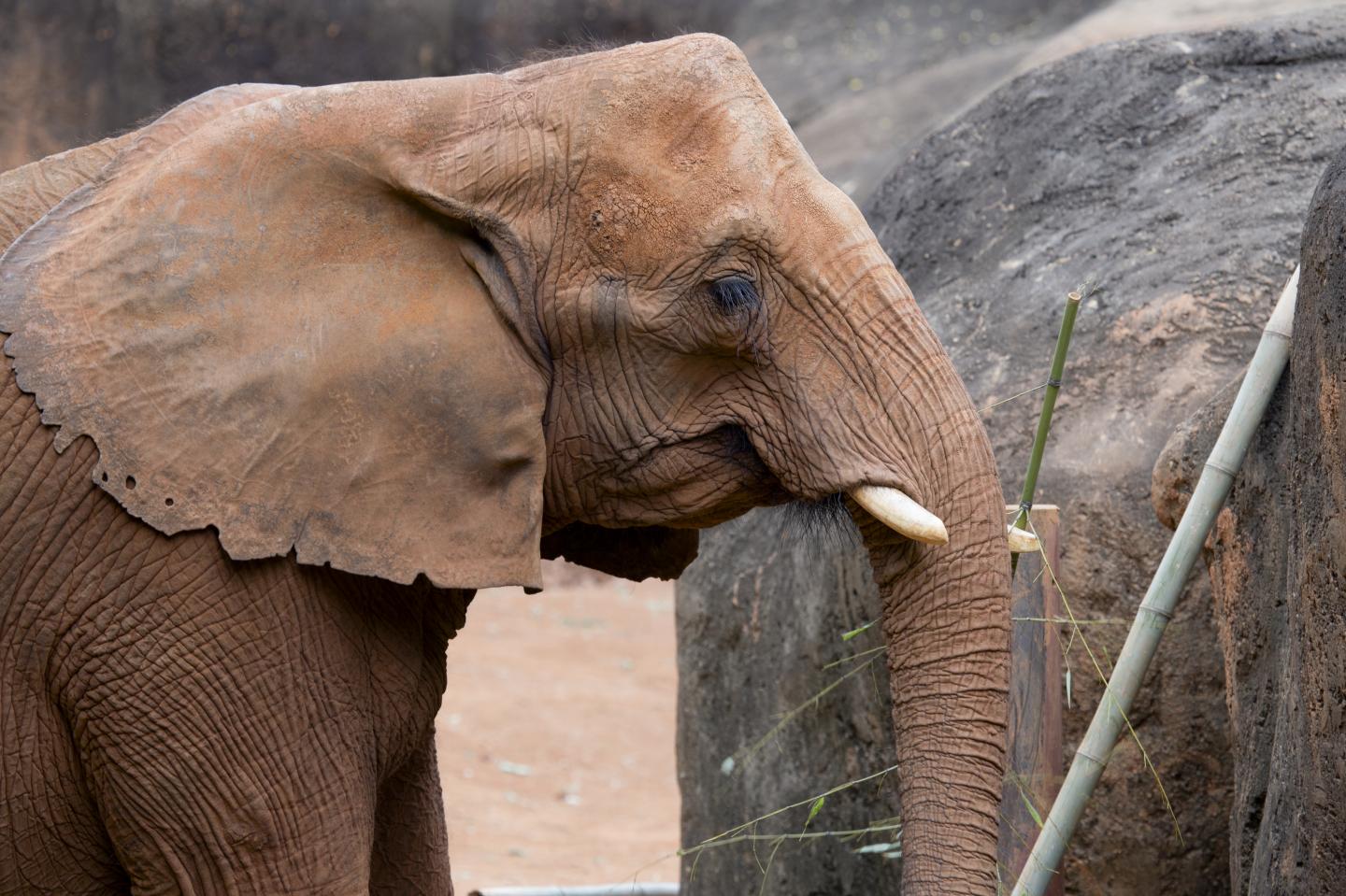
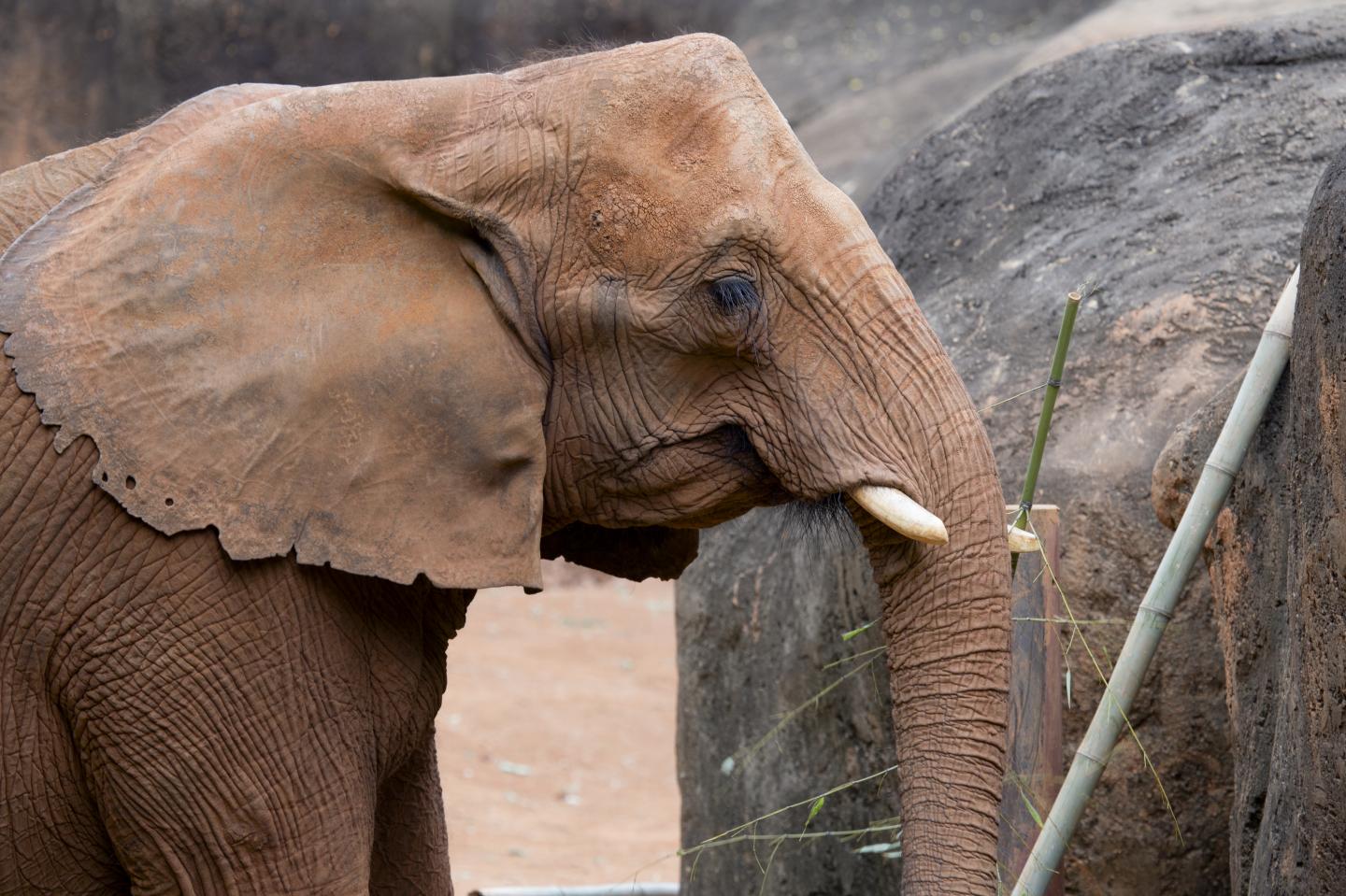
IMAGE

Credit: Courtesy of Zoo Atlanta

Understanding how elephants use their trunks to pick up small objects could lead to robots designed with flexible hands or grippers, according to a new study that includes Rochester Institute of Technology research.

RIT scientist Scott Franklin collaborated with David Hu at Georgia Institute of Technology to understand how elephants apply force with their trunk to manipulate different sized objects. Hu led the study that appears in the Oct. 24 issue of the Journal of the Royal Society Interface.

Elephants graze nearly non-stop and eat about 440 pounds of food per day, according to the authors. Elephant trunks, which lack bones, form kinks or joints to compress small pieces of food into an efficient bite-sized masses.

Staff at Zoo Atlanta conducted videotaped experiments involving the zoo's popular 35-year-old female African elephant named "Kelly." Her handlers offered her rutabaga and carrot cubes of different sizes and piles of wheat bran on a force plate. The experiment measured the force the elephant applied to the piles of food and imaged the shape of her trunk when grabbing each object.

Franklin studied the video and data provided by Hu's team that suggested the elephant applied more force when attempting to pick up a pile of small particles. The behavior had a characteristic shape Franklin recognized from his earlier work applying the weakest link theory to granular materials. The chance for a weakest link increases when a pile consists of many individual particles, and the elephant stabilized the weakest link in the mound of food by applying more force, according to Franklin.

"It seems counterintuitive that you put more weight on something that you're trying to pick up, but the reason that makes sense is that when you push down on this food, because it's particulate, it forces all the food to squeeze together even more," said Franklin, a professor of physics in RIT's School of Physics and Astronomy. "The more tightly the food is squeezed together, the more likely the friction between them will be enough to allow you to pick it up."

The elephant trunk could be a model for researchers designing robotic hands or grippers with the finesse to pick up different objects, varying in material and quantity, he said.

"It is very difficult to develop a gripper that is flexible enough to pick up a variety of objects, for example a single pen or a pile of pens, or a cube of Jell-O," Franklin said. "The elephant trunk is a single thing; it doesn't change shape at all, but it is able to pick up food of different sizes, weights and masses, so the idea is that this will give us insight and information into how nature has solved this problem of how to pick up multiple things and then we can try to reproduce it."

###

Media Contact

Susan Gawlowicz
[email protected]
585-475-5061
@ritnews

http://www.rit.edu

Original Source

https://www.rit.edu/news/story.php?id=68268

Share12Tweet7Share2ShareShareShare1

Related Posts

ELMO2: Key Target in Resistant Lung Cancer

April 17, 2026

Targeting Nicotinamide N-Methyltransferase in Taxane-Resistant Prostate Cancer

April 17, 2026

Ahead-of-Print Highlights from The Journal of Nuclear Medicine – April 17, 2026 Edition

April 17, 2026

Dr. Todd P. Semla to Present Henderson State-of-the-Art Lecture on the Evolution of Pharmacotherapy for Older Adults at #AGS26

April 17, 2026
Please login to join discussion

POPULAR NEWS

  • Scientists Investigate Possible Connection Between COVID-19 and Increased Lung Cancer Risk

    62 shares
    Share 25 Tweet 16
  • NSF funds machine-learning research at UNO and UNL to study energy requirements of walking in older adults

    100 shares
    Share 40 Tweet 25
  • Boosting Breast Cancer Risk Prediction with Genetics

    47 shares
    Share 19 Tweet 12
  • Popular Anti-Aging Compound Linked to Damage in Corpus Callosum, Study Finds

    46 shares
    Share 18 Tweet 12

About

We bring you the latest biotechnology news from best research centers and universities around the world. Check our website.

Follow us

Recent News

ELMO2: Key Target in Resistant Lung Cancer

UTS Study Reveals Toxic Metal Exposure from E-Cigarette Devices

Targeting Nicotinamide N-Methyltransferase in Taxane-Resistant Prostate Cancer

Subscribe to Blog via Email

Success! An email was just sent to confirm your subscription. Please find the email now and click 'Confirm' to start subscribing.

Join 79 other subscribers
  • Contact Us

Bioengineer.org © Copyright 2023 All Rights Reserved.

Welcome Back!

Login to your account below

Forgotten Password?

Retrieve your password

Please enter your username or email address to reset your password.

Log In
No Result
View All Result
  • Homepages
    • Home Page 1
    • Home Page 2
  • News
  • National
  • Business
  • Health
  • Lifestyle
  • Science

Bioengineer.org © Copyright 2023 All Rights Reserved.