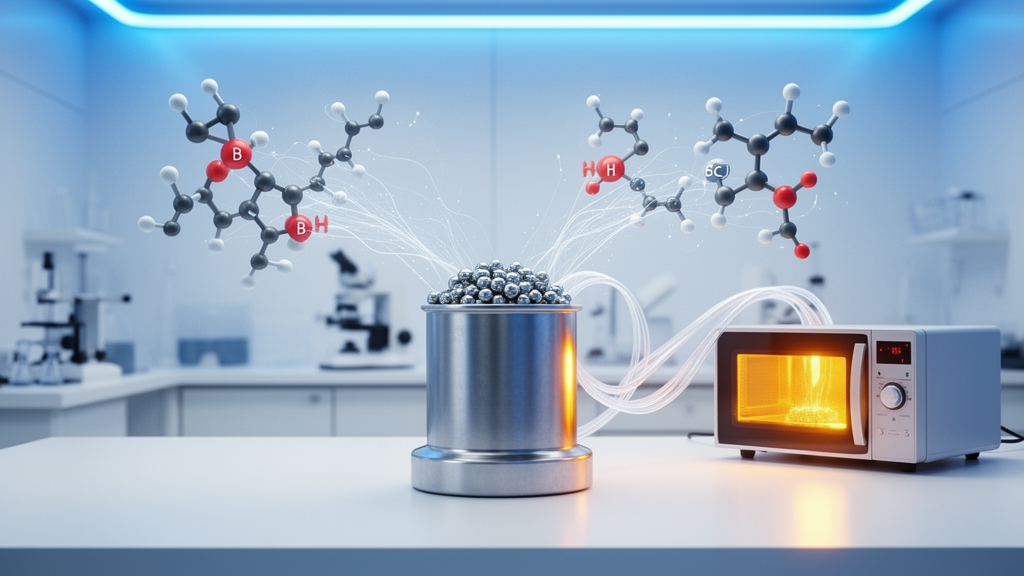
Boronic acids and their ester cousins sit at the heart of modern organic chemistry, serving as the go-to building blocks for carbon-carbon and carbon-heteroatom bond formation, most famously in Suzuki-Miyaura cross-coupling. Yet despite their versatility, the industrial and laboratory preparation of these compounds has remained stubbornly anchored to classical solution-phase chemistry. A new open-access review, published in Discover Catalysis by Anna Chojnacka, Szymon Rogalski, Sylwia Ostrowska and Cezary Pietraszuk, takes stock of a quiet revolution: between 2020 and 2025, chemists have increasingly turned to electricity, mechanical force, microwave irradiation, water and ionic liquids to forge the carbon-boron bond in ways that conventional flasks never could.
The authors frame the problem clearly. Two strategies derived from organic halides still dominate boronic acid preparation. The first, developed by Brown, converts organic halides into organolithium intermediates via halogen-metal exchange, followed by reaction with borate esters and hydrolysis. The second, Miyaura borylation, introduced in the mid-1990s, couples organic halides with bis(pinacolato)diboron under palladium catalysis and remains one of the most widely adopted tools for making boronic esters. A third family, direct C-H borylation catalyzed by transition metals, has broadened substrate scope considerably, with iridium complexes paired with bipyridine-type ligands now the workhorses for arenes, heteroarenes and alkanes, while visible-light metal-free variants offer milder alternatives.
The review’s first major section examines electrochemical synthesis, where the authors identify a decisive paradigm shift after 2019. Early electroborylation approaches from 2002 to 2005 relied on cathodic reduction of aryl halides followed by trapping with trialkylboranes or HBpin, but these methods suffered from dependence on electrode material, sacrificial anodes, competing dehalogenation and sensitivity to cell parameters that hampered standardization between laboratories. The modern wave instead exploits controlled single-electron regimes to generate radical intermediates predictably, with B2pin2 as the predominant boron source.
Among the standout examples is a 2021 metal-free electrochemical hydroboration of aromatic alkenes reported by Qing and co-workers, run in an undivided cell at constant current with platinum electrodes and DIPEA as an additive. The reaction delivered boronate esters from terminal and internal styrenes in yields of roughly 22 to 72 percent, while vinyl naphthalenes underwent controlled diborylation in yields reaching 70 to 88 percent. Deuterium-labeling experiments showed the hydrogen atom in the product originates predominantly from electrolysis of acetonitrile, and radical inhibition tests with TEMPO and galvinoxyl, along with EPR signals, provided direct evidence for boryl and benzylic radical intermediates. Gram-scale reactions gave isolated yields of 58 to 68 percent, and a diboronate ester was prepared from 10 millimoles of substrate in 85 percent yield.
Decarboxylative borylation features prominently as well. Baran and co-workers developed an electrochemical method converting redox-active esters into boronate esters without transition-metal catalysts or external reductants, using B2cat2 in an undivided cell to deliver moderate to high yields of 38 to 84 percent for primary and secondary aliphatic substrates. Cyclic voltammetry and boron-11 NMR revealed a complex between the redox-active ester and B2cat2 as the species undergoing reduction, and reaction progress kinetic analysis showed electron transfer at the electrode is rate-determining. The method scaled to the 100-gram level in a flow reactor without significant yield erosion, though tertiary, benzylic and alpha-heteroatom-substituted substrates performed poorly. Related protocols by Jiang and Yi converted arylazo sulfones to aryl boronate esters in 78 to 88 percent yields, while Qi and Lu reported a transition-metal-free borylation of alkyl halides spanning more than 70 examples with yields of 34 to 93 percent, including late-stage functionalization of natural product and drug derivatives, with gram-scale runs reaching up to 1000 milliamps of current.
Mechanochemistry emerges as the review’s second pillar. Kubota and Ito demonstrated that borylation of aromatic diazonium salts with bis(pinacolato)diboron proceeds in a ball mill with piezoelectric barium titanate under solvent-free conditions in air, typically affording boronic esters in the range of about 45 to 80 percent. Their iridium-catalyzed C-H borylation of indoles under solvent-free milling delivered C2-borylated products in yields of 26 to 64 percent, with the notable bonus that both boryl units of the diboron reagent were consumed, unlike in solution. In 2022 the same group reported a palladium-catalyzed solid-state borylation of aryl halides with isolated yields of 51 to 93 percent, typically within ten minutes of milling, all conducted in ambient air without Schlenk techniques or glovebox handling. Liu later achieved solvent-free palladium-catalyzed borylation of aryl bromides with catalyst loadings as low as 0.05 percent in an electromagnetic mill, though ortho-substituted substrates performed poorly, revealing the steric sensitivity of solid-state reactivity.
The mechanochemical section closes with two recent advances: a 2024 catalyst- and solvent-free three-component coupling from Fan and Wei that generates aryl radicals from diazonium tetrafluoroborates to make alpha-haloalkyl boronic esters, demonstrated on a 6.8-millimole scale in 94 percent isolated yield, and a 2025 ruthenium-catalyzed deoxygenative borylation of free phenols via C-O bond cleavage from Mkrtchyan and Iaroshenko, delivering aryl pinacol boronates in 90 to 96 percent yields and a 10-millimole demonstration at 91 percent. The authors caution, however, that mechanochemical reactions are highly sensitive to instrumental parameters such as mill type, vessel material, ball size and frequency, which complicates reproducibility and interlaboratory comparison, a significant barrier for pharmaceutical applications where stringent purity requirements apply.
Microwave-assisted synthesis forms the third strategy, valued as a process-intensification tool. Carreras and co-workers reported in 2020 a solvent-free, catalyst-free hydroboration of terminal alkynes with pinacolborane at 215 degrees Celsius for just 18 minutes, delivering (E)-alkenyl boronic esters with complete stereoselectivity and high anti-Markovnikov regioselectivity, with electron-withdrawing substituents giving the highest yields. Rocheblave extended this with a metal-free variant at 120 degrees Celsius using an organic acid catalyst, affording moderate to high yields of 48 to 92 percent for aromatic alkynes. Most strikingly, Torres and Garcia-Calvo showed in 2025 that microwave heating cuts iridium-catalyzed ortho-borylation of perylene derivatives from days to a single hour, delivering a diborylated product in near-quantitative 88 percent yield where conventional heating in dioxane for three days gave only 55 percent.
The final sections address unconventional media. In water, Yang and Liu reported a palladium-catalyzed hydroboration of unactivated alkynes in neat water with B2pin2, giving alkenyl boronic esters in roughly 60 to 85 percent yields, while Dai, Wei and Liu developed a metal- and base-free hydroboration catalyzed by an in situ generated N-heterocyclic carbene, affording products in 80 to 95 percent yields with near-complete E-stereoselectivity under air at 50 degrees Celsius. In ionic liquids, Szyling and Walkowiak achieved ruthenium-catalyzed borylative coupling of olefins with vinyl boronic pinacol ester in a biphasic ionic liquid and supercritical CO2 system that retained and reused the catalyst, and Walkowiak’s 2023 organocatalytic hydroboration using a pyrrolidinium ionic liquid as the catalyst itself delivered linear alkyl boronic esters as single regioisomers in 75 to 96 percent yields, with a gram-scale run isolating 2.25 grams of product in 98 percent yield.
The review’s verdict is measured rather than triumphant. Electrochemical methods offer transition-metal-free borylation under mild conditions with broad functional-group tolerance and genuine scalability, but still require supporting electrolytes and lack mature electrochemical C-H borylation. Mechanochemistry excels where solubility constraints defeat homogeneous catalysis but demands rigorous standardization. Microwave protocols intensify processes selectively rather than universally, and aqueous and ionic-liquid systems remain limited by insufficiently validated scalability and a lack of systematic comparative benchmarking against established solution-phase methods. The authors argue that future breakthroughs will come from hybrid strategies that treat the reaction environment as an active determinant of reactivity rather than a passive medium, integrating non-conventional activation modes with rational catalyst design to carve out areas where these approaches deliver genuine synthetic advantage rather than remaining laboratory curiosities.
Subject of Research: Non-conventional catalytic strategies for synthesizing boronic acids and esters
Article Title: Advances in the electrochemical, mechanochemical, microwave-assisted and non-conventional media-based synthesis of boronic acids and esters
Article References: Chojnacka, A., Rogalski, S., Ostrowska, S., & Pietraszuk, C. (2026). Advances in the electrochemical, mechanochemical, microwave-assisted and non-conventional media-based synthesis of boronic acids and esters. Discover Catalysis, 3(1), Article 12. https://doi.org/10.1007/s44344-026-00043-w
Image Credits: AI Generated
DOI: 10.1007/s44344-026-00043-w
Keywords: boronic acids, boronic esters, electrochemistry, mechanochemistry, microwave synthesis, ionic liquids, C-H borylation, green chemistry, organoboron, radical borylation, hydroboration, aqueous catalysis
News Source: Bethany Barker. (October 29, 2026). Electrons, milling balls and microwaves reshape how chemists make boronic acids. Scienmag.