Chemists at the Massachusetts Institute of Technology have demonstrated an electrochemical strategy that extracts pure hydrogen gas from ammonia while dramatically lowering the temperature and energy the conversion demands. The approach, described in a new study published in Nature, couples a hydrogen-selective palladium membrane with a hydrogen-generating electrode through a molten hydroxide electrolyte, allowing the team to liberate hydrogen from its chemical carrier and collect it in a concentrated, high-purity stream in a single integrated process. Conventional ammonia cracking, by contrast, requires temperatures above 500 degrees Celsius and leaves the product mixed with nitrogen and unreacted ammonia that must be separated downstream before use.
The work addresses a persistent bottleneck in what researchers often describe as a future hydrogen economy. Hydrogen is already an industrial staple: it is consumed in semiconductor manufacturing, in chemical processing, and in fuel cells that combine hydrogen and oxygen to generate electricity without combustion. Yet hydrogen gas itself is awkward to move. Unless it is compressed to high pressures or liquefied at cryogenic temperatures, transporting it efficiently from where it is produced to where it is needed remains difficult. One widely discussed alternative is to store hydrogen chemically inside molecules that are liquid or readily liquefied, ship those carriers using existing infrastructure, and release the hydrogen on demand at the point of use.
Ammonia is among the most attractive of these carriers. It is already manufactured at enormous scale and shipped across long distances, so the logistics of moving it are well established. The problem lies in getting the hydrogen back out. Recovering hydrogen from ammonia, a process known as cracking, demands temperatures higher than 500 degrees Celsius to reach useful reaction rates and conversion levels, and the resulting gas mixture then requires additional purification steps before the hydrogen can feed a fuel cell or another application that needs high purity. Those separation stages carry their own energy penalties, adding to the overall cost of the recovered fuel.
The MIT team, led by postdoc Rui Zeng, now a professor of materials science and engineering at Harbin Institute of Technology in Shenzhen, China, and corresponding author Yogesh Surendranath, the Donner Professor of Science and a professor of chemistry and chemical engineering at MIT, asked a different question. Could electrical inputs drive a dehydrogenation reaction that would otherwise be thermodynamically unfavorable and kinetically sluggish, while simultaneously separating the hydrogen from its carrier so that the product emerges pure enough for direct use? Their answer, embodied in the new device, is yes.
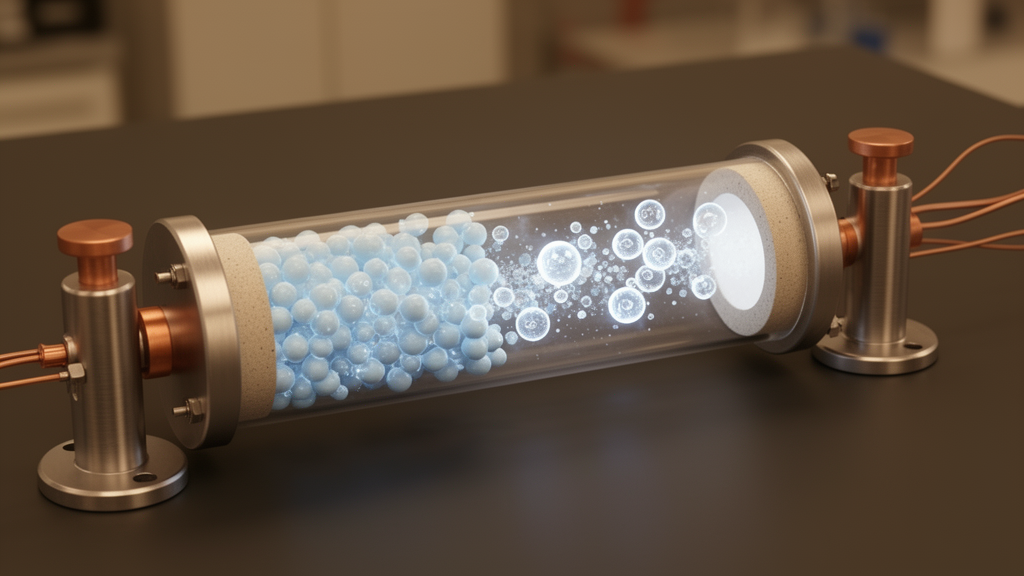
The design centers on the coupling of a palladium-based separation membrane with a hydrogen-generating electrode through a molten hydroxide electrolyte. In operation, ammonia is first dehydrogenated by a catalyst containing ruthenium and cesium. The liberated hydrogen then reaches the separation membrane, whose opposite side contacts the molten hydroxide electrolyte. An electrochemical gradient across the membrane effectively creates what the researchers describe as a vacuum for hydrogen, a strong driving force that pulls the gas through the membrane. As it crosses, the hydrogen is converted into protons and electrons, which travel separately through the molten electrolyte and the external circuit before recombining at a second electrode to form hydrogen gas.
Because the membrane selectively transports hydrogen while blocking the other components of the reaction mixture, the system delivers a concentrated stream of hydrogen gas without any separate downstream purification. Using this electrochemical process, the team is able to actively pump hydrogen from a low concentration to a high concentration, Surendranath explains. That active extraction does more than simply collect the product. Continuously removing hydrogen from the reaction environment helps drive the dehydrogenation reaction forward, a benefit that becomes especially important when accumulated hydrogen would otherwise inhibit the reaction. In this way the strategy changes the reaction environment itself and enables hydrogen recovery under milder conditions than conventional thermal cracking allows.
The practical consequences are substantial. The process can be performed at temperatures around 200 or 300 degrees Celsius, far below the more than 500 degrees Celsius required for conventional ammonia cracking, which reduces the thermal energy input needed to run the conversion. And because the output emerges as a pure stream, the energy-intensive purification stage that conventional cracking demands is eliminated entirely. The researchers also showed that the same approach works beyond ammonia: they used it to dehydrogenate methylcyclohexane, a member of a class of molecules known as liquid organic hydrogen carriers, or LOHCs, which are also considered promising candidates for storing and transporting hydrogen in liquid form.
Surendranath frames the result as a demonstration of electrochemistry’s power to reshape difficult chemistry. The team has shown the ability to use electrochemistry to drive thermodynamically uphill and kinetically difficult dehydrogenation reactions, he says. Ammonia and a liquid organic molecule were studied because of their importance as possible hydrogen carriers for a hydrogen economy, but the concepts learned here could in principle be translated further, and the group is actively working on applying them to other important dehydrogenation reactions.
Outside experts took note of the advance. Curtis Berlinguette, a professor of chemistry and of chemical and biological engineering at the University of British Columbia, who was not involved in the research, described the method as a powerful new way to solve the problem of obtaining a pure stream of hydrogen from ammonia and other hydrogen carriers. By using electricity to pull hydrogen through the membrane as it is released, he notes, the approach accelerates the dehydrogenation of ammonia and liquid organic hydrogen carriers while simultaneously producing a purified hydrogen stream. In his view, this is an important advance for the energy sciences because it opens a credible pathway for transporting hydrogen in stable chemical carriers and releasing it where and when it is needed.
The researchers envision applications ranging from transportation, such as powering cars, buses, or ships, to industrial uses like fabricating semiconductors and electronics, where pure hydrogen gas plays important roles in boosting manufacturing yields and reducing surface defects across several production steps. Significant engineering challenges remain before the laboratory demonstration becomes a commercial technology. Because palladium is an expensive metal, the team is now working on ways to reduce the amount of palladium needed in the separation membrane. They are also pursuing scale-up of the process and exploring its application to other dehydrogenation reactions that could prove industrially useful. The research, published in Nature under the title describing anodic palladium membrane hydrogen extraction that enhances thermochemical dehydrogenation, was funded by the U.S. National Science Foundation, and its DOI is 10.1038/s41586-026-11008-2.
Subject of Research: Electrochemical extraction of pure hydrogen from ammonia and liquid organic hydrogen carriers
Article Title: An electrochemical approach turns ammonia into pure hydrogen.
Article References: An electrochemical approach turns ammonia into pure hydrogen.. Original publication (Bibliographic details unavailable.)
Image Credits: AI Generated
DOI: Not provided
Keywords: hydrogen, ammonia, electrochemistry, hydrogen carriers, palladium membrane, dehydrogenation, fuel cells, liquid organic hydrogen carriers, molten hydroxide electrolyte, MIT, Nature, semiconductor manufacturing
News Source: Bethany Barker. (October 27, 2026). Electrochemical method pulls pure hydrogen from ammonia at lower temperatures. Scienmag.