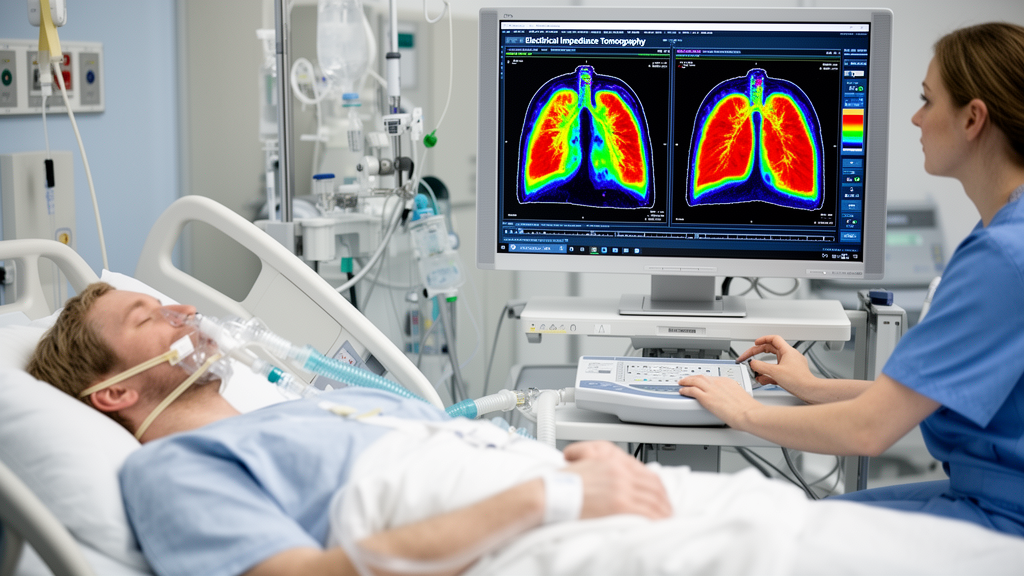
A systematic review and meta-analysis evaluating electrical impedance tomography for adults receiving invasive mechanical ventilation found that regional impedance indices show potential for predicting weaning failure, though performance varies substantially by clinical outcome and evidence certainty remains very low. Across four studies evaluating spontaneous breathing trial failure, pooled sensitivity reached 0.91 with a 95 percent confidence interval from 0.73 to 0.97, alongside a pooled specificity of 0.85 with a confidence interval from 0.75 to 0.92. For predicting extubation failure within 48 hours across three studies, pooled sensitivity was 0.98 with a confidence interval spanning 0.06 to 1.00, while pooled specificity reached 0.77 with a confidence interval between 0.52 and 0.92.
Conventional bedside measures offer limited diagnostic information regarding regional pulmonary physiology while clinicians assess whether patients can safely separate from invasive mechanical ventilation.
The research team performed systematic electronic literature searches across four major scientific databases, comprising PubMed, Embase, Web of Science, and the Cochrane Library, from database inception through June 12, 2026. Eligible publications included studies involving adult patients receiving invasive mechanical ventilation that evaluated electrical impedance tomography metrics against documented clinical weaning outcomes. Methodological quality and risk of bias across included studies were formally evaluated using the QUADAS-2 tool, while the overall certainty of the synthesized evidence base was graded according to the GRADE methodology.
Across the retrieved literature, twelve studies comprising a total of 819 reported adult participants were retained for inclusion in the systematic review. From this collective cohort, eight studies supplied nine outcome-specific diagnostic accuracy estimates. The investigators examined three clinical endpoints separately: failure during a spontaneous breathing trial, extubation failure occurring within 48 hours, and a 48-hour composite failure outcome. To preserve statistical independence and prevent double-counting, only one selected estimate per independent cohort was incorporated within each specific analysis, as participant samples across the distinct outcomes overlapped and were not summed.
Quantitative meta-analysis was performed using bivariate binomial random-effects models whenever sufficient published studies were available for a designated clinical endpoint. A total of four studies representing 260 participants contributed diagnostic accuracy data to the pooled analysis of spontaneous breathing trial failure, where the fitted bivariate random-effects model produced a boundary correlation estimate. In the separate pooled analysis of extubation failure within 48 hours, three independent studies representing 179 participants contributed outcome-specific estimates. Beyond these two pooled syntheses, one study contributed a 48-hour composite failure estimate and another study provided a separate seven-day composite validation result, with both of these individual results reported separately outside the pooled models.
Overall certainty of the evidence was graded as very low across the evaluated clinical outcomes under the GRADE framework, which substantially constrains clinical interpretation of the findings. The authors emphasized that while electrical impedance tomography-derived measures demonstrated prospective potential for identifying clinical weaning failure, actual diagnostic performance depended heavily on the specific outcome evaluated and the specific physiological index selected. The clinical utility of the synthesized findings was severely limited by small numbers of included studies, wide confidence intervals indicating high statistical uncertainty, heterogeneous measurement indices, and reliance on data-derived analytical thresholds. Consequently, the researchers concluded that electrical impedance tomography may complement clinical assessment, but current findings do not support utilizing it as a single standalone test to determine patient extubation.
Subject of Research: Diagnostic accuracy of electrical impedance tomography for predicting mechanical ventilation weaning failure
Article Title: Electrical impedance tomography for predicting weaning failure from mechanical ventilation: a systematic review and meta-analysis
Article References: Ren, Q., Dong, H., Dong, S., & Wu, L. (2026). Electrical impedance tomography for predicting weaning failure from mechanical ventilation: a systematic review and meta-analysis. Frontiers in Medicine, 13, Article 2028817. https://doi.org/10.3389/fmed.2026.2028817
Image Credits: AI Generated
DOI: 10.3389/fmed.2026.2028817
Keywords: electrical impedance tomography, mechanical ventilation, weaning failure, extubation failure, spontaneous breathing trial, diagnostic test accuracy, systematic review, meta-analysis, bivariate random-effects model, QUADAS-2, GRADE assessment, pulmonary physiology, respiratory medicine, invasive ventilation, bedside monitoring, PROSPERO registration
News Source: Ophelia Keating. (November 26, 2026). Electrical Impedance Tomography Shows Potential for Predicting Ventilator Weaning Failure. Scienmag.