Avian eggshells are among the fastest examples of biomineralization in nature: a chicken egg completes mineral deposition in less than a day, and different avian species generally show similarly efficient eggshell formation. Within this process, the eggshell membrane (ESM) serves as an important initial interface for mineral deposition. A new study published in National Science Review, led by Professor Meng Li of Chongqing University together with the team of Professor Zuankai Wang of The Hong Kong Polytechnic University, set out to determine how the membrane promotes such rapid mineralization and whether that capacity is shared across species.
To answer this, the researchers compared eggshell membranes from 33 avian species, ranging from large-bodied ostriches to small songbirds, under standardized low-supersaturation conditions. Every tested sample promoted calcium carbonate deposition, and the best-performing sample reached a deposition rate approximately 20 times that of the control material. The result pointed to a common mineralization capacity beneath the striking diversity of eggshell appearances.
Further investigation revealed why the membranes behave so similarly despite their differences. They share interwoven fibrous networks, similar amino acid compositions, and negatively charged surfaces. These features facilitate the enrichment of calcium ions at the solid–liquid interface and reduce the crystal nucleation energy barrier, jointly creating an interfacial environment that favors rapid mineralization. In other words, the membrane does not merely passively host crystals; it actively shapes the local chemistry so that nucleation becomes easier and faster.
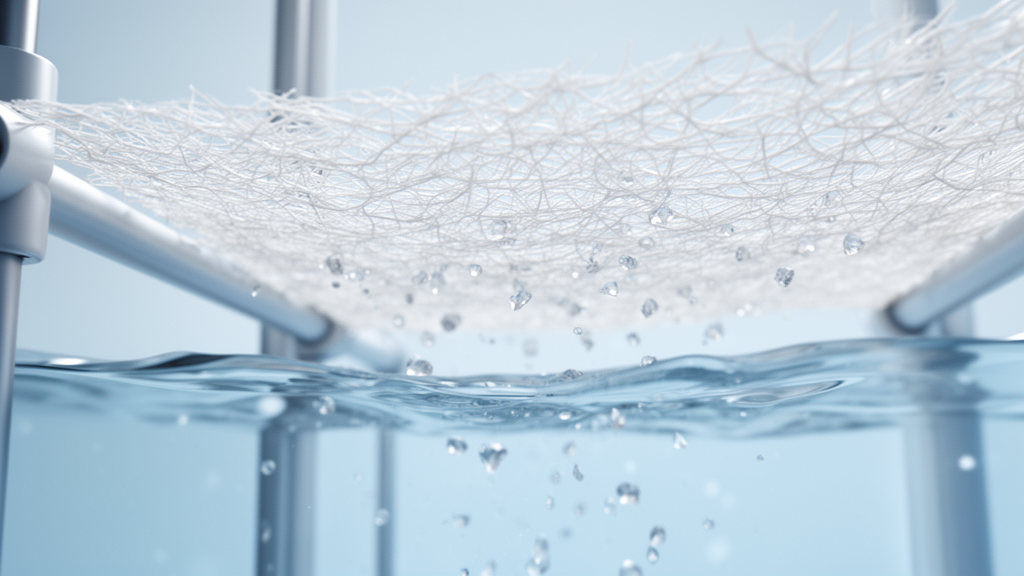
Having identified these shared interfacial features, the team translated them into an engineered material. Using fiber formation and surface chemical modification, they prepared a biomimetic fibrous membrane (b-FM) designed to achieve synergistic regulation of interfacial ion migration, crystal nucleation, and crystal polymorph evolution. Under identical experimental conditions, the crystallization-inducing capacity of the b-FM exceeded that of the best-performing natural eggshell membrane, demonstrating that the natural design principles could be reproduced and even improved upon in a synthetic system.
The practical motivation for this work lies in a persistent industrial problem: calcium carbonate scale in circulating cooling water. Scale readily increases the heat transfer resistance of heat exchange equipment and the flow resistance of pipelines, degrading system performance and raising energy costs. The research team instead sought a shift from passive inhibition to active crystallization regulation, guiding minerals to preferentially deposit on the biomimetic membrane surface rather than on critical equipment surfaces.
In a continuous 30-day circulation experiment, the treatment system effectively reduced water hardness and kept the loss of effective flow cross-sectional area of different metal pipelines within 2%. The experiment demonstrates the concept in a circulating cooling-water setting; broader deployment in industrial systems would require further validation at larger scales.
The study, whose first author is doctoral student Zhaoyu Chen of Chongqing University, established a link between biomineralization and the mass transfer and crystallization regulation problems of energy and chemical engineering. By revealing, through cross-species comparison, the common principles by which eggshell membranes promote mineralization, and then translating those principles into an interfacial design method for artificial biomimetic materials, the work offers new ideas for low-energy water treatment, scaling prevention and control in heat exchange systems, and engineering applications of biomineralization mechanisms.
The team especially thanks Chongqing Zoo for its support in the collection and acquisition of avian eggshell samples, which provided important support for the study.
From a scientific standpoint, the work illustrates how a comparative biological observation can mature into an engineering design rule. The identification of shared features across 33 species, fibrous architecture, amino acid composition, and surface charge, provided a mechanistic basis for controlling where and how crystals form. The biomimetic membrane then applies those rules to direct crystallization at a designated interface, turning a natural phenomenon into a controllable process for water treatment.
As energy and power systems continue to grapple with scaling and the energy costs of water softening, the study suggests that answers may be found in structures as ordinary as the membrane lining an eggshell. The paper, titled “Membrane-induced eggshell biomineralization towards controllable crystallization,” is published in National Science Review (DOI: 10.1093/nsr/nwag672).
Subject of Research: Eggshell membrane biomineralization and its translation into a biomimetic crystallization membrane for water treatment
Article Title: From biomineralization to energy applications — Chinese researchers decode the natural wisdom hidden in avian eggshell membranes | An NSR paper
Article References: From biomineralization to energy applications — Chinese researchers decode the natural wisdom hidden in avian eggshell membranes | An NSR paper. Original publication (Bibliographic details unavailable.)
Image Credits: AI Generated
DOI: Not provided
Keywords: biomineralization, eggshell membrane, calcium carbonate, crystallization, biomimetic membrane, water softening, scaling control, cooling water, National Science Review, Chongqing University, Hong Kong Polytechnic University, heat exchangers
News Source: Bethany Barker. (October 29, 2026). Eggshell membranes inspire biomimetic membrane for low-energy water softening and pipe scaling control. Scienmag.