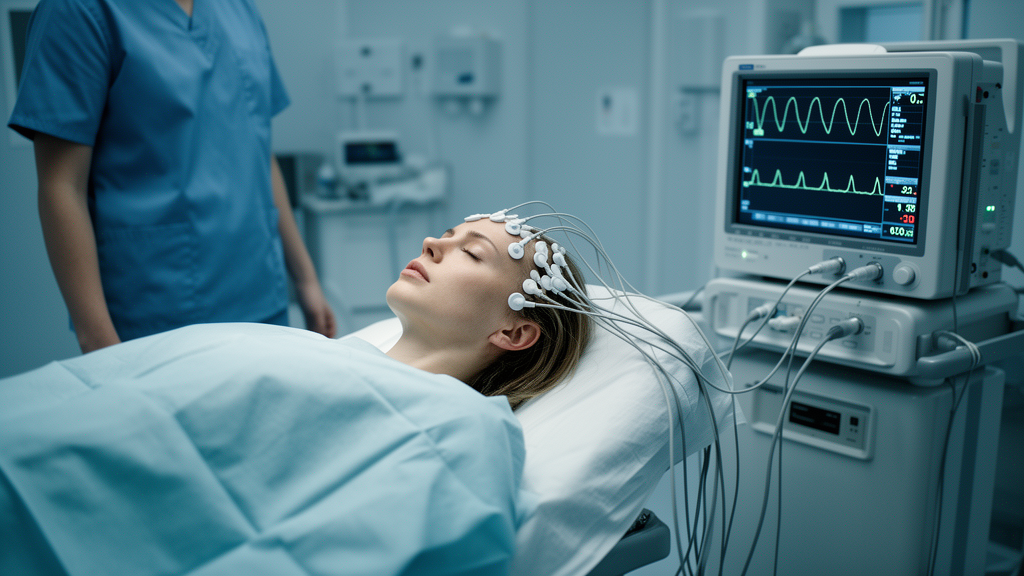
A large scoping review published in BMC Biomedical Engineering has mapped how the processed electroencephalography (EEG) indices used in operating rooms around the world relate to mathematically defined entropy measures of brain signal complexity. The review, conducted according to the PRISMA-ScR reporting guideline, included 93 studies spanning surgical patients, non-surgical volunteers, intensive care unit (ICU) patients, and animal models, and its central message is that commercial depth-of-anesthesia monitors and theoretical entropy metrics capture overlapping but not identical dimensions of cortical dynamics during anesthesia.
Processed EEG monitors such as the bispectral index (BIS), the patient state index (PSI), and the Conox system, which produces qCON for hypnotic depth and qNOX for nociceptive response, translate complex neural signals into simplified numerical indices that reflect the level of consciousness. Each system relies on proprietary algorithms that integrate EEG features such as spectral power, bispectral phase coupling, and signal complexity to produce a unitless value between 0, corresponding to an isoelectric EEG, and 100, corresponding to an awake state. These indices have been extensively validated for guiding anesthetic titration, but the lack of transparency in their algorithms makes it difficult to understand how they work and to compare results across devices.
Entropy-based analyses offer a complementary framework grounded in information theory, in which entropy quantifies the irregularity, unpredictability, or complexity of neural oscillations. Measures such as approximate entropy (ApEn), sample entropy (SampEn), and permutation entropy (PE) have been shown to decrease systematically with increasing anesthetic depth, reflecting the transition from complex, high-dimensional cortical dynamics to more synchronized, low-dimensional states. A complication is that the commercially available GE Entropy module computes state entropy (SE) and response entropy (RE) using entropy-based algorithms, but these indices are derived from simplified or modified implementations of entropy principles rather than direct theoretical measures, and the review classifies them as entropy-based metrics based on their underlying methodology despite their proprietary implementation.
The review team searched PubMed, SCOPUS, EMBASE, the Cochrane Library, and BIOSIS from database inception to May 13, 2025. From 6,616 initially identified studies, 927 duplicates were removed and 5,555 were excluded after title and abstract screening, leaving 134 studies for full-text review. Of these, 86 met the eligibility criteria and 46 were excluded as out of scope, and 7 additional studies were identified through reference list screening, for a total of 93 included studies. To qualify, an article had to directly compare a commercial EEG monitor with a non-processed entropy measure, and studies that were non-English, not full length, or lacking a quantitative comparison were excluded. Because of significant variability in study designs and outcomes, meta-analysis was excluded, and consistent with scoping review methodology no formal risk of bias assessment was undertaken, a limitation the authors flag for readers interpreting the findings.
The included studies covered adult, pediatric, and veterinary populations under a variety of anesthetic agents including propofol, sevoflurane, desflurane, and opioids. Most studies were conducted in clinical settings, with smaller numbers in volunteer, cadaver, or experimental settings. In the surgical literature, 49 studies involved general surgery patients, 15 involved abdominal or pelvic surgery, nine involved cardiac or thoracic surgery, two involved orthopedic surgery, five involved neurosurgical or spine procedures, and one involved neck surgery. Across the majority of general surgical studies, BIS and entropy-based indices were consistently correlated, with several studies demonstrating strong BIS-entropy correlations ranging between 0.8 and 0.96 and comparable abilities to track loss and recovery of consciousness, though BIS tended to show slightly higher sensitivity to propofol concentration and muscle activity.
Agreement between the indices was often imperfect. One study reported strong correlation but poor absolute agreement between BIS and entropy measures, and another found that one-quarter of paired BIS-SE values crossed clinical thresholds. Age emerged as a significant factor: in elderly patients, consistency between indices decreased and baseline index values were higher, and separate studies observed age-related increases in BIS and Lempel-Ziv complexity alongside reduced alpha power. Pediatric populations showed greater variability, with one study reporting weaker BIS correlations in infants compared with SE and RE, and another finding reduced reliability of both BIS and SE in children with cerebral palsy compared with healthy controls, indicating that neurodevelopmental factors affect EEG index interpretation.
Artifact behavior differed systematically between the index families. BIS was highly sensitive to electromyographic (EMG) contamination, while SE and RE were more resistant, and SE was also less affected by electrocautery and artifact-related fluctuations. Neuromuscular blocking agents such as rocuronium and atracurium reduced RE and BIS more than SE, suggesting differential susceptibility to muscle activity. Entropy indices were generally more reactive to clinical events such as intubation, movement, and position change. Across anesthetic types, propofol-based anesthetics tended to produce closer BIS-entropy agreement than other agents, and BIS correlated more strongly with propofol effect-site concentrations than entropy did. Novel entropy-derived metrics, including SampEn, transfer entropy, phase lag entropy, and depth of anesthesia index or frequency-band SE indices, demonstrated comparable or superior performance to BIS for detecting transitions in consciousness, although BIS remained the most widely validated index, with studies confirming that all measures effectively distinguished consciousness from unconsciousness.
Sub-specialty populations added contextual nuance. In elderly neck surgery patients under unguided anesthesia, BIS and RE showed limited consistency, with both indices frequently outside recommended ranges. In abdominal and gynecologic populations, BIS better predicted loss of consciousness while RE better reflected recovery and eye opening, and some studies observed slightly superior predictive performance for SE over BIS. Cardiac surgery studies showed moderate correlations, but clinical reliability was limited under hypothermia or cardiopulmonary bypass, where SE and RE were more resistant to artifacts while in one study BIS remained stable as SEF95 and ApEn declined during late bypass, reflecting altered cortical dynamics. In neurosurgical and spine procedures, BIS, SE, and RE showed strong correlations with prediction probabilities near 0.9 for distinguishing anesthesia stages, though entropy values sometimes overlapped between conscious and unconscious states in these patients.
Non-surgical and animal evidence largely reinforced the human surgical findings. In volunteer studies, ApEn and PE tracked anesthetic depth comparably or more accurately than BIS, with ApEn more sensitive to changes in propofol concentration and PE performing as well as BIS while exceeding SE and ApEn in distinguishing anesthesia depth; BIS and ApEn also shared nearly identical dose-response profiles to propofol and remifentanil. In ICU sedation, all indices were strongly correlated, with BIS showing marginally superior predictive performance, and SE more reliably detected return of consciousness than BIS during electroconvulsive therapy recovery. However, large inter- and intra-individual variability under different sedatives, including remifentanil, midazolam, and dexmedetomidine, complicated sedation assessment with all indices, and small homogeneous volunteer samples limited generalizability. In animal models, response entropy more closely matched BIS than SE in isoflurane- and medetomidine-anesthetized horses, while in rabbits PE and composite multiscale permutation entropy strongly correlated with plasma propofol concentrations, and both PE and the index of consciousness reliably reflected anesthesia depth under propofol and isoflurane with high prediction probabilities.
The review’s authors conclude that commercially processed EEG indices and theoretical entropy measures capture overlapping but distinct dimensions of cortical dynamics during anesthesia, and that while both reliably track transitions in consciousness, discrepancies arise from differences in signal filtering, algorithm design, and physiological variability. Algorithmic opacity remains a major obstacle, since commercial systems apply undisclosed preprocessing, weighting, and artifact rejection parameters that may nonlinearly distort underlying entropy relationships, and BIS and entropy indices can yield opposing values even under identical anesthetic concentrations, likely reflecting differences in filtering strategies and algorithmic delays. Clinically, the authors recommend interpreting EEG-derived indices within the broader clinical context of patient age, neurological status, and anesthetic regimen, cautioning that no single index should be relied upon in isolation and that discrepancies between indices should prompt consideration of EMG interference, drug effects, or signal quality. Future research, they argue, should prioritize transparent algorithmic frameworks and standardized entropy computation to enhance the interpretability and cross-device comparability of EEG-derived anesthesia monitors.
Subject of Research: Relationship between commercial processed EEG anesthesia depth indices and entropy-based EEG metrics
Article Title: Comparative analysis of processed EEG indices and entropy-based metrics for assessing anesthetic depth: a scoping review – PRISMA-ScR
Article References: Vakitbilir, N., Ryznar, J., Roca, V., Bergmann, T., Herath, I., Hasan, R., Stein, K. Y., Sainbhi, A. S., Silvaggio, N., Hayat, M., Moon, J., & Zeiler, F. A. (2026). Comparative analysis of processed EEG indices and entropy-based metrics for assessing anesthetic depth: a scoping review – PRISMA-ScR. BMC Biomedical Engineering, 8(1), Article 7. https://doi.org/10.1186/s42490-026-00112-z
Image Credits: AI Generated
DOI: 10.1186/s42490-026-00112-z
Keywords: EEG, anesthetic depth, bispectral index, entropy, state entropy, response entropy, approximate entropy, permutation entropy, PRISMA-ScR, scoping review, patient state index, electromyographic artifacts
News Source: Cassandra Pierce. (October 29, 2026). EEG monitors and entropy measures track anesthesia depth, review finds. Scienmag.