Researchers in Salamanca, Spain, have laid out a detailed plan for a randomized controlled trial testing whether a home-based mindfulness program guided by real-time brainwave feedback from a consumer EEG headband can reduce the burden of episodic migraine. The protocol, published in Frontiers in Digital Health, describes the Neurofeedback-Assisted Mindfulness Training Program, or NAMTP, as an add-on to standard care for adults whose migraines strike on five to fourteen days each month. Because the study is registered and its methods are specified in advance, the article reports a planned investigation rather than results; no efficacy findings yet exist. Still, the design aims to bring a low-cost, commercially available neurofeedback device into rigorous clinical evaluation for a condition ranked among the world’s most disabling.
The clinical stakes are considerable. Migraine is currently ranked as the second leading cause of disability worldwide and the first among women aged 15 to 49 years. Population-based studies in Spain estimate a prevalence close to 12.6 percent, with a marked sex difference: 17.2 percent of women compared with 8.0 percent of men. International epidemiological estimates place the global prevalence at around 14.0 percent, affecting roughly 15.5 percent of women and 7.4 percent of men. Beyond the attacks themselves, the condition carries a broad spectrum of vascular and psychiatric comorbidities, including elevated risks of ischemic and hemorrhagic stroke, subclinical brain lesions, ischemic heart disease, peripheral artery disease, depression, anxiety, bipolar disorder, attention deficit disorder, and increased suicide risk. Absenteeism and reduced work performance rise directly with the number of headache days per month, and migraine accounts for 66.2 percent of healthcare center visits among affected individuals. In Spain, living with migraine is associated with an approximate 1.7-fold increase in healthcare costs per patient.
Pharmacological treatment, while advancing, remains constrained. The protocol’s authors note that drug options are limited by efficacy, tolerability, contraindications, and adverse effects, and that inappropriate medication use can itself trigger medication-overuse headache, compounding the disease burden. This has fueled interest in non-pharmacological approaches, particularly neuromodulation-based interventions. Neurofeedback is a form of biofeedback that records brain activity through imaging techniques and feeds that information back to the user, allowing gradual control and regulation of brain activity patterns through principles of operant conditioning. Real-time brain signals can be captured with magnetic resonance imaging, functional near-infrared spectroscopy, or electroencephalography, with EEG the most widely used in neurofeedback because of its lower cost, accessibility, and ease of clinical implementation.
The evidence base for mindfulness in headache care is nuanced. In a benchmark active-controlled randomized trial, Wells and colleagues demonstrated that Mindfulness-Based Stress Reduction did not reduce monthly migraine frequency significantly more than enhanced headache education, although it produced meaningful improvements in migraine-related disability, health-related quality of life, self-efficacy, pain catastrophizing, and depressive symptoms. That distinction motivates the new trial: mindfulness appears to mitigate the affective and functional burden of migraine, and pairing it with real-time EEG feedback represents an unexplored strategy to potentially enhance behavioral self-regulation and optimize both headache frequency and patient-reported outcomes. Neurofeedback-assisted mindfulness interventions have shown promising results in reducing perceived stress, anxiety, depression, fatigue, and insomnia while improving resilience and neurophysiological markers of deeper relaxation. In migraine specifically, a randomized trial by Golshan and colleagues using EEG-based neurofeedback observed significant improvement in self-efficacy for disease management, but no clear benefits in disability or attack severity compared with a control group.
The new trial will enroll 66 adults diagnosed with medium-to-high-frequency episodic migraine, defined strictly as 5 to 14 monthly migraine days and fewer than 15 total monthly headache days, confirmed prospectively over a four-week baseline diary period. Participants must maintain at least 80 percent diary compliance, or at least 22.5 logged days, to qualify for randomization. Recruitment will take place at the neurology outpatient clinics of the University Hospital of Salamanca and the Hospital of Ávila, with diagnosis according to the ICHD-3 criteria of the International Headache Society. Exclusion criteria screen out chronic migraine, medication-overuse headache, severe psychiatric disorders treated within the past six months, severe cognitive impairment, and structural brain lesions or conditions contraindicating EEG headband use. The sample size, calculated with Epidat 4.2 software, assumes 33 participants per arm, an alpha risk of 0.05, statistical power above 0.80, and a common standard deviation of 4.8 days to detect a difference of 3.6 or more migraine days per month, a target aligned with or exceeding the minimal clinically important difference in episodic migraine trials, with a 15 percent allowance for follow-up loss.
Randomization will use permuted blocks of variable sizes of four and six, with allocation concealed until inclusion. The investigator generating the sequence will not collect data or assess outcomes, follow-up assessors will remain blinded to group assignment throughout the study, participants will be instructed not to reveal their allocation, and statistical analysis will be performed blind to allocation. Both groups continue their standard routine care. To prevent pharmacological confounding, candidates using preventive migraine medication must have been on a stable regimen and dosage for at least three months before the baseline period and must keep it unchanged for the 24-week trial unless clinically mandatory, with all medication use logged at every follow-up milestone. The intervention group will complete 60 sessions over three months, five sessions per week, each lasting 15 to 20 minutes, performed at home in a quiet, private room in a comfortable seated position with eyes closed. The control group receives no device and no meditation guidance during the intervention period.
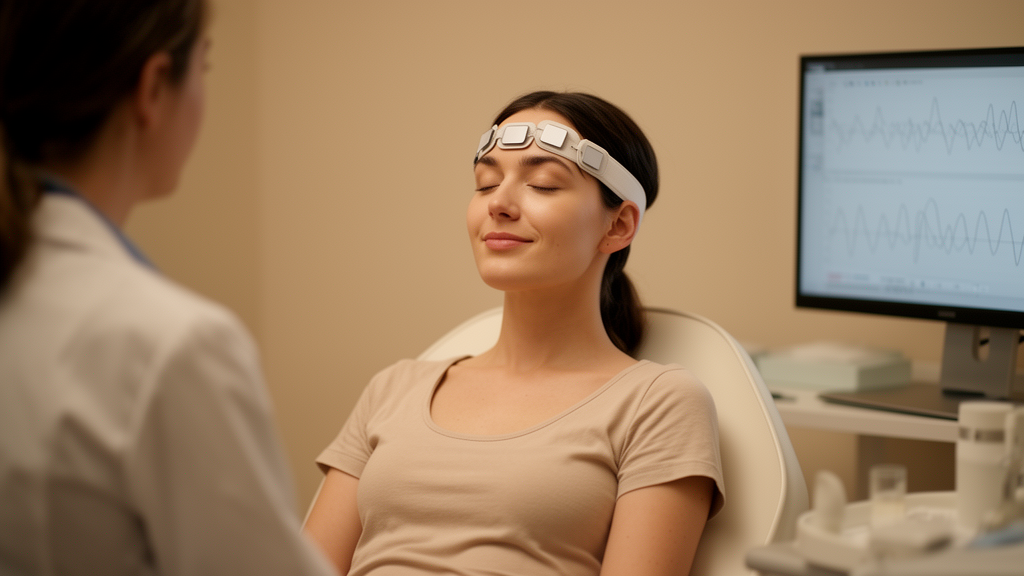
The technology at the heart of the program is the Muse headband by InteraXon, a surface EEG interface for real-time monitoring of cortical activity and cognitive self-regulation training. The trial will use the Muse 2 and Muse S models, which share the same sensors but differ in ergonomics, the latter being an elastic fabric band that also permits sleep monitoring. Seven dry conductive sensors placed according to the International 10-20 system record EEG from four channels: two over the prefrontal cortex at AF7 and AF8, two in temporal positions at TP9 and TP10 posterior to the pinnae, one active reference at the mid-frontal Fpz location, and two auxiliary ground and reference electrodes on the forehead to optimize signal quality. Signals travel by Bluetooth to a mobile application, where machine learning algorithms analyze brainwaves in the delta, theta, alpha, beta, and gamma bands to categorize mental state as calm, active, or neutral. The calm state is characterized by a rhythmic, stable signal with alpha predominance, and previous studies have established these markers as reliable behavioral correlates of attentional control and mindfulness engagement, showing reductions in mind-wandering.
The feedback loop is auditory. When the device detects calm states, it delivers positive reinforcement in the form of pleasant, harmonic sounds; when it identifies rising beta activity associated with loss of attentional focus, it produces more intense sounds that cue the user to redirect attention. During onboarding, participants learn that quiet weather and bird sounds indicate a calm mental state, while intensified wind signals mind-wandering. The first two sessions use beginner programs from the application, after which unguided sessions targeting stress coping, performance, and mind and posture begin from the third session onward. After each session, the application generates a report including duration, time spent in each mental state, heart rate, and posture, with key metrics including recoveries, the number of times the user restored attentional focus after mind-wandering, and birds, representing periods of sustained attention exceeding five seconds. Participants complete a paper log after each session, and adherence is quantified through these reports tracking completed sessions out of the 60 prescribed and weekly practice frequency.
Measurement spans the multidimensional nature of the disease. The powered primary outcome is the change in monthly migraine days, recorded prospectively in a continuous daily headache diary across 28-day windows at baseline, 12 weeks, and 24 weeks post-randomization, alongside monthly headache days, discrete attacks, acute medication use, and a monthly cumulative pain index calculated as the sum of headache duration in hours multiplied by daily peak pain on a 0 to 100 millimeter visual analog scale, divided by 100. Secondary outcomes include the Migraine Disability Assessment questionnaire, which grades disability from little or none at 0 to 5 points to severe at 21 or more; the Headache Impact Test, scoring 36 to 78 points with 60 or more indicating severe impact; sleep measured objectively by five consecutive days of wrist-worn ActiGraph GT3X+ accelerometry capturing total sleep time, sleep efficiency, and wake after sleep onset, and subjectively by the Pittsburgh Sleep Quality Index; quality of life via the 14-item Migraine-Specific Quality of Life Questionnaire version 2; and mood symptoms via the Beck Depression Inventory-II and the State-Trait Anxiety Inventory. Potential triggers such as stress, sleep disturbances, diet, physical activity, and menstrual cycle phase will be logged daily, and adverse events including transient headache exacerbation, meditation-related distress, and device-related skin discomfort will be systematically monitored, with serious events reported to the ethics committee within 24 hours.
Analysis will employ linear mixed models in SPSS version 29.0, with group, time, and their interaction as fixed effects, adherence as a covariate, and participants as random intercepts, an approach chosen for handling longitudinal missing data under the missing-at-random assumption without artificial imputation. Formal significance testing will be reserved for the powered primary outcome, while secondary outcomes will emphasize point estimates, 95 percent confidence intervals, and Cohen’s d effect sizes. Major preventive medication changes will be treated as intercurrent events under the ICH E9 (R1) guideline, with the primary estimand reflecting an intention-to-treat approach and a prespecified per-protocol sensitivity analysis excluding post-modification data. The authors are candid about limitations: the open-label design cannot fully exclude expectation or placebo effects because sham blinding is unfeasible, the pragmatic comparison cannot isolate EEG neurofeedback from the mindfulness and digital-tracking components of the package, and no quantitative EEG mapping was included, so the device’s proprietary calm score relies on internal algorithmic outputs rather than primary spectral analysis. The week-24 assessment, falling 12 weeks after active training ends, is specifically designed to test whether gains persist without ongoing device feedback. The protocol was approved by the Drug Research Ethics Committee of the Salamanca Health Area on July 30, 2025, and registered at ClinicalTrials.gov as NCT07661888 on June 22, 2026.
Subject of Research: A randomized controlled trial protocol testing neurofeedback-assisted mindfulness training for episodic migraine
Article Title: Effect of neurofeedback-assisted mindfulness training on migraine severity, associated disability, sleep quality, and emotional distress: protocol for a randomized controlled trial
Article References: Zahri-Haidar, C., Garcia-Yu, I. A., Sanchez-Sanchez, N., Gonzalez-Sanchez, J., Lee, H.-C., Alejos-Herrera, V., Iglesias-Sierra, V., Lu, H.-C., & Recio-Rodriguez, J. I. (2026). Effect of neurofeedback-assisted mindfulness training on migraine severity, associated disability, sleep quality, and emotional distress: protocol for a randomized controlled trial. Frontiers in Digital Health, 8, Article 1962535. https://doi.org/10.3389/fdgth.2026.1962535
Image Credits: AI Generated
DOI: 10.3389/fdgth.2026.1962535
Keywords: migraine, neurofeedback, mindfulness, EEG, randomized controlled trial, episodic migraine, digital health, sleep quality, headache disability, non-pharmacological therapy, study protocol, Muse headband
News Source: Glenn Wilkins. (October 26, 2026). EEG Headband Trial Will Test Whether Neurofeedback Mindfulness Can Ease Migraine Burden. Scienmag.