Tokyo, Japan – It’s well known that obesity is linked to the development of numerous diseases in humans. Heart disease, diabetes, and other ailments are extremely common in obese individuals. However, it’s not fully clear how body organs specifically deteriorate and lose functionality from chronic obesity. In a recent article published in Nature, a group of researchers from Tokyo Medical and Dental University (TMDU) used mouse model experiments to examine how a high-fat diet or genetically induced obesity can affect hair thinning and loss. The authors found that obesity can lead to depletion of hair follicle stem cells (HFSCs) through the induction of certain inflammatory signals, blocking hair follicle regeneration and ultimately resulting in loss of hair follicles.
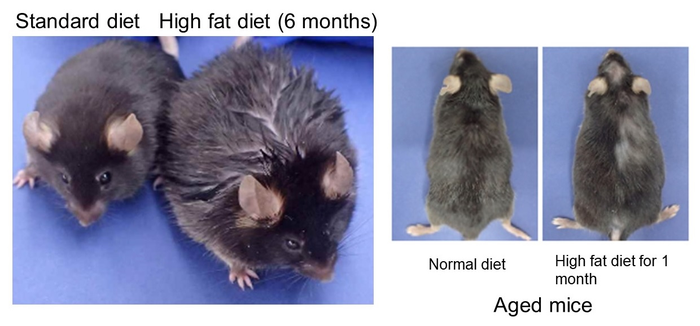
Credit: Department of Stem Cell Biology, TMDU
Tokyo, Japan – It’s well known that obesity is linked to the development of numerous diseases in humans. Heart disease, diabetes, and other ailments are extremely common in obese individuals. However, it’s not fully clear how body organs specifically deteriorate and lose functionality from chronic obesity. In a recent article published in Nature, a group of researchers from Tokyo Medical and Dental University (TMDU) used mouse model experiments to examine how a high-fat diet or genetically induced obesity can affect hair thinning and loss. The authors found that obesity can lead to depletion of hair follicle stem cells (HFSCs) through the induction of certain inflammatory signals, blocking hair follicle regeneration and ultimately resulting in loss of hair follicles.
Normally, HFSCs self-renew every hair follicle cycle. This is part of the process that allows our hair to continuously grow back. As humans age, HFSCs fail to replenish themselves leading to fewer HFSCs and therefore hair thinning. Although overweight people has higher risk of androgenic alopecia, whether obesity accelerates hair thinning, how and the molecular mechanisms have been largely unknown. The TMDU group aimed to address those qeustions and identified some of the mechanisms.
“High-fat diet feeding accelerates hair thinning by depleting HFSCs that replenish mature cells that grow hair, especially in old mice. ” says lead author of the study Hironobu Morinaga. “We compared the gene expression in HFSCs between HFD-fed mice and standard diet-fed mice and traced the fate of those HFSCs after their activation. “We found that those HFSCs in HFD-fed obesed mice change their fate into the skin surface corneocytes or sebocytes that secrete sebum upon their activation. Those mice show faster hair loss and smaller hair follicles along with depletion of HFSCs”.
“Even with HFD feeding in four consecutive days, HFSCs shows increased oxidative stress and the signs of epidermal differentiation.”
“The gene expression in HFSCs from the high-fat–fed mice indicated the activation of inflammatory cytokine signaling within HFSCs” describes Emi K. Nishimura, senior author. “The inflammatory signals in HFSCs strikingly repress Sonic hedgehog signaling that plays crucial role in hair follicle regeneration in HFSCs.
The researchers confirmed the activation of the Sonic hedgehog signaling pathway in this process can rescue the depletion of HFSCs. “This could prevent the hair loss brought on by the high-fat diet. “said Nishimura.
This study provides interesting new insights into the specific cellular fate changes and tissue dysfunction that can occur following a high-fat diet or genetically induced obesity and may open the door for future prevention and treatment of hair thinning as well as for understanding of obesity-related diseases.
###
The article, “Obesity accelerates hair thinning by stem cell-centric converging mechanisms,” was published in Nature at DOI: 10.1038/s41586-021-03624-x
Journal
Nature
DOI
10.1038/s41586-021-03624-x
Article Title
Obesity accelerates hair thinning by stem cell-centric converging mechanisms