• HOME
  • NEWS
  • EXPLORE
    • CAREER
      • Companies
      • Jobs
    • EVENTS
    • iGEM
      • News
      • Team
    • PHOTOS
    • VIDEO
    • WIKI
  • BLOG
  • COMMUNITY
    • FACEBOOK
    • INSTAGRAM
    • TWITTER
Wednesday, May 13, 2026
BIOENGINEER.ORG
No Result
View All Result
  • Login
  • HOME
  • NEWS
  • EXPLORE
    • CAREER
      • Companies
      • Jobs
        • Lecturer
        • PhD Studentship
        • Postdoc
        • Research Assistant
    • EVENTS
    • iGEM
      • News
      • Team
    • PHOTOS
    • VIDEO
    • WIKI
  • BLOG
  • COMMUNITY
    • FACEBOOK
    • INSTAGRAM
    • TWITTER
  • HOME
  • NEWS
  • EXPLORE
    • CAREER
      • Companies
      • Jobs
        • Lecturer
        • PhD Studentship
        • Postdoc
        • Research Assistant
    • EVENTS
    • iGEM
      • News
      • Team
    • PHOTOS
    • VIDEO
    • WIKI
  • BLOG
  • COMMUNITY
    • FACEBOOK
    • INSTAGRAM
    • TWITTER
No Result
View All Result
Bioengineer.org
No Result
View All Result
Home NEWS Science News Chemistry

Earth faster, closer to black hole in new map of galaxy

Bioengineer by Bioengineer
November 30, 2020
in Chemistry
Reading Time: 2 mins read
0
IMAGE
Share on FacebookShare on TwitterShare on LinkedinShare on RedditShare on Telegram

IMAGE

Credit: NAOJ

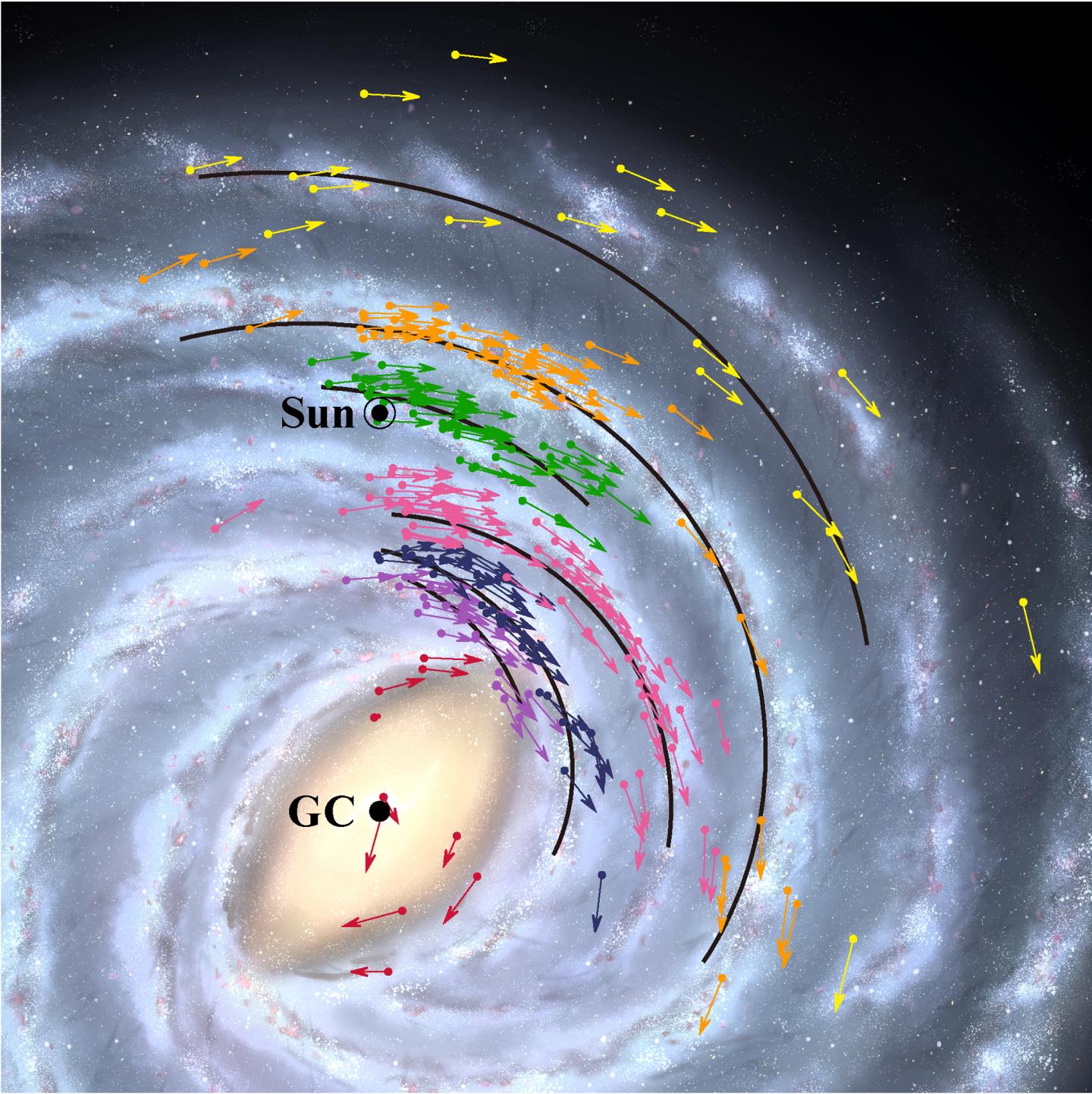
Earth just got 7 km/s faster and about 2000 light-years closer to the supermassive black hole in the center of the Milky Way Galaxy. But don’t worry, this doesn’t mean that our planet is plunging towards the black hole. Instead the changes are results of a better model of the Milky Way Galaxy based on new observation data, including a catalog of objects observed over the course of more than 15 years by the Japanese radio astronomy project VERA.

VERA (VLBI Exploration of Radio Astrometry, by the way “VLBI” stands for Very Long Baseline Interferometry) started in 2000 to map three-dimensional velocity and spatial structures in the Milky Way. VERA uses a technique known as interferometry to combine data from radio telescopes scattered across the Japanese archipelago in order to achieve the same resolution as a 2300 km diameter telescope would have. Measurement accuracy achieved with this resolution, 10 micro-arcseconds, is sharp enough in theory to resolve a United States penny placed on the surface of the Moon.

Because Earth is located inside the Milky Way Galaxy, we can’t step back and see what the Galaxy looks like from the outside. Astrometry, accurate measurement of the positions and motions of objects, is a vital tool to understand the overall structure of the Galaxy and our place in it. This year, the First VERA Astrometry Catalog was published containing data for 99 objects.

Based on the VERA Astrometry Catalog and recent observations by other groups, astronomers constructed a position and velocity map. From this map they calculated the center of the Galaxy, the point that everything revolves around. The map suggests that the center of the Galaxy, and the supermassive black hole which resides there, is located 25800 light-years from Earth. This is closer than the official value of 27700 light-years adopted by the International Astronomical Union in 1985. The velocity component of the map indicates that Earth is travelling at 227 km/s as it orbits around the Galactic Center. This is faster than the official value of 220 km/s.

Now VERA hopes to observe more objects, particularly ones close to the central supermassive black hole, to better characterizes the structure and motion of the Galaxy. As part of these efforts VERA will participate in EAVN (East Asian VLBI Network) comprised of radio telescope located in Japan, South Korea, and China. By increasing the number of telescopes and the maximum separation between telescopes, EAVN can achieve even higher accuracy.

###

“The First VERA Astrometry Catalog” by VERA collaboration et al. appeared in Publications of the Astronomical Society of Japan in August 2020.

Media Contact
Dr. Hitoshi Yamaoka
[email protected]

Original Source

https://www.nao.ac.jp/en/news/science/2020/20201126-mizusawa.html

Related Journal Article

http://dx.doi.org/10.1093/pasj/psaa018

Tags: AstronomyAstrophysicsSpace/Planetary ScienceStars/The Sun
Share13Tweet8Share2ShareShareShare2

Related Posts

Liquid-like Behavior Observed in Gold Nanoparticles — Chemistry

Liquid-like Behavior Observed in Gold Nanoparticles

May 13, 2026
Vortex-Induced Triboelectric Nanogenerator Enables Efficient Multidirectional Wind Energy Harvesting in Low Wind and High Humidity Conditions — Chemistry

Vortex-Induced Triboelectric Nanogenerator Enables Efficient Multidirectional Wind Energy Harvesting in Low Wind and High Humidity Conditions

May 13, 2026

Enhanced Cancer Drug Targeting and Efficacy Through Molecular Grappling Hooks

May 13, 2026

Optimized Slurry Processing Paves the Way for Better Batteries

May 13, 2026
Please login to join discussion

POPULAR NEWS

  • Research Indicates Potential Connection Between Prenatal Medication Exposure and Elevated Autism Risk

    842 shares
    Share 337 Tweet 211
  • New Study Reveals Plants Can Detect the Sound of Rain

    728 shares
    Share 290 Tweet 182
  • Salmonella Haem Blocks Macrophages, Boosts Infection

    62 shares
    Share 25 Tweet 16
  • Breastmilk Balances E. coli and Beneficial Bacteria in Infant Gut Microbiomes

    57 shares
    Share 23 Tweet 14

About

We bring you the latest biotechnology news from best research centers and universities around the world. Check our website.

Follow us

Recent News

Effective Parental Support Strategies to Reduce Burnout in Pregnant and Postpartum Trainees

Two Regions, One Virus: Nipah’s Recurrence Unveiled

Machine Learning Predicts Hospital Stay in Pediatric Cardiology

Subscribe to Blog via Email

Enter your email address to subscribe to this blog and receive notifications of new posts by email.

Join 82 other subscribers
  • Contact Us

Bioengineer.org © Copyright 2023 All Rights Reserved.

Welcome Back!

Login to your account below

Forgotten Password?

Retrieve your password

Please enter your username or email address to reset your password.

Log In
No Result
View All Result
  • Homepages
    • Home Page 1
    • Home Page 2
  • News
  • National
  • Business
  • Health
  • Lifestyle
  • Science

Bioengineer.org © Copyright 2023 All Rights Reserved.