


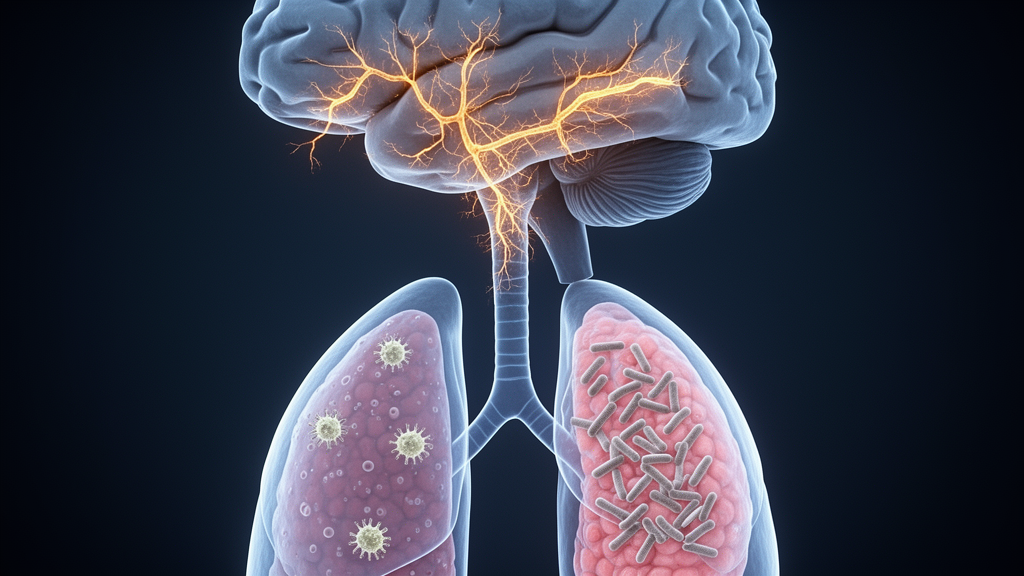
Ventilator-associated pneumonia develops in roughly one third of mechanically ventilated patients with traumatic brain injury, and a new narrative review argues that the timing of the infection matters as much as its occurrence. Writing in Intensive Care Medicine, an international team of intensive care and infectious disease specialists proposes that severe brain injury compresses a set of well-established pneumonia mechanisms into a narrow early window, creating a vulnerable host-microbe state that lowers the threshold at which colonisation becomes clinically apparent infection. The framework is explicitly hypothesis-generating rather than a validated diagnostic tool, but it reframes why pneumonia clusters in the first days after injury and why its effect on mortality varies so widely across studies.
The authors are careful about what they are not claiming. Ventilator-associated pneumonia after traumatic brain injury is not a distinct disease entity, and none of the underlying mechanisms is unique to brain injury. Microaspiration, endotracheal tube biofilm, antibiotic pressure, brain-lung immune crosstalk, immune depression after central nervous system injury, and respiratory microbiome disruption have all been described in general ventilated intensive care populations, including patients with ischaemic stroke and subarachnoid haemorrhage. What may be distinctive about severe traumatic brain injury is the early convergence of these domains: abrupt neurological injury, depressed consciousness, impaired cough and swallowing, frequent emergency intubation, aspiration risk, sedative exposure, pressure-directed therapies, and ventilation initiated for airway protection rather than lung disease.
Cross-diagnostic comparisons support a higher pneumonia burden after brain trauma. In a prospective multicentre cohort of mechanically ventilated patients, pneumonia occurred in 8 percent of patients with brain trauma, compared with 4 percent in haemorrhagic stroke, 4 percent in ischaemic stroke, and 4 percent in non-neurological controls. The more recent ENIO international prospective cohort reported incidence densities of 16.6 episodes per 1000 ventilator-days in traumatic brain injury, against 11.0 in intracerebral haemorrhage, 7.0 in aneurysmal subarachnoid haemorrhage, and 7.1 in ischaemic stroke. The review notes, however, that these comparisons were not designed to isolate the biological contribution of brain injury from differences in injury severity, ventilation duration, and treatment intensity.
Timing is central to the proposed model. In CENTER-TBI, pneumonia occurred in approximately one in five patients and developed at a median of five days. A prospective cohort of 144 mechanically ventilated patients with severe traumatic brain injury recorded early- and late-onset pneumonia in 24.3 percent and 26.4 percent of the overall cohort respectively, with 49.3 percent remaining pneumonia-free. In the TAVeM study, ventilator-associated tracheobronchitis and pneumonia frequently occurred during the first week of mechanical ventilation, and recent microbiome studies in patients intubated for non-pulmonary neurological conditions show early microbial shifts and clustering of infections within the first days. Interventional data point the same way: early ceftriaxone prophylaxis in acute brain injury reduced early pneumonia but did not affect late infections or mortality, and meta-analyses of antibiotic prophylaxis show reduced early pneumonia without an established mortality benefit and with unresolved concerns about selection pressure. These findings identify a short early window rather than justify routine prophylaxis.
The biological core of the framework is neuroimmune-endocrine dysregulation. Acute central nervous system injury can be followed by systemic immune dysregulation involving sympathetic and hypothalamic-pituitary-adrenal activation, release of damage-associated molecular patterns, reduced antigen presentation, lower monocyte HLA-DR expression, altered monocyte and neutrophil function, lymphocyte dysfunction, and impaired pathogen clearance. In severe traumatic brain injury these processes may begin within hours, in parallel with airway-control failure and invasive ventilation. The authors stress that this remains a biologically plausible hypothesis rather than a validated bedside mechanism, and that it must be tested against alternative explanations such as injury severity, polytrauma, aspiration burden, and treatment exposure. The interaction is also bidirectional: pulmonary inflammation can worsen neurological injury, because cytokines released during pneumonia may activate glial cells and promote neuroinflammation, while mechanical ventilation with high airway pressures may influence cerebral perfusion and intracranial pressure.
The lung itself is treated as a dynamic ecological system rather than a passive recipient of aspirated bacteria. During mechanical ventilation, microbial diversity may decrease, bacterial burden may rise, and opportunistic pathogens may expand, sometimes before clinical infection appears. In the longitudinal PULMIVAP cohort, which enrolled patients intubated predominantly for neurological indications, paired upper- and lower-airway sampling showed substantial microbial changes during ventilation. Patients who later developed pneumonia showed a trend towards lower baseline microbial richness and enrichment of potentially pathogenic taxa such as Escherichia-Shigella and Peptoniphilus, whereas Corynebacterium was more abundant in those who remained pneumonia-free. Exploratory analyses linked airway taxa, local inflammatory mediators, and respiratory dysfunction, supporting an early interaction between microbial ecology and host response.
Changing bacteriology fits this sequence. In CENTER-TBI, Staphylococcus aureus was the leading isolate, detected in 80 of 196 pneumonia cases, or 40.8 percent, followed by Haemophilus influenzae at 24.0 percent and Streptococcus pneumoniae at 8.2 percent. Staphylococcus aureus accounted for 161 of 350 cases, or 46.0 percent, in a multicentre cohort of patients with severe brain injury. In a prospective study of 100 intubated patients with head trauma, 68 percent were already tracheally colonised within 24 hours, early-onset pneumonia developed in 26 percent, and Staphylococcus aureus caused 44 percent of isolates. In another cohort of 109 patients with severe head trauma, admission nasal carriage of Staphylococcus aureus, aspiration before intubation, and barbiturate use were independently associated with early-onset pneumonia. The review acknowledges that direct comparative evidence showing greater Staphylococcus aureus predominance in traumatic brain injury than in other early-pneumonia populations remains limited. Late pneumonia, by contrast, more likely reflects biofilm maturation, antibiotic selection, loss of microbial diversity, and multidrug-resistant Gram-negative organisms including Pseudomonas aeruginosa and Enterobacterales, although the authors describe the early-late distinction as probabilistic rather than sharply separated.
Extracranial injury emerges as a critical modifier. In a prospective population-based cohort of patients with severe traumatic brain injury, pneumonia occurred in 45 percent, and patients with polytrauma showed a higher, though not statistically significant, risk than those with isolated head injury, with a risk ratio of 1.7 and a 95 percent confidence interval of 0.9 to 3.1. Complementary trauma data showed post-traumatic pneumonia in 14.8 percent of patients with traumatic brain injury without severe chest injury, 30.8 percent with combined brain and severe chest injury, 26.8 percent with severe chest injury alone, and 10.0 percent with neither. The authors therefore insist that isolated traumatic brain injury and polytrauma be treated as biologically different phenotypes and separated in future studies.
Clinical impact splits cleanly along morbidity and mortality lines. Pneumonia consistently prolongs mechanical ventilation, intensive care and hospital stay, antibiotic exposure, and resource use. Mortality is more heterogeneous: some cohorts report a significant association, but adjusted analyses including CENTER-TBI found no independent association with mortality or six-month neurological outcome, and meta-analyses suggest crude associations attenuate after adjustment for baseline severity and competing risks. The review argues this should not be read as pneumonia lacking lethality; its mortality effect is likely phenotype-dependent, becoming apparent with high pathogen burden, late infection, shock, multidrug-resistant pathogens, or severe pulmonary involvement. Recovery trajectory, ventilator dependence, and rehabilitation delay may be more consistent markers of its burden.
On prevention, the authors keep established measures firmly in place: head-of-bed elevation, oral care, subglottic secretion drainage, sedation minimisation, cuff pressure control, and ventilator liberation. Subglottic secretion drainage reduces pneumonia incidence but shows inconsistent mortality effects, and selective digestive decontamination has only post hoc support in acute brain injury alongside broader resistance concerns. Early risk phenotyping, they conclude, should serve surveillance, trial enrichment, and clinical vigilance in the first 24 to 72 hours, not pre-emptive antimicrobial escalation. No immune- or microbiome-directed intervention can currently be recommended for pneumonia associated with traumatic brain injury outside research settings, and future trials should use endpoints such as ventilator-free days, antibiotic exposure, and functional recovery rather than mortality alone.
Subject of Research: Ventilator-associated pneumonia after traumatic brain injury framed as a timing-sensitive convergence of neuroimmune, airway, and microbial vulnerability
Article Title: Ventilator-associated pneumonia after traumatic brain injury: a timing-sensitive ecological framework of neuroimmune–pulmonary vulnerability
Article References: Martin-Loeches, I., Povoa, P., Robba, C., Bandera, A., Guglielmi, A., & Citerio, G. (2026). Ventilator-associated pneumonia after traumatic brain injury: a timing-sensitive ecological framework of neuroimmune–pulmonary vulnerability. Intensive Care Medicine. https://doi.org/10.1007/s00134-026-08606-z
Image Credits: AI Generated
DOI: 10.1007/s00134-026-08606-z
Keywords: ventilator-associated pneumonia, traumatic brain injury, neuroimmune dysregulation, respiratory microbiome, mechanical ventilation, early-onset infection, polytrauma, Staphylococcus aureus, brain-lung crosstalk, antibiotic prophylaxis, intensive care, host-microbe ecology
News Source: Cassandra Pierce. (October 30, 2026). Early Vulnerability, Not Ventilation Alone, Drives Pneumonia After Brain Injury. Scienmag.



