

• HOME
  • NEWS
  • EXPLORE
    • CAREER
      • Companies
      • Jobs
    • EVENTS
    • iGEM
      • News
      • Team
    • PHOTOS
    • VIDEO
    • WIKI
  • BLOG
  • COMMUNITY
    • FACEBOOK
    • INSTAGRAM
    • TWITTER
Sunday, May 17, 2026
BIOENGINEER.ORG
No Result
View All Result
  • Login
  • HOME
  • NEWS
  • EXPLORE
    • CAREER
      • Companies
      • Jobs
        • Lecturer
        • PhD Studentship
        • Postdoc
        • Research Assistant
    • EVENTS
    • iGEM
      • News
      • Team
    • PHOTOS
    • VIDEO
    • WIKI
  • BLOG
  • COMMUNITY
    • FACEBOOK
    • INSTAGRAM
    • TWITTER
  • HOME
  • NEWS
  • EXPLORE
    • CAREER
      • Companies
      • Jobs
        • Lecturer
        • PhD Studentship
        • Postdoc
        • Research Assistant
    • EVENTS
    • iGEM
      • News
      • Team
    • PHOTOS
    • VIDEO
    • WIKI
  • BLOG
  • COMMUNITY
    • FACEBOOK
    • INSTAGRAM
    • TWITTER
No Result
View All Result
Bioengineer.org
No Result
View All Result
Home Headlines

Early diagnostic imaging to prevent kidney disease

Bioengineer.org by Bioengineer.org
January 23, 2018
in Headlines, Health, Science News
Reading Time: 2 mins read
0
Share on FacebookShare on TwitterShare on LinkedinShare on RedditShare on Telegram
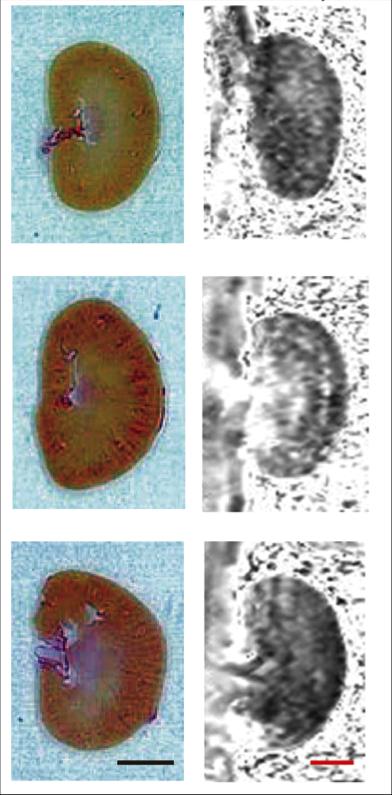
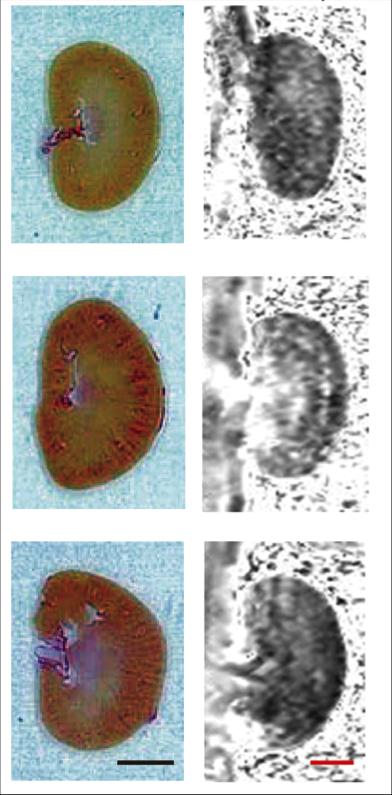
IMAGE

Credit: Osaka University

Osaka University researchers, in collaboration with several Japanese companies, translate neuroimaging tools to study renal fibrosis in rat kidney. The technique is expected to replace the invasive biopsies currently used to identify patients at risk of developing chronic kidney disease.

Diabetes patients are at a high risk of developing chronic kidney disease. To identify which patients have higher risk, non-invasive technologies such as MRI are useful because they can detect abnormal perfusion in the kidneys, which could be signs of renal fibrosis, which is an early sign of kidney failure.

"Diffusion tensor MRI (DTI) is ideal for detecting kidney damage, because the main functions of the kidney are all related to water movement," explains Osaka University Professor and Surgeon Shiro Takahara.

"DTI is used to image brain structures, because the diffusion of water in the white matter of the brain is anisotropic. Water diffusion in the kidney is also anisotropic," he continues.

DTI has been used previously to study kidney pathologies, but with limited success. In their latest studies, Takahara and colleagues at Osaka University incorporate a spin-echo sequence to DTI and a special kidney attachment to observe renal fibrosis in diabetic rats.

The anisotropy of the fluid flow allowed the researchers to construct maps of the different regions of the kidney.

"In DTI, we make fractional anisotropy maps of the kidney. This identifies which regions have renal fibrosis," said Osaka University Associate Professor Jun-Ya Kaimori, who first authored the study.

By preparing maps of specific kidney regions, the scientists could compare which regions showed different kidney fluid dynamics in live diabetic and healthy rats.

"The cortex and outer stripe of the medulla were different," said Kaimori. This distinction not only validated the new method for the detection of renal fibrosis, but also provided a target region when diagnosing diabetic patients.

"The application of non-invasive techniques like MRI will help prevent progression to intractable kidney diseases," he said.

###

The study was conducted in collaboration with Astellas, a pharmaceutical company, and BioView, an imaging company, both located in or around Tokyo.

Media Contact

Saori Obayashi
[email protected]
81-661-055-886
@osaka_univ_e

http://www.osaka-u.ac.jp/en

Original Source

http://resou.osaka-u.ac.jp/en/research/2017/20170718_3 http://dx.doi.org/10.1038/s41598-017-06111-4

Share12Tweet8Share2ShareShareShare2

Related Posts

Noncanonical Sulfur Metabolism, Immunity Altered in Down Syndrome — Technology and Engineering

Noncanonical Sulfur Metabolism, Immunity Altered in Down Syndrome

May 17, 2026

Physical Resilience Linked to Aging Views in Chinese Elders

May 17, 2026

Tau T205 Phosphorylation Controls Memory and Engrams

May 17, 2026

Phocaeicola dorei Eases Liver Fibrosis via Efferocytosis

May 17, 2026
Please login to join discussion

POPULAR NEWS

  • Research Indicates Potential Connection Between Prenatal Medication Exposure and Elevated Autism Risk

    844 shares
    Share 338 Tweet 211
  • New Study Reveals Plants Can Detect the Sound of Rain

    730 shares
    Share 291 Tweet 182
  • Salmonella Haem Blocks Macrophages, Boosts Infection

    62 shares
    Share 25 Tweet 16
  • Breastmilk Balances E. coli and Beneficial Bacteria in Infant Gut Microbiomes

    58 shares
    Share 23 Tweet 15

About

We bring you the latest biotechnology news from best research centers and universities around the world. Check our website.

Follow us

Recent News

Noncanonical Sulfur Metabolism, Immunity Altered in Down Syndrome

Physical Resilience Linked to Aging Views in Chinese Elders

Tau T205 Phosphorylation Controls Memory and Engrams

Subscribe to Blog via Email

Enter your email address to subscribe to this blog and receive notifications of new posts by email.

Join 82 other subscribers
  • Contact Us

Bioengineer.org © Copyright 2023 All Rights Reserved.

Welcome Back!

Login to your account below

Forgotten Password?

Retrieve your password

Please enter your username or email address to reset your password.

Log In
No Result
View All Result
  • Homepages
    • Home Page 1
    • Home Page 2
  • News
  • National
  • Business
  • Health
  • Lifestyle
  • Science

Bioengineer.org © Copyright 2023 All Rights Reserved.
