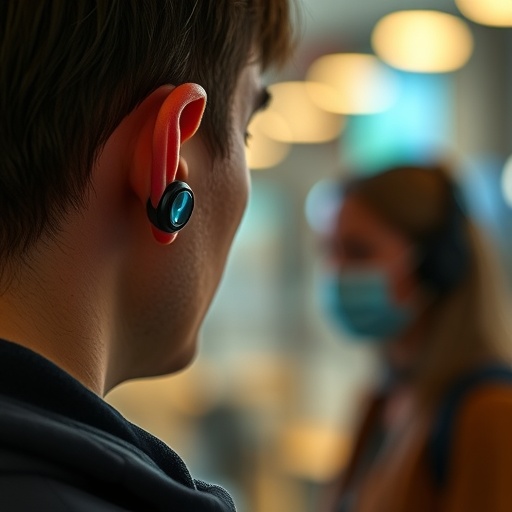
In a groundbreaking leap for wearable technology, University of Washington researchers have unveiled VueBuds, an innovative system that embeds miniature cameras into off-the-shelf wireless earbuds, enabling real-time interaction with an AI model that interprets the wearer’s immediate visual environment. Unlike bulky augmented reality glasses or headsets, which have struggled to gain widespread adoption due to discomfort and privacy concerns, VueBuds taps into the ubiquity of earbuds to deliver discreet, context-aware intelligence without compromising user privacy or convenience.
VueBuds utilizes tiny, low-power black-and-white cameras about the size of a grain of rice, integrated subtly into earbuds. These cameras capture low-resolution images and transmit them via Bluetooth to a companion device such as a smartphone. Employing edge AI computing, the images are processed locally on the device rather than being uploaded to the cloud, a crucial decision that safeguards user privacy by keeping sensitive visual data off the internet. The model can analyze the scenery in under a second, enabling users to query it about objects or text they encounter, such as requesting translations of foreign language packaging or identifying books and authors.
One of the main technical challenges addressed was balancing image quality, power consumption, and data transmission limits. Cameras inherently draw more power than microphones, so VueBuds’ design embraces grayscale, low-resolution snapshots rather than high-definition video to conserve battery life. This approach also mitigates the bandwidth constraints posed by Bluetooth’s limited streaming capacity. The simple yet effective use of still images sidesteps continuous video streaming, thereby extending the earbuds’ operational duration while maintaining rapid response times.
Another innovation lies in the strategic angling of the earbud cameras. Researchers determined that positioning each camera outward at a 5 to 10-degree angle creates a combined field of view spanning between 98 and 108 degrees. This configuration maximizes the visual coverage without being obstructed by the user’s face. Although there is a minor blind spot for objects held very close—inside about 20 centimeters—it seldom impacts typical user interactions since most people tend to hold objects slightly farther away when examining them.
To enhance processing efficiency and reduce latency, VueBuds employs an image “stitching” technique that merges the two grayscale images from the left and right earbuds into a single composite field of view. This reduces the required inference time from roughly two seconds using separate images down to about one second, an interval that users perceive as virtually instantaneous. This synergy is critical in achieving seamless user experiences where instant feedback is paramount.
The research team conducted a comparative evaluation involving 74 participants who viewed outputs produced by VueBuds alongside those from Ray-Ban Meta Glasses, a state-of-the-art smart eyewear device. Despite VueBuds’ much lower-resolution imaging and stringent privacy controls, its performance was on par with the Ray-Bans, with users favoring VueBuds’ translation responses. The Ray-Bans slightly outperformed in object counting tasks, but VueBuds demonstrated that privacy-focused, low-power solutions could rival high-end devices in many respects.
Further testing with 16 individuals assessing VueBuds’ in situ functionality verified accuracy rates between 83 to 84 percent in translating text and identifying objects, and an impressive 93 percent accuracy in recognizing the author and title of displayed books. Such results underscore VueBuds’ potential as an assistive technology tool, particularly valuable for individuals with low vision or blindness, or travelers requiring instant language translation on the go.
However, due to its current reliance on grayscale imaging, VueBuds cannot handle queries involving color detection or differentiation—a limitation the developers plan to address in future iterations. Adding color sensors will increase power demands, necessitating further hardware and AI model optimizations to maintain the lightweight, low-energy profile essential for earbuds.
This pioneering work not only demonstrates the feasibility of incorporating visual sensing into common wearable audio devices but also opens avenues toward specialized AI applications. By training tailored models for discrete tasks such as text translation or object recognition optimized for the earbud camera’s capabilities, VueBuds promises to transform everyday auditory accessories into powerful multimodal interfaces.
Senior author Professor Shyam Gollakota highlighted the significance of this innovation within the broader wearable tech landscape, emphasizing how VueBuds circumvents the adoption barriers of smart glasses. With ears being socially and ergonomically more acceptable than glasses, and with strict privacy protections on local processing and data management, VueBuds sets a new standard for invisible computing embedded in the accessories people already use.
The system’s design is intentionally mindful of privacy: a visible indicator light activates when the camera is recording, and users have immediate control to delete any captured images, instilling transparency and user trust. This contrasts with some prior smart glasses models whose cloud-dependent architectures raised concerns about unauthorized video recording and remote data storage.
Looking forward, the team aims to enhance the system’s capabilities further by integrating color vision, extending battery longevity, refining AI processing algorithms, and tailoring the platform to real-world user scenarios, especially assistive technologies for visually impaired populations and multilingual travelers. The hope is that VueBuds can transition from a proof-of-concept into a versatile consumer product that redefines personal digital assistants by blending auditory and visual intelligence in an unobtrusive form factor.
The upcoming presentation of this research at the ACM Conference on Human Factors in Computing Systems in Barcelona promises to ignite discussion among experts in computer vision, wearable tech, and privacy-centric AI. As the field strives toward ever-smaller sensors and smarter edge devices, VueBuds stands as a compelling example of how power constraints, privacy, and real-time interaction can be harmonized in novel wearable designs destined to influence the future of human-computer interaction.
Subject of Research: Visual intelligence integration in wireless earbuds using miniature cameras and onboard AI processing
Article Title: VueBuds: Visual Intelligence with Wireless Earbuds
News Publication Date: 13-Apr-2026
Web References: https://dl.acm.org/doi/10.1145/3772318.3791322
References: Kim et al./CHI ‘26
Image Credits: Kim et al./CHI ‘26
Keywords
Artificial intelligence, Wireless earbuds, Cameras, Edge computing, Privacy, Wearable technology, AI vision models, Translation, Assistive technology
Tags: AI translation in wearable techAI-assisted environment recognitionBluetooth-enabled AI earbudsdiscrete AI interaction devicesearbuds with embedded camerasedge AI computing in wearablesinnovative AI user interfaceslow-power miniature camerasprivacy-focused AI devicesreal-time AI visual interpretationwearable technology with AIwireless earbuds for augmented reality