The central challenge addressed by the study is the weak correlation between ear-surface temperature and core body temperature in cattle. In the dataset collected for the trial, the raw correlation coefficient between these two metrics was only 0.291, indicating that ear temperature alone is an unreliable proxy for internal health status. The signed difference between core and ear temperature varied widely, ranging from -1.3 to 13.0 degrees Celsius across different observations. This variability arises from complex interactions between local heat exchange, ambient conditions, temporal rhythms, and individual animal differences, making a simple fixed-offset calculation inadequate for accurate monitoring.
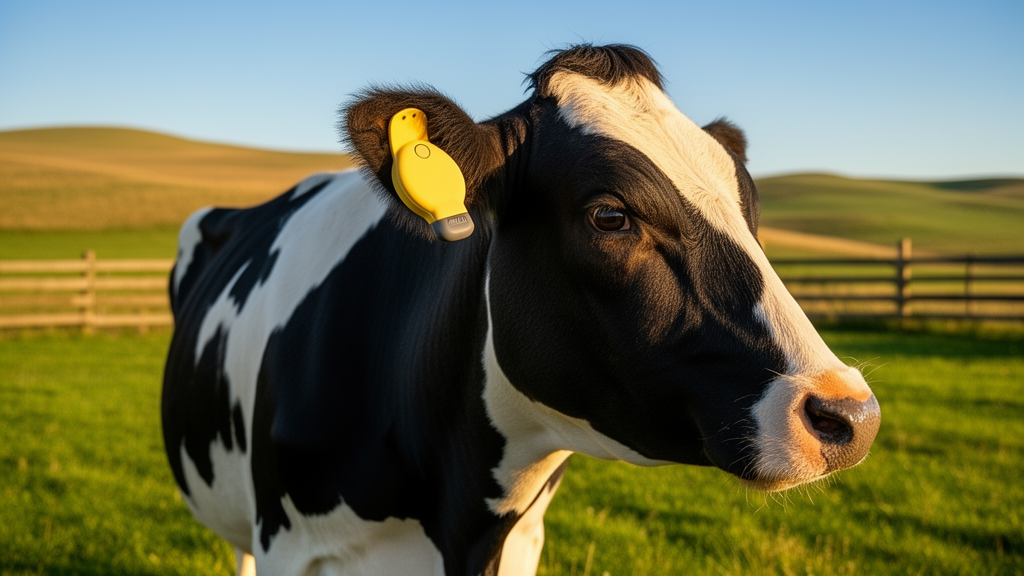
To overcome this limitation, the researchers designed a hardware node weighing 30.4 grams that attaches to the middle of the cow’s ear using a conventional stud. The device contains an M1820Z digital sensor to measure ear-surface temperature and a TMP117 high-precision sensor to record local ambient temperature near the attachment site. A metal probe faces the inner ear surface to ensure stable thermal contact with the skin, while a thermoplastic polyurethane housing protects the electronics from the farming environment. The system operates on a low-duty-cycle schedule, waking every 60 minutes to acquire data and then entering deep sleep to conserve power from a 200 mAh lithium-polymer battery.
Data transmission is handled through a LoRa wireless link operating at 433 MHz, which offers favorable diffraction and penetration characteristics in barn environments compared to higher-frequency alternatives like Bluetooth or Zigbee. The ear tag encodes its data into a lightweight 3-byte packet, reducing the transmission payload by 75% compared to standard character-based formats. These packets are received by an on-farm gateway that validates the data, adds reception metadata such as signal strength, and uploads the records to a remote server via a 4G cellular network. This architecture ensures that individual temperature records remain linked to specific animal identities throughout the data chain, from sensing to remote storage.
The field trial was conducted between December 2025 and May 2026 at a commercial farm in Xinjiang, involving 30 lactating Simmental cows within one month of calving. The final analysis dataset comprised 520 paired records, where ear-surface and ambient temperatures were matched with reference core temperatures measured manually via vaginal thermometry. This reference method, while invasive, provided the ground truth necessary to train and validate the compensation model. The study was approved by the Animal Welfare and Ethics Committee of Xinjiang Agricultural University, and all procedures were designed to minimize handling stress during routine husbandry operations.
The core of the system is the Thermal-Hysteresis-aware Stacked Hierarchical Residual Compensation (TH-SHRC) model, which processes the raw sensor data to estimate core temperature. This model comprises three complementary branches: thermal-state memory and retrieval, individual-session calibration, and hierarchical residual correction. The first branch retrieves similar historical thermal states to provide a baseline prediction, while the second branch accounts for individual temperature baselines by shrinking individual statistics toward the overall mean. The third branch uses an XGBoost algorithm to correct for nonlinear residual errors that the first two branches do not capture. The outputs of these branches are fused using ridge regression to produce the final compensated temperature estimate.
Performance evaluation using within-cow random five-fold out-of-fold validation showed that the TH-SHRC model achieved a coefficient of determination (R-squared) of 0.849 and a mean absolute error of 0.161 degrees Celsius. These results represented a significant improvement over raw ear-surface measurements, which had an RMSE of 5.915 degrees Celsius. The model outperformed 32 benchmark models, including various statistical regression, machine learning, and neural network approaches. The best-performing benchmark, GA-SVR, achieved an R-squared of 0.761, whereas the proposed model reduced the RMSE by 20.6% and the MAE by 29.9% relative to this benchmark.
Ablation experiments revealed that individual-session calibration was the most critical component of the model, contributing the largest improvement in accuracy. Removing this branch caused the R-squared to drop sharply to 0.153, indicating that accounting for individual animal differences is essential for accurate estimation. Thermal-state memory and retrieval provided the next largest contribution, while hierarchical residual correction offered a smaller but consistent additional reduction in error. This hierarchy of contributions aligns with SHAP analysis results, which identified cattle identity as the largest conditional contributor to the model’s predictions, followed by temporal state information.
Communication performance testing demonstrated that the LoRa link maintained a packet delivery ratio of 93.88% at a distance of 200 meters from the gateway, with an overall PDR of 93.8% across all tested distances. Signal quality, measured by received signal strength indicator and signal-to-noise ratio, decreased as distance increased, with the PDR dropping to 83.13% at 250 meters. The gateway included local caching and retransmission capabilities to handle temporary network outages, ensuring data integrity even when the 4G connection was unstable.
The system also included a web-based monitoring platform that visualizes temperature trends, manages cattle-ear-tag mappings, and provides remote control capabilities for the gateway. The platform allows farm managers to view individual temperature curves, review communication logs, and receive rule-based alerts for animals exhibiting abnormal temperature patterns. By linking communication records with temperature data, the system provides a traceable data flow that supports both operational maintenance and physiological monitoring. This integrated approach addresses the need for practical, field-ready tools that can operate under the dynamic conditions of free-stall barns without requiring continuous video streams or implantable hardware.
Despite these promising results, the study has several limitations that define the current scope of its conclusions. The validation was conducted at a single commercial farm and focused specifically on recently calved lactating Simmental cows, which may limit the generalizability of the findings to other breeds, ages, or physiological stages. The hardware remains at the prototype stage, and future work will be required to evaluate cross-farm transferability and reduce costs through larger-scale production. Nevertheless, the study provides a systems-engineering implementation for periodic physiological monitoring that successfully converts peripheral ear-surface signals into remotely recordable individualized core-temperature estimates.
The development of this system represents a significant step toward precision livestock management, offering a non-invasive alternative to traditional core temperature monitoring. The ability to maintain individual identity throughout the data chain ensures that each temperature record is attributable to a specific animal, facilitating targeted interventions and improved herd management practices in commercial settings.
In the 520 paired field records, ear-surface temperature averaged 33.65 ± 2.83 °C (range 25.3–39.9 °C) under local ambient conditions averaging 19.22 ± 12.49 °C (range 2.3–41.3 °C), while measured core temperatures averaged 38.91 ± 0.76 °C (range 37.5–41.5 °C) with an average signed core-minus-ear gap of 5.26 ± 2.71 °C. Before field deployment, the packaged M1820Z probe was verified against a veterinary mercury-in-glass thermometer in a 40 °C water bath for five minutes. Across the full out-of-fold validation set, Bland–Altman analysis confirmed close agreement with measured core values, yielding a mean difference of 0.002 °C and 95% limits of agreement spanning -0.579 to 0.582 °C. Furthermore, error distribution analyses showed that 73.8% of compensated predictions fell within 0.2 °C of reference measurements, 83.8% remained within 0.3 °C, and 92.3% were within 0.5 °C, reducing the median absolute error from 5.300 °C to 0.063 °C.
The statistical contribution of each modeling mechanism was verified through cow-level cluster bootstrap resampling with 10,000 replicates. Removing individual-session calibration caused the largest error escalation, increasing root mean square error by a 95% confidence interval of 0.2565 to 0.5712 °C, while omitting thermal-state memory and retrieval increased it by 0.0478 to 0.1479 °C, and excluding nonlinear residual correction increased it by 0.0012 to 0.0157 °C. In broader comparative rankings, TH-SHRC significantly exceeded simpler alternatives; an ear-only linear regression produced an R² of only 0.081, an RMSE of 0.731 °C, and an MAE of 0.597 °C. Detailed on-farm radio testing across eight directional bearings further established coverage boundaries, recording packet delivery ratios of 98.25% at 50 meters, 97.50% at 100 meters, 96.13% at 150 meters, and 83.13% at 250 meters. As transmission distance stretched to 250 meters, mean received signal strength declined from -71.97 dBm at 50 meters to -136.82 dBm, while signal-to-noise ratio fell from 9.26 dB to -3.61 dB, reflecting structural obstruction within the barn facility.
Subject of Research: Development and validation of a LoRa-based smart ear-tag system for non-invasive core temperature estimation in Simmental cattle using a stacked hierarchical residual compensation model.
Article Title: A LoRa smart ear-tag system with a stacked temperature-compensation model for ear-surface thermometry in Simmental cattle
Article References: Huang, J., Zhang, J., Wang, B., An, S., Yao, S., Li, H., & Chen, Q. (2026). A LoRa smart ear-tag system with a stacked temperature-compensation model for ear-surface thermometry in Simmental cattle. Smart Agricultural Technology, 15, Article 102703. https://doi.org/10.1016/j.atech.2026.102703
Image Credits: AI Generated
DOI: 10.1016/j.atech.2026.102703
Keywords: Smart Agriculture, LoRa Technology, Cattle Health Monitoring, Machine Learning, Thermal Imaging, Precision Livestock Farming, Wireless Sensor Networks, Simmental Cattle, Core Temperature Estimation, Non-invasive Sensing, IoT in Agriculture, Data Transmission, Animal Welfare, Edge Computing, Predictive Modeling, Herd Management, Signal Processing, Field Validation, Biomedical Engineering, Agricultural Technology
News Source: William Thompson. (November 12, 2026). Ear-tag system estimates cattle core temperature with 0.3 °C error. Scienmag.