Credit: by Iksung Kang, Alexandre Goy, and George Barbastathis
A wide range of objects, from biological cells to integrated circuits, are tomographically imaged to identify their interior structures. Volumetric reconstruction of the objects’ interiors is of practical implications, for instance, quantitative phase imaging of the cells and failure analysis of the circuits to validate their designs. Limiting the tomographic angular range is often desirable to reduce the time of radiation exposure and avoid any devastating effects upon the samples, or even unavoidable due to the structure of objects like in the case of tomosynthesis for mammography. However, tomographic reconstruction from limited angular views is not always welcome in an algorithmic sense, as it inevitably introduces artifacts and ambiguities to the reconstructions and thus, decreases overall reconstruction fidelity.
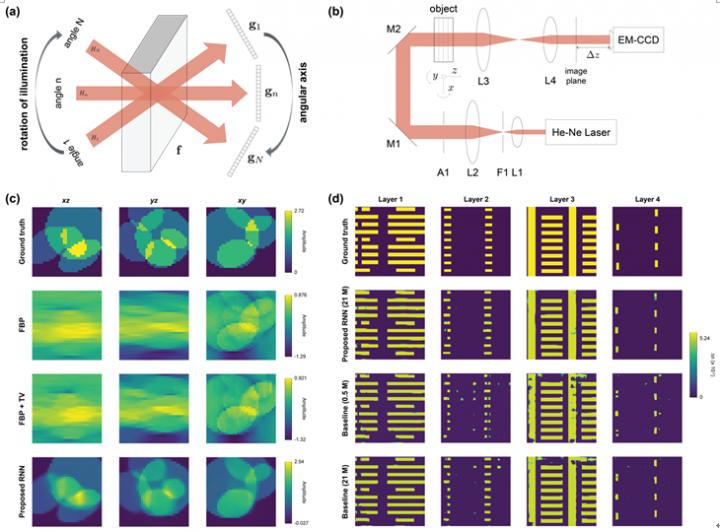
In a new paper published in Light: Science & Applications, a team at Massachusetts Institute of Technology, led by Professor George Barbastathis in the Department of Mechanical Engineering, has developed a dynamical machine learning approach to tackle this important problem, which takes a radically different path from most conventional inverse algorithms. They demonstrate the new method’s performance in two problems, limited-angle tomography under weak and strong scattering conditions. Depending on the degree of scattering due to the objects, the complexity of the problem is determined. It is often the case that hard X-rays are employed to image most materials, including biological tissues that the rays can be well approximated as straight lines without a large deviation because the materials weakly scatter the light. The next level of complexity arises when the light is more strongly scattered with objects with complex structures. The MIT team says their approach exploits “machine learning for a generic 3D refractive index reconstruction independent of the type of scattering.”
“Our motivation is that, as the angle of illumination is changed, the light goes through the same scattering volume, but the scattering events, weak or strong, follow a different sequence. At the same time, the raw image obtained from a new angle of illumination adds information to the tomographic problem, but that information is constrained by the previously obtained patterns. We interpret this as similar to a dynamical system, where the output is constrained by the history of earlier inputs as time evolves and new inputs arrive,” they added.
Recurrent neural network (RNN) architecture was their choice to implement their idea viewing the problem of limited-angle tomography as a dynamical system as the RNNs are often used to process data with dynamics. Here, the MIT team regards their raw images also as a sequence as the images are obtained one after the other. They say “our RNN architecture processes the raw images recurrently so that each raw image from a new angle improves over the reconstructions obtained from the previous angles.”
“The new method’s performance in the two problems that we tackled, tomography under weak (Radon) and strong scattering, indicates its promise for a number of other equally or more challenging inverse problems. Thus, we anticipate this publication to have significant impact beyond the immediate context that we are addressing here,” they noted.
###
Media Contact
Iksung Kang
[email protected]
Related Journal Article
http://dx.