When the Atlantic Meridional Overturning Circulation, the giant ocean conveyor that drags tropical heat northward, weakens, the effects ripple far beyond a chill over the North Atlantic. A new modelling study shows that the slowdown also reshuffles the atmosphere’s aerosols — the tiny particles on which clouds form — and that this reshuffling leaves a measurable fingerprint on clouds and radiation. The finding adds a previously unexplored microphysical pathway to the catalogue of consequences that follow a weakening of one of the climate system’s most consequential tipping elements.
Researchers at ETH Zurich, led by Ryan Vella and Ulrike Lohmann, used the ICON-HAM global aerosol–climate model, which explicitly simulates aerosol microphysics, cloud droplet and ice crystal formation, and the interaction of both clouds and aerosols with radiation. They compared two ten-year simulations. In the control run, the sea surface followed present-day conditions; in the so-called hosing run, they superimposed sea surface temperature and sea ice anomalies taken from a fully coupled EC-Earth3 simulation in which freshwater was poured into the North Atlantic at a rate of 0.3 Sverdrups poleward of 50° N. That freshwater forcing cut the simulated AMOC from roughly 17.5 to 7.0 Sverdrups — a weakening of about 60 percent. Crucially, all anthropogenic and biomass-burning emissions were held fixed, so any change in atmospheric aerosols had to arise purely from altered winds, transport and rainfall.
The imposed slowdown produced a stark hemispheric temperature asymmetry. Surface temperatures dropped by more than 4 kelvin over the subpolar North Atlantic, and averaged over the Northern Hemisphere the cooling reached about 2.4 kelvin — nearly twice the global mean of roughly 1.2 kelvin. The annual-mean surface freezing line marched about 761 kilometres southward, from around 58° N to 51° N. Global precipitation fell by about 0.10 millimetres per day, with the reduction concentrated in the Northern Hemisphere at 0.29 millimetres per day, and the tropical rain belt — the Intertropical Convergence Zone — shifted southward, drying the North Atlantic, western Europe and much of the northern tropics while wetting regions to the south of the equator.
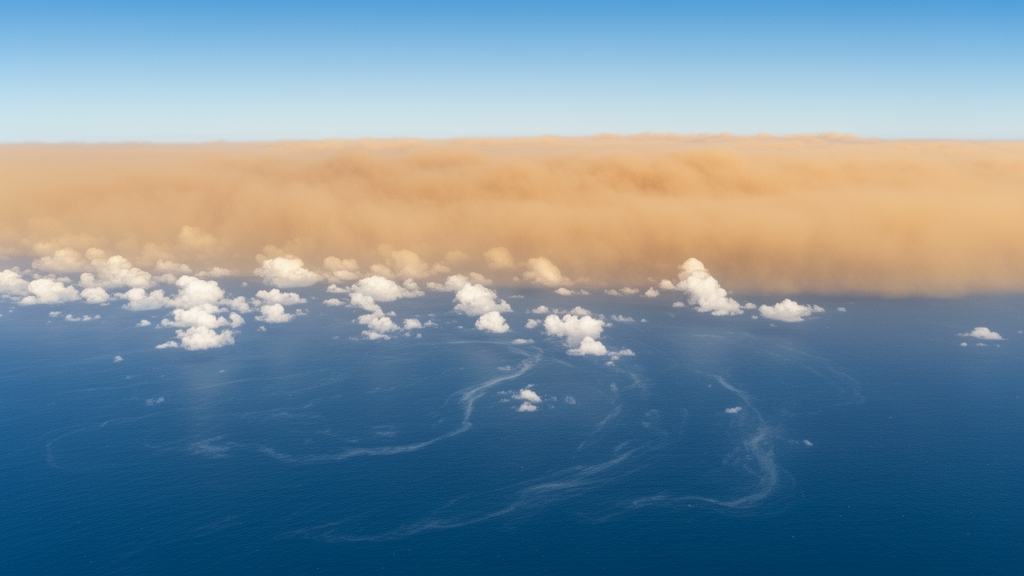
That reorganisation of winds and rain transformed the atmosphere’s particle load. Weakened westerlies over the subpolar North Atlantic cut sea-salt emissions there by roughly 63 percent, but the dominant change came from the Sahara. Steepened temperature gradients between the cooled mid-latitudes and the relatively unchanged tropics strengthened low-level winds over the subtropical Atlantic and western Sahara, boosting Saharan dust emissions by 81.0 milligrams per square metre per day — a 56 percent increase — and sending a thicker plume westward across the tropical North Atlantic. Globally, the total aerosol column burden rose by 38 percent, almost entirely in the Northern Hemisphere, where the mean burden climbed 41 percent.
A second, subtler mechanism lengthened the lifetime of existing particles. Because Northern Hemisphere rainfall declined, wet scavenging — the rainout of particles from the atmosphere — became less efficient, so fine sulfate and carbonaceous aerosols lingered longer aloft. Together, the enhanced dust and the extended lifetimes raised the availability of cloud condensation nuclei in the lower and middle troposphere between the equator and about 40° N, and increased the concentration of dust particles capable of nucleating ice — the ice-nucleating particles — mainly between 10 and 30° N where the Saharan plume is most prominent.
Clouds responded in two distinct ways. Thermodynamically, the colder and more stable lower troposphere over the subpolar North Atlantic favoured persistent stratiform cloud decks: low cloud cover increased by roughly 4 to 9 percent across the region, with local anomalies above 12 percent, while liquid water path rose by up to 24 grams per square metre over the North Atlantic and 37 grams per square metre over the North Pacific. But this local brightening was the exception within a broader loss of cloud water. North of 40° N, total water path fell over 82 percent of the area, by 11.6 percent on average and by about a third over the Nordic and Barents Seas, because the colder, more ice-covered surface supplied less moisture to the atmosphere.
The microphysical story emerged when the team sorted clouds by temperature over 40–90° N. In mixed-phase clouds — the realm between 0 and −35 °C where supercooled droplets and ice crystals coexist — dust ice-nucleating particle concentrations rose by 27.2 percent and in-cloud ice crystal number climbed 32.1 percent. The extra crystals grew at the expense of supercooled droplets through the Wegener–Bergeron–Findeisen process, in which ice, having a lower saturation vapour pressure than liquid water, drains vapour from nearby droplets. The result: mixed-phase clouds held 8.1 percent less water and became optically thinner. Warm clouds behaved differently, gaining 6.4 percent in total water path as the increased droplet numbers suppressed the collision-coalescence process that converts cloud droplets to rain. Cirrus ice crystal numbers, by contrast, fell by 7.1 percent despite abundant dust, because the stabilised atmosphere suppressed the deepest convective towers and shifted the coldest cloud tops toward warmer temperatures where homogeneous freezing nucleates fewer crystals.
When all these regional effects were tallied with a radiative-kernel decomposition, the global-mean cloud contribution turned out surprisingly small: a net warming of just +0.21 watts per square metre at the top of the atmosphere. Subpolar low-cloud brightening — a cooling effect — was largely cancelled by optical thinning of mixed-phase and ice clouds and by opposing tropical cloud changes tied to the southward ITCZ shift. The large apparent cloud radiative effect anomaly of +0.86 watts per square metre was mostly clear-sky masking: brighter ice, snow and dust hidden beneath clouds, not a genuine change in cloud properties. This contrasts with earlier studies that found cloud changes acting as a net positive feedback on AMOC-induced cooling — a difference the authors attribute to their resolution of aerosol–cloud microphysics.
The dominant cooling terms lay elsewhere. The expansion of subpolar sea ice and Northern Hemisphere snow cover reflected an additional 0.83 watts per square metre of sunlight back to space — of which 0.68 watts came from sea ice and 0.15 from continental snow — and the enhanced Saharan dust itself scattered and absorbed radiation, contributing an effective radiative forcing of −0.23 watts per square metre. Together with the modest cloud term, these channels summed to −0.86 watts per square metre, reinforcing rather than offsetting the surface cooling. Notably, this figure excludes the longwave response to the cooling, such as the Planck and lapse-rate responses, which the decomposition did not separate.
The study carries clear caveats. Because sea surface temperatures and sea ice were prescribed rather than coupled, the diagnosed cloud and aerosol effects cannot feed back on the ocean or the AMOC itself — a significant constraint given that the largest identified term is the sea-ice albedo response, which in the real world interacts with the very ice and ocean state held fixed here. With emissions pinned at 2015 levels and no concurrent greenhouse warming, the results isolate a mechanistic pathway rather than a realistic future trajectory, and as a single-model study the magnitudes, and in some regimes the signs, may depend on the ICON-HAM parameterisations. Still, the message is striking: a slowdown of the Atlantic conveyor can boost Saharan dust by more than half and stretch aerosol lifetimes through suppressed rainfall alone, and those particles then sculpt clouds from within — dehydrating mixed-phase clouds through dust-triggered ice formation even as they brighten low marine clouds. Climate models that prescribe aerosol effects rather than simulating them cannot capture this coupling, and its omission may help explain why projections of the climate response to future AMOC change vary so widely.
Subject of Research: Aerosol and cloud responses to a simulated weakening of the Atlantic Meridional Overturning Circulation
Article Title: Aerosol–cloud interactions influence the climate response to AMOC weakening
Article References: Vella, R., & Lohmann, U. (2026). Aerosol–cloud interactions influence the climate response to AMOC weakening. Atmospheric Chemistry and Physics, 26(20), 14939-14959. https://doi.org/10.5194/acp-26-14939-2026
Image Credits: AI Generated
DOI: 10.5194/acp-26-14939-2026
Keywords: AMOC, aerosol-cloud interactions, Saharan dust, mixed-phase clouds, sea ice, radiative forcing, ICON-HAM, climate modelling, North Atlantic, ITCZ, ice-nucleating particles, freshwater hosing
News Source: Russell Cooper. (October 23, 2026). Dust and clouds reshape how Earth cools when the Atlantic circulation slows. Scienmag.