


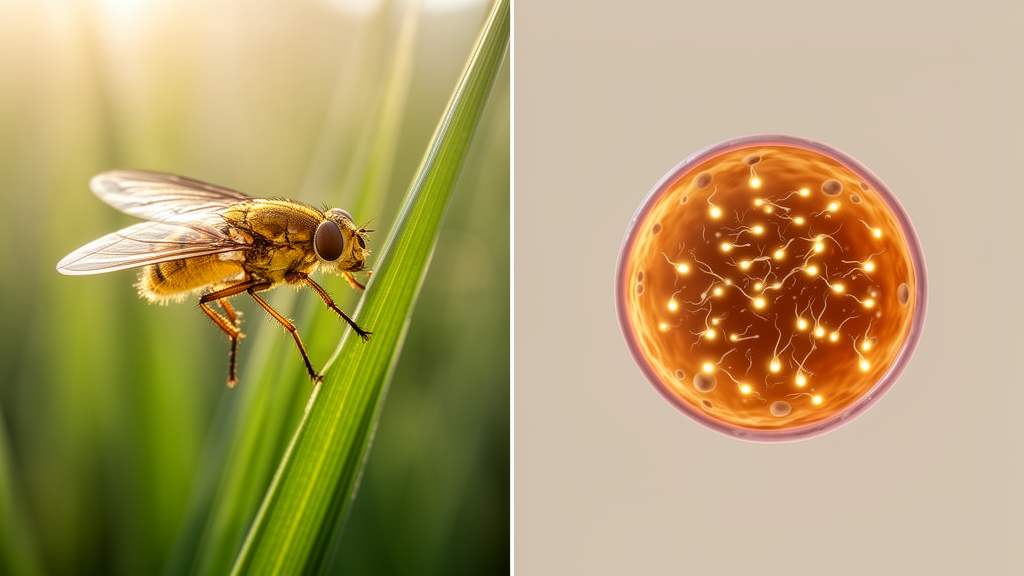
In the quiet war between the sexes, one of the most intimate battlegrounds is invisible to the naked eye: the interior of the female reproductive tract, where newly arrived sperm meet a chemical environment they did not choose and cannot control. For decades, biologists have assumed that females of many species actively cull the sperm they receive, destroying or ejecting most of the millions transferred during mating so that only a small elite ever reaches the site of fertilization. A new laboratory experiment with yellow dung flies now complicates that picture. Rather than killing sperm, the fluid produced by the females’ accessory glands appears to do the opposite: it keeps more sperm alive.
The study, published in the journal Alpine Entomology, revisited a long-standing question in the biology of Scathophaga stercoraria, the yellow dung fly, a cool-climate species that swarms around livestock pastures across the cold-temperate northern hemisphere. In Switzerland, where the experimental flies were collected, the species thrives up to high altitudes beyond the treeline. Females lay their eggs into vertebrate dung, which the larvae then consume, and males gather in large numbers on and around cow pats waiting for females to arrive. Thanks to the pioneering work of Geoff Parker and colleagues, this unglamorous insect has become a classic model for studying sexual selection, sexual conflict and sperm competition.
The theoretical stakes are considerable. In species with internal fertilization, only a fraction of the vast numbers of sperm transferred by males ever reach the fertilization site. Some of this loss reflects physiological or biochemical challenges within the female reproductive tract, and some simply reflects dilution in a large tract. Females of a striking diversity of species actively reduce sperm numbers by extrusion, dissolution or degradation, from house flies and bruchid beetles to spiders, fruit flies and fowl. Such female influences on sperm storage and paternity may or may not be adaptive, but the result is that sperm are often short-lived inside the female, with notable exceptions such as bees, ants and bats, whose queens and females can store viable sperm for remarkably long periods.
Males, in turn, have evolved countermeasures. Males of several insect species produce and transfer accessory substances that protect their ejaculates against female enzymatic attack and digestion. These male substances may benefit the males even at the females’ expense, a textbook signature of sexual conflict. Documented effects in other insects include decreased female receptivity to further mating, accelerated egg laying, altered storage and use of sperm, and reduced female life span. The female reproductive tract, meanwhile, typically includes a pair of ovaries, one to several spermathecae that serve as sperm storage organs, and paired accessory glands whose secretions have been implicated in lubrication during copulation and oviposition, the production of oviposition pheromones, and protective coatings for eggs.
Against this backdrop, one hypothesis has loomed large: that female accessory gland fluid acts as a spermicide, selectively killing sperm and thereby giving the female a form of cryptic choice over paternity. Such selective killing could promote competition among males, counter antagonistic male adaptations, or bias paternity toward males of high genetic quality. But there is a rival hypothesis that has received far less attention. Keeping sperm alive could serve the female just as well, whether to avoid fertilization failure or to encourage sperm competition, and selective nourishment of sperm is as consistent with cryptic female choice as selective spermicide. The two functions are chemical opposites, yet evolutionarily equivalent in their consequences for female control.
Earlier work on yellow dung flies had muddied the waters. Bernasconi and colleagues found in 2002 that after mating, sperm viability was significantly reduced in the spermathecae compared with a male’s testes, yet in vitro exposure of sperm to several parts of the female reproductive tract, including the accessory glands, showed no sperm degradation. The authors of the new study identified a crucial limitation in that earlier experiment: the accessory gland fluid had been previously frozen, which could have inactivated important substances. Until now, there was no direct evidence that accessory gland products could debilitate sperm in this species, and it remained equally conceivable that the fluid actually promotes sperm survival.
To settle the question, the researchers used fresh rather than frozen gland fluid. They collected flies from a pasture in Fehraltorf, Switzerland, and maintained them for multiple generations in the laboratory. The experiment used offspring of the sixth laboratory generation: fifty females and thirty males, dissected after reaching sexual maturity, more than ten days after adult emergence for females and more than four days for males. Three females had to be discarded after unsuccessful dissections. Dissections were performed in five temporal blocks no more than twelve minutes apart, with ten females and six males per block, to provide equally fresh sperm. The fluid of both accessory glands of each female was extracted by rupturing each gland in a micro-centrifuge tube containing twenty microliters of buffer, and the extracted fluid from all ten females in a block was pooled so that every sperm sample within a block encountered the same accessory gland product.
Sperm samples came from the proximal end of male testes, adjacent to the ejaculatory duct, released into buffer on a glass slide. In a paired design, each of the thirty males’ sperm samples was exposed both to fresh accessory gland fluid mixed with buffer and to buffer alone. Fifteen microliters of sperm suspension were incubated with thirty microliters of buffer plus fifteen microliters of gland fluid suspension, or with forty-five microliters of buffer in the control, for eleven plus or minus two minutes at room temperature. Viability was assessed with a fluorescent live-dead stain: a green membrane-permeant dye marks live sperm, while a red dye penetrates only the damaged membranes of dead ones, and cells taking on both stains were scored as dead. Researchers counted sperm across twenty randomly taken images per male and analyzed the data with a binomial generalized linear mixed model, fitting a random effect for male identity to respect the paired design and using parametric bootstrapping to assess significance.
The result was unambiguous. Sperm exposed to fresh accessory gland fluid survived at a significantly higher rate than sperm in plain buffer: sixty-three percent versus forty-four percent, with non-overlapping confidence intervals and a parametric bootstrap P-value of 0.001. In raw counts, 2,955 sperm were alive in the gland fluid treatment against 1,520 dead, while in the buffer control 1,453 were alive against 1,819 dead. The authors conclude that female accessory gland fluid in yellow dung flies can help nourish rather than kill male sperm, at least in vitro, though they caution that other organs or their secretions may additionally affect sperm viability inside the spermathecae or elsewhere in the reproductive tract.
The finding reframes the evolutionary conversation. Selective provisioning of sperm could, in principle, serve the same function as selective spermicide by creating storage conditions that favor some males over others, though whether a nourishing function can actively favor certain ejaculates remains unclear. There are practical caveats: the gland fluid was diluted in buffer, following the earlier protocol, which may have weakened its effects, although the authors consider it highly unlikely that the direction of the effect reverses with concentration. Related work offers context: gland extract in this species does not inhibit bacterial growth, suggesting a fertilization-related rather than antimicrobial role, and studies of bees and ants show that male accessory fluids can also prolong sperm viability. Because sperm storage is energetically costly and far fewer sperm are released per fertilization than theory once predicted, females may benefit from provisioning only the sperm they need. More work on the physiological and biochemical interactions of sperm storage, and on the reproductive consequences of sperm mortality for male fertilization success and female fitness, will be needed to untangle the full interplay of sexual conflict and postmating sexual selection in insects.
Subject of Research: The effect of female accessory gland fluid on sperm viability in yellow dung flies
Article Title: Female accessory gland fluid promotes sperm survival in yellow dung flies
Article References: Thüler, K., Blanckenhorn, W. U., Ward, P. I., Lüpold, S., & Bussière, L. F. (2021). Female accessory gland fluid promotes sperm survival in yellow dung flies. Alpine Entomology, 5, 95-100. https://doi.org/10.3897/alpento.5.68501
Image Credits: AI Generated
Keywords: yellow dung fly, sperm viability, accessory glands, sexual conflict, cryptic female choice, sperm competition, reproductive biology, in vitro experiment, Scathophaga stercoraria, entomology, spermicide, Switzerland
News Source: Gavin Prescott. (October 28, 2026). Dung fly study finds female gland fluid keeps sperm alive, not kills it. Scienmag.



