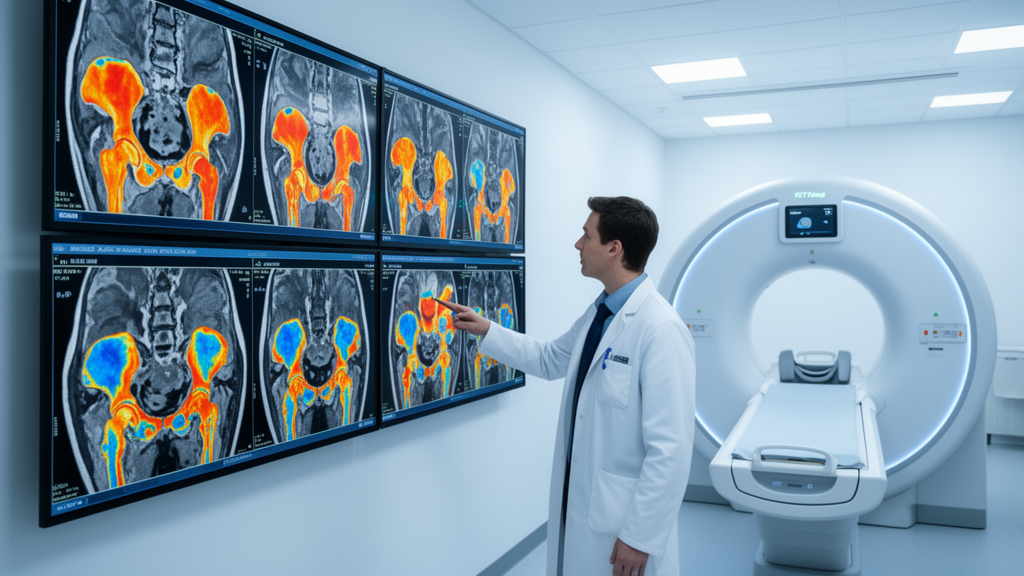
Combining two radioactive tracers with magnetic resonance imaging may give surgeons a sharper picture of how rectal tumors respond to treatment before an operation. In a prospective study published in EJNMMI Research, researchers report that post-treatment PET/MRI using both [18F]-FDG, the workhorse glucose tracer, and the fibroblast-activation-protein-targeting tracer [18F]-FAPI-42, predicted pathological response to neoadjuvant therapy in locally advanced rectal cancer more accurately than either modality alone.
The study enrolled 36 patients with locally advanced rectal cancer who completed short-course radiotherapy followed by immunochemotherapy. Twenty-eight days after treatment, each patient underwent paired PET/MRI scans along with dynamic contrast-enhanced MRI, and surgery followed within one week, allowing the imaging findings to be checked directly against pathology from the resected specimen.
Combined PET/MRI interpretation achieved 75.00% accuracy for predicting tumor regression grade and 86.11% accuracy for predicting pathological complete response, significantly higher than PET or MRI interpreted on its own, with all comparisons reaching statistical significance. Agreement with pathology was substantial, with kappa values of 0.66 for tumor regression grade and 0.68 for pathological complete response.
The most striking single metric was the ratio of FAPI-SUVmax to FDG-SUVmax. This ratio differed significantly between patients with and without a pathological complete response (P = 0.004) and showed good diagnostic performance with an area under the curve of 0.82. Using a cutoff of 1.25, the ratio detected complete responders with 65% sensitivity and 92% specificity, meaning it rarely mislabeled a non-responder as a complete responder.
Among the MRI parameters examined, the time-intensity curve from dynamic contrast-enhanced imaging outperformed apparent diffusion coefficient values for predicting pathological complete response, with AUCs of 0.84 versus 0.38.
The authors conclude that post-treatment dual-tracer PET/MRI effectively evaluates pathological response to neoadjuvant therapy in rectal cancer, and they highlight the FAPI-to-FDG SUVmax ratio as a promising imaging biomarker for identifying pathological complete response, potentially guiding de-escalation of surgery in selected patients.
The findings come with important caveats. The cohort was small, all patients received the same short-course radiotherapy plus immunochemotherapy regimen, and the results are reported in an early-shared, peer-reviewed accepted version of the article. The registered trial (NCT06318234) is prospective, but accuracy figures from 36 patients will need validation in larger and more diverse populations before such scans change operative decisions.
Even so, the study addresses a real clinical gap. If validated, a single post-treatment PET/MRI combining a metabolic and a fibroblast-targeted tracer could help identify which patients achieve a complete response and might safely avoid extensive resection.
Subject of Research: Dual-tracer FDG and FAPI-42 PET/MRI for assessing pathological response to neoadjuvant therapy in rectal cancer
Article Title: Detecting pathological response to neoadjuvant therapy in rectal cancer by [18F]-FDG and [18F]-FAPI-42 PET/MRI
Article References: Zhou, W., Shen, H., Ma, Q., Luo, Y., Xia, R., Tang, Y., Wang, Y., Chen, C., Li, F., & Chen, X. (2026). Detecting pathological response to neoadjuvant therapy in rectal cancer by [18F]-FDG and [18F]-FAPI-42 PET/MRI. EJNMMI Research. https://doi.org/10.1186/s13550-026-01533-6
Image Credits: AI Generated
DOI: 10.1186/s13550-026-01533-6
Keywords: rectal cancer, PET/MRI, 18F-FDG, 18F-FAPI-42, neoadjuvant therapy, pathological complete response, tumor regression grade, immunochemotherapy, imaging biomarker, SUVmax ratio, dynamic contrast-enhanced MRI, Detecting
News Source: Nathaniel Bowman. (October 29, 2026). Dual-Tracer PET/MRI Spots Rectal Cancer Response After Neoadjuvant Therapy. Scienmag.