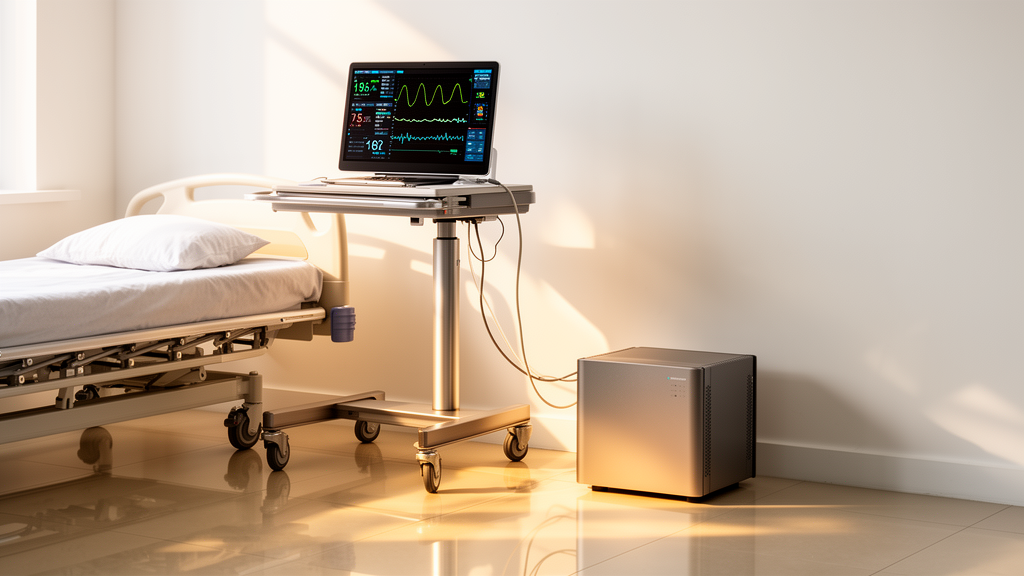
A research study published in Frontiers in Public Health introduces a Dual-Layer Edge Intelligence Framework designed to deliver secure, real-time data processing for the Internet of Medical Things in intensive care units. Developed by researchers Reema Shaheen and Adnan Shahid Khan of Universiti Malaysia Sarawak alongside Dr. Irshad Ahmed Abbasi of the University of Bisha, the architecture deploys two sequential artificial intelligence modules directly onto a ward-level edge computing node. The integrated system addresses the acute vulnerabilities of clinical monitoring environments by pairing automated network intrusion defense directly with patient physiological deterioration tracking.
In modern intensive care units, the Internet of Medical Things facilitates the continuous transmission of patient vital signs to inform clinical decision-making. These clinical settings rely on a diverse collection of interdependent medical devices engineered to maintain high reliability and operational timeliness. However, perpetual network connectivity exposes medical devices to significant cybersecurity hazards, including unauthorized system access, data tampering, and targeted network intrusions. Relying on conventional cloud-based infrastructures introduces communication latency and dependencies on broader network availability, which can compromise the timely delivery of urgent clinical alerts.
The study highlights an existing gap in clinical edge computing research, noting that prevailing investigations typically concentrate on either patient physiological monitoring or network intrusion detection independently. Very few technological designs combine both defensive filtering and clinical analytics within an integrated edge framework. To resolve this division, the authors engineered a ward-level sequential pipeline designed to verify the security of inbound network transmissions before any clinical algorithms evaluate the transmitted physiological information.
Under the proposed architecture, an initial Security AI Module operates as a strict Zero-Trust gatekeeper. Implemented as a soft-voting ensemble, this first defensive tier inspects every inbound network flow to detect potential intrusion patterns. The framework adheres to an uncompromising sequential structure: only network traffic explicitly validated and cleared as benign by the Security AI Module is permitted to advance to the downstream diagnostic components, preventing unverified or compromised telemetry from reaching clinical analytic models.
Traffic that successfully clears the security perimeter is forwarded directly to the Healthcare AI Module. Constructed using Histogram Gradient Boosting, this second tier examines the patient’s physiological state to detect anomaly-based indicators of critical clinical deterioration. By coupling the modules sequentially, the framework prevents clinical decision-support models from processing unverified or corrupted data streams while maintaining safe operational boundaries between routine network management and bedside healthcare analytics.
The research team evaluated the dual-layer architecture using two standard benchmark datasets: the CICIDS-2017 cybersecurity intrusion dataset and the MIMIC-IV clinical dataset. Experimental testing revealed that the soft-voting Security AI Module achieved an accuracy of 99.4 percent while maintaining a false positive rate below 2 percent. Meanwhile, the Histogram Gradient Boosting Healthcare AI Module demonstrated a cross-validated accuracy of 98.97 percent, an area under the receiver operating characteristic curve of 0.995, and complete recall across every validation fold evaluated.
Across the entire sequential pipeline, the integrated edge architecture recorded an end-to-end processing latency of approximately 28.8 milliseconds, satisfying the operational latency thresholds required for real-time monitoring in intensive care settings. Looking to future governance architectures, the authors described a conceptual model incorporating a permissioned Hyperledger Fabric ledger paired with off-chain InterPlanetary File System storage; however, they explicitly noted that this blockchain governance tier was not implemented or tested within the current experimental study.
Subject of Research: Sequential Zero-Trust edge intelligence framework for secure real-time Medical Internet of Things monitoring in intensive care units
Article Title: Dual-layer edge intelligence for secure real-time medical IoT: a Zero-Trust sequential framework integrating soft-voting intrusion detection and Histogram Gradient Boosting
Article References: Shaheen, R., Khan, A. S., & Abbasi, I. A. (2026). Dual-layer edge intelligence for secure real-time medical IoT: a Zero-Trust sequential framework integrating soft-voting intrusion detection and Histogram Gradient Boosting. Frontiers in Public Health, 14, Article 1974012. https://doi.org/10.3389/fpubh.2026.1974012
Image Credits: AI Generated
DOI: 10.3389/fpubh.2026.1974012
Keywords: Internet of Medical Things, MIoT, edge intelligence, Zero-Trust architecture, soft-voting ensemble, Histogram Gradient Boosting, intrusion detection, CICIDS-2017, MIMIC-IV, intensive care units, real-time monitoring, patient vital signs, ward-level edge node, clinical decision support, end-to-end latency, Hyperledger Fabric, IPFS off-chain storage
News Source: Ophelia Keating. (November 10, 2026). Dual-Layer Edge Intelligence Secures Medical IoT Devices With Low Latency. Scienmag.