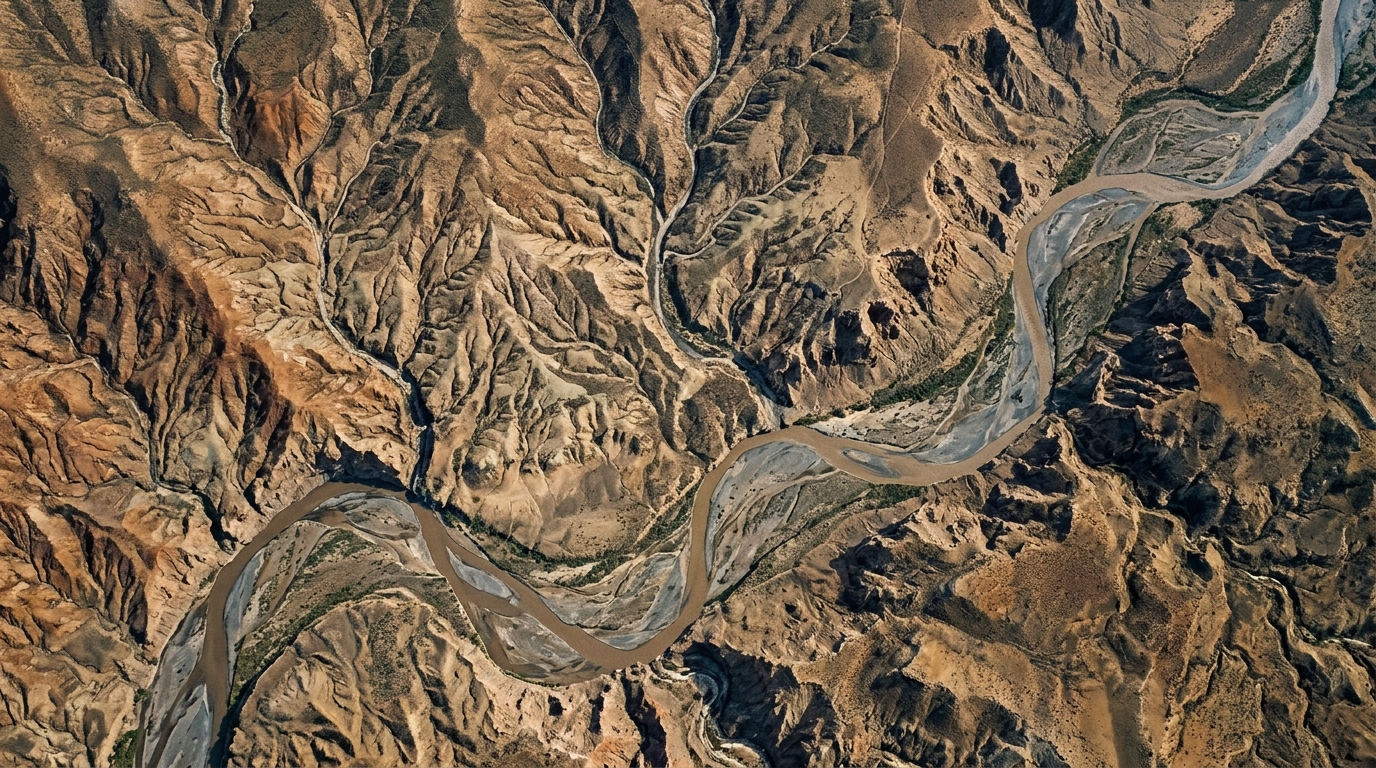
A dual-branch graph neural network architecture achieved 93.62 percent classification accuracy and a 94.01 percent F1-score in automatically identifying river network morphology, outperforming conventional single-branch neural baselines. The study directly addresses a recognized challenge in digital cartography, where traditional analytical methods struggle to capture both the intricate topological connectivity and the local geometric features of complex river networks simultaneously.
To address this dual challenge, the proposed computational framework utilizes watersheds as fundamental basic units for feature extraction and structural modeling. Working with multi-morphological river network data, the procedure applies river segment densification, Delaunay triangulation, and boundary extraction across each watershed unit. Through these spatial operations, the researchers calculate nine distinct morphological parameters that capture the underlying spatial structure of the drainage systems.
The neural network architecture integrates two specialized processing pathways designed to extract complementary structural properties in parallel. A topological branch powered by GraphSAGE learns stream connectivity relationships and relational dependencies across the network. Concurrently, a geometric branch built upon a multilayer perceptron learns global geometric statistics across the watershed units, ensuring that structural topology and spatial geometry inform the classification process together.
Because topological connectivity features and global geometric statistics display divergent numerical scales, unnormalized combination could distort model training. To eliminate these feature-scale discrepancies, the architecture introduces Layer Normalization immediately prior to the fusion layer. This normalization step standardizes internal feature representations before the network merges topological and geometric vectors into a unified representation for category classification.
Systematic experiments conducted on an evaluation dataset of 1,000 samples spanning five typical river network types confirmed the effectiveness of the design. The combined model achieved a 93.62 percent overall accuracy and a 94.01 percent F1-score, significantly outperforming multiple neural network baselines, including Single-GCN, Single-GAT, and an adapted GraphSAGE model inspired by previous work from Wang and colleagues.
The model also displayed high experimental stability and reproducibility across five independent testing runs initialized with distinct random seeds, yielding a standard deviation of only 0.97 percent. Furthermore, evaluation of the model’s confusion matrix demonstrated that skeleton river network patterns were identified with 100 percent recognition accuracy across all test samples.
Feature ablation studies and Pearson correlation analysis indicated that morphological variance provides the most critical discriminative information for differentiating river systems, while the overall network demonstrates strong robustness against redundant features. The authors noted that this dual-branch methodology provides reliable and robust technical support for adaptive river network generalization within practical map production environments requiring multiple map versions from a single database.
Subject of Research: Automated river network morphology recognition using graph neural networks
Article Title: Automated recognition of river network patterns via dual‑branch graph neural networks and watershed fundamental units
Article References: Wang, H. (2027). Automated recognition of river network patterns via dual‑branch graph neural networks and watershed fundamental units. Earth Science Informatics, 20(1), Article 6. https://doi.org/10.1007/s12145-026-02321-5
Image Credits: AI Generated
DOI: 10.1007/s12145-026-02321-5
Keywords: river networks, graph neural networks, GraphSAGE, watershed fundamental units, Delaunay triangulation, river network morphology, topological connectivity, geometric features, multilayer perceptron, Layer Normalization, cartographic generalization, morphological variance, skeleton patterns, digital cartography, Single-GCN, Single-GAT, boundary extraction, Pearson correlation analysis
News Source: Cassandra Pierce. (November 27, 2026). Dual-Branch Graph Neural Network Recognizes River Network Patterns With 93 Percent Accuracy. Scienmag.