The world’s first dual-beamline photoelectron momentum microscope has been developed at the UVSOR Synchrotron Facility, Japan. This innovative experimental station brings breakthroughs in studying the behavior of electrons in materials governing material properties, particularly in analyzing valence orbitals.
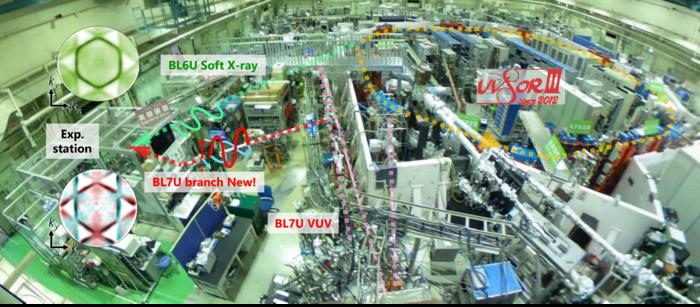
Credit: Prof. Fumihiko Matsui Group, Institute for Molecular Science
The world’s first dual-beamline photoelectron momentum microscope has been developed at the UVSOR Synchrotron Facility, Japan. This innovative experimental station brings breakthroughs in studying the behavior of electrons in materials governing material properties, particularly in analyzing valence orbitals.
Understanding the behavior of electrons in materials is crucial for the advancement of materials science and device engineering. Conventional photoelectron spectroscopy provides deep insight into the nature of the electronic structure of solids. Currently, the challenge of researching electronic structures on the micrometer scale is being pursued all over the world. A state-of-the-art momentum-resolved photoelectron spectroscopy apparatus with additional microscopic function, called “photoelectron momentum microscope”, was constructed at the UVSOR Synchrotron Facility, Institute for Molecular Science, Japan, revolutionizing micrometer-scale analyses of the behavior of electrons.
Researchers from Institute for Molecular Science / The Graduate University for Advanced Studies, SOKENDAI in collaboration with Osaka University have upgraded this advanced analyzer and experimental station to use two undulator beamlines as excitation sources. By branching the existing vacuum ultraviolet (VUV) beamline BL7U, VUV light has now become simultaneously available at the photoelectron momentum microscope in addition to a soft-X ray beam from the beamline BL6U.
This world’s first “dual-beamline photoelectron momentum microscope” allows 1) element selective measurements using the grazing-incidence soft X-ray light and 2) highly symmetric measurements using the normal-incidence VUV light. Taking advantage of the flexibility of these light sources creates a new pathway for multimodal analyses of the behavior of electrons. Particularly, we stress that photoelectron spectroscopy in the normal-incidence configuration is only available with this apparatus at UVSOR worldwide. Highly symmetric configuration with such normal incidence facilitates, especially, precise analyses of valence orbital via photon polarization-dependent transition-matrix-element analysis. In this work, we applied this approach to the valence electrons of the Au(111) surface.
This unique dual-beamline photoelectron momentum microscopy offers deeper insights into the behavior of electrons in materials, innovating fields of condensed matter physics, molecular science, and materials science.
* UVSOR Synchrotron Facility:
UVSOR is a synchrotron radiation facility at Institute for Molecular Science, Japan with the world’s highest performance in the extreme ultraviolet energy range and is widely used by domestic and overseas researchers. The extreme ultraviolet energy range is suitable for observing behavior of electrons which are responsible for properties of molecules and solids. Synchrotron radiation emitted from an electron storage ring with a circumference of about 50 meters is introduced into more than a dozen experimental stations in which a wide variety of researches on bioscience, environmental and energy sciences as well as physical and chemical sciences are conducted. Although it is the second oldest synchrotron radiation facility in Japan since the first light was observed in 1983, it successfully maintains state-of-the-art performance through undergoing intensive upgrades twice.
Information of the paper:
Authors: Kenta Hagiwara, Eiken Nakamura, Seiji Makita, Shigemasa Suga, Shin-ichiro, Tanaka, Satoshi Kera and Fumihiko Matsui
Journal Name: Journal of Synchrotron Radiation
Journal Title: “Development of dual-beamline photoelectron momentum microscopy for valence orbital analysis”
DOI: https://doi.org/10.1107/S1600577524002406
Financial Supports:
MEXT Fostering Joint International Research (B): 19KK0137
MEXT Grant-in-Aid for Scientific Research(S): 23H05461
Contact Person:
Name: Kenta HAGIWARA
E-mail: k-hagiwara_at_ims.ac.jp
Name: Fumihiko MATSUI
E-mail: matui_at_ims.ac.jp
(Please replace the “_at_” with @)
Journal
Journal of Synchrotron Radiation
DOI
10.1107/S1600577524002406
Method of Research
Experimental study
Subject of Research
Not applicable
Article Title
Development of dual-beamline photoelectron momentum microscopy for valence orbital analysis
Article Publication Date
15-Apr-2024