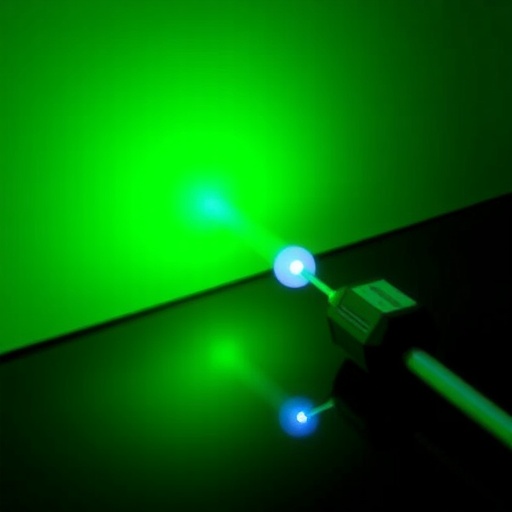
Supercontinuum light sources are often described as “white lasers” because they produce an extraordinarily broad, continuous spectrum containing many colors at once. Unlike ordinary lasers, which typically emit within a narrow wavelength range, supercontinuum sources can cover large portions of the visible and infrared regions. This unusual combination of brightness and spectral breadth has made them valuable in medical imaging, environmental monitoring, spectroscopy, industrial inspection, and biological research. Yet one major limitation has continued to restrict their usefulness: the broader the spectrum becomes, the more difficult it is to keep the emitted light stable.
Researchers at DTU Electro have now demonstrated a way to overcome that trade-off. In a study published in Optica, the team reports an ultra-low-noise supercontinuum source whose usable wavelength range extends from 0.86 to 2.90 micrometers. That span nearly doubles the bandwidth previously achieved by comparable low-noise systems, while preserving the remarkable stability required for precise measurements. The result could help optical technologies detect faint signals more quickly and reliably, from subtle changes in human tissue to trace concentrations of gases in the atmosphere.
The central challenge in supercontinuum generation lies in controlling what happens when intense laser pulses travel through an optical fiber. As a pulse propagates, nonlinear optical effects can spread its energy across a wide range of wavelengths. This process creates the characteristic rainbow-like output, but it can also amplify tiny variations in the pulse. Those fluctuations appear as noise in the final spectrum. For applications that depend on measuring weak signals, such as the absorption fingerprint of a molecule, even small changes in the light source can obscure the information researchers are trying to capture.
The DTU team addressed this problem through a technique called thermal dispersion engineering. Rather than combining several different types of optical fiber, the researchers heated a short section of a single fiber. The controlled thermal treatment altered the fiber’s microscopic structure and changed the way it interacted with light. In particular, the treated region acquired dispersion characteristics opposite to those of the original fiber, allowing it to compress the pulse as it passed through.
Dispersion describes how different wavelengths travel at different speeds inside a material. In an untreated fiber, this effect can stretch a light pulse in time. The thermally modified section reverses the relevant dispersion behavior, causing the pulse to become shorter and more intense. That compressed pulse then drives nonlinear interactions more efficiently in the remainder of the fiber, broadening the spectrum without requiring a complicated chain of separate optical components. The approach effectively integrates linear pulse compression directly into the fiber itself.
“We essentially let the fibre do the work for us,” says Andrea Arduin, a postdoctoral researcher at DTU Electro and the study’s first author. By precisely modifying only a small region of the fiber, the researchers were able to reshape the pulse before it generated the supercontinuum. The method avoids the need to splice together multiple fibers with different properties, a process that can introduce optical losses, alignment challenges, and additional points of failure. A single engineered fiber can therefore perform functions that would traditionally require a more elaborate optical setup.
The improvement is significant because spectral width and noise have historically been linked in supercontinuum systems. Expanding the output toward longer and shorter wavelengths generally increases the risk of instability. The new source, however, maintains low noise across a range reaching well into the infrared. This region is especially important for chemical sensing because many molecules absorb infrared light at distinctive wavelengths. These absorption features act as optical fingerprints, allowing instruments to identify and measure gases or other substances even when they are present in very small quantities.
The potential applications extend from laboratories to clinical and environmental settings. In medical imaging, a steadier broadband source could improve image quality and reduce the time required to scan tissue. More stable illumination can make it easier to distinguish subtle biological structures or changes associated with disease. In environmental monitoring, the expanded infrared coverage could support faster detection of pollutants and greenhouse gases. Industrial systems could also use the source for process monitoring, quality control, and spectroscopy in situations where weak signals must be separated from background fluctuations.
The researchers emphasize that the importance of the work goes beyond the performance of one supercontinuum laser. Thermal dispersion engineering suggests that optical fibers can be designed to carry out more of the functions normally assigned to separate components. By building pulse compression and other forms of light manipulation directly into the fiber, future systems could become smaller, more robust, and easier to operate. The team is now investigating whether the same strategy can be adapted to other wavelength ranges and fiber platforms. “What we have shown is that you can push the spectral width significantly without paying the price in noise,” Arduin says. “If the light fluctuates, it becomes harder to detect weak signals. By keeping the noise low, we make these sources much more useful.”
Subject of Research: Ultra-low-noise supercontinuum light generation using fiber-integrated linear pulse compression and thermal dispersion engineering.
Article Title: Doubling the bandwidth of low-noise supercontinuum through fiber-integrated linear pulse compression
News Publication Date: 5-Jun-2026
Web References: https://doi.org/10.1364/OPTICA.595939
References: Optica, “Doubling the bandwidth of low-noise supercontinuum through fiber-integrated linear pulse compression,” DOI: 10.1364/OPTICA.595939.
Image Credits: Arduin et al.
Keywords
Supercontinuum laser, white laser, optical fiber, pulse compression, thermal dispersion engineering, low-noise optics, infrared spectroscopy, medical imaging, gas sensing, DTU Electro
Tags: advances in optical fiber laser stabilitybroadband supercontinuum spectrumenvironmental monitoring with white lasersindustrial inspection with broadband laserslow-noise white laser rangemedical imaging applications of supercontinuumoptical fiber laser technologyoptical fiber supercontinuum generationspectroscopy and biological researchstable supercontinuum light sourcessupercontinuum laser sourcesultra-low-noise supercontinuum