• HOME
  • NEWS
  • EXPLORE
    • CAREER
      • Companies
      • Jobs
    • EVENTS
    • iGEM
      • News
      • Team
    • PHOTOS
    • VIDEO
    • WIKI
  • BLOG
  • COMMUNITY
    • FACEBOOK
    • INSTAGRAM
    • TWITTER
Thursday, March 26, 2026
BIOENGINEER.ORG
No Result
View All Result
  • Login
  • HOME
  • NEWS
  • EXPLORE
    • CAREER
      • Companies
      • Jobs
        • Lecturer
        • PhD Studentship
        • Postdoc
        • Research Assistant
    • EVENTS
    • iGEM
      • News
      • Team
    • PHOTOS
    • VIDEO
    • WIKI
  • BLOG
  • COMMUNITY
    • FACEBOOK
    • INSTAGRAM
    • TWITTER
  • HOME
  • NEWS
  • EXPLORE
    • CAREER
      • Companies
      • Jobs
        • Lecturer
        • PhD Studentship
        • Postdoc
        • Research Assistant
    • EVENTS
    • iGEM
      • News
      • Team
    • PHOTOS
    • VIDEO
    • WIKI
  • BLOG
  • COMMUNITY
    • FACEBOOK
    • INSTAGRAM
    • TWITTER
No Result
View All Result
Bioengineer.org
No Result
View All Result
Home NEWS Science News Chemistry

Dresden researchers develop new strategy for efficient OLED active matrix displays

Bioengineer by Bioengineer
March 2, 2021
in Chemistry
Reading Time: 2 mins read
0
IMAGE
Share on FacebookShare on TwitterShare on LinkedinShare on RedditShare on Telegram

IMAGE

Credit: ©Zhongbin Wu

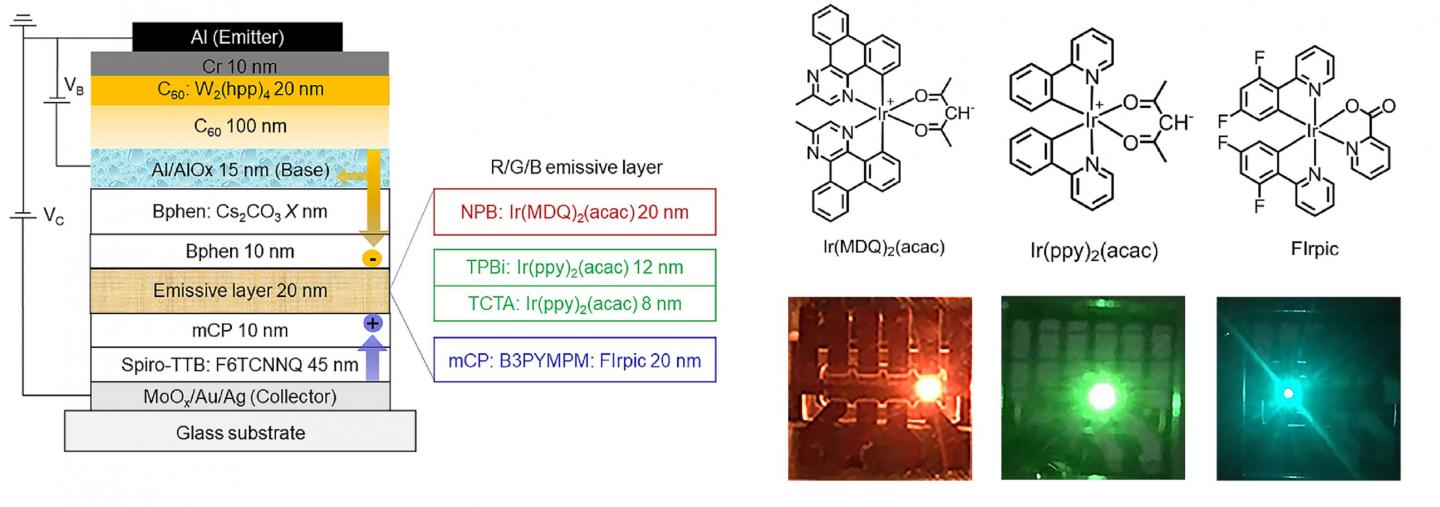
In the group of Prof. Karl Leo, physicists, material scientists and engineers are working jointly on the development of novel organic materials and devices for high performance, flexible and possibly even biocompatible electronics and optoelectronics of the future. Increasing the performance of organic devices is one of the key challenges in their research. It was only last year, when the team headed by Dr. Hans Kleemann announced an important breakthrough with the development of efficient, printable vertical organic transistors.

Now Dr. Zhongbin Wu, Dr. Yuan Liu, and PhD student Erjuan Guo present the first electronic device that combines a vertical organic permeable base transistor (OPBT) and an OLED. With this novel device concept of an organic permeable base light-emitting transistor (OPB-LET), the researchers succeeded in combining the function of a highly efficient switching transistor and an organic light-emitting diode as commonly employed in active matrix displays. Active matrix liquid crystal displays (AMLCD) usually contain a matrix of thin-film transistors to drive LCD pixels. Each individual pixel has a circuit with active components (mostly transistors). In this context, organic light-emitting transistors, three-terminal devices combining a thin-film transistor with a light-emitting diode, have generated increasing interest. However, increasing their efficiency while keeping the operating voltage low remains a key challenge. “The key to construct the high performance OPB-LETs is the permeable base electrode located at the center of the device, forming a distinctive optical microcavity and regulating charge carrier injection and transport. The thus designed three-terminal vertical optoelectronic devices can simultaneously high efficiencies (up to 24.6%), high luminance (up to 12,513 cd m-2), and low driving voltages (

The performance of OPB-LETs demonstrated in this work is comparable to state-of-the-art OLEDs and cutting-edge, low-voltage organic transistors. Prof. Karl Leo explains: “We expect that this novel device principle will pave the way for highly-efficient flexible displays with a rather simple pixel design.”

###

Media Contact
Erjuan Guo
[email protected]

Related Journal Article

http://dx.doi.org/10.1038/s41563-021-00937-0

Tags: Chemistry/Physics/Materials SciencesMaterialsOptics
Share12Tweet8Share2ShareShareShare2

Related Posts

blank

Physicists Identify Electronic Drivers Behind Flat Band Quantum Materials

March 21, 2026
Würzburg Chemistry Professor Claudia Höbartner Receives Prestigious Honor

Würzburg Chemistry Professor Claudia Höbartner Receives Prestigious Honor

March 20, 2026

Scientists Reveal How Magnets Control Metamaterial Behavior

March 20, 2026

Gallium-Based Liquid Metals: Pioneering Cybernetic Bridges for Human-Machine Integration

March 20, 2026
Please login to join discussion

POPULAR NEWS

  • blank

    Revolutionary AI Model Enhances Precision in Detecting Food Contamination

    96 shares
    Share 38 Tweet 24
  • Imagine a Social Media Feed That Challenges Your Views Instead of Reinforcing Them

    1003 shares
    Share 397 Tweet 248
  • Uncovering Functions of Cavernous Malformation Proteins in Organoids

    54 shares
    Share 22 Tweet 14
  • Promising Outcomes from First Clinical Trials of Gene Regulation in Epilepsy

    51 shares
    Share 20 Tweet 13

About

We bring you the latest biotechnology news from best research centers and universities around the world. Check our website.

Follow us

Recent News

In-Sensor Cryptography Links Physical Process to Digital Identity

Can Psychosocial Factors Influence Cancer Risk?

Depression Factors in Elderly: Pre vs. Post-COVID Analysis

Subscribe to Blog via Email

Success! An email was just sent to confirm your subscription. Please find the email now and click 'Confirm' to start subscribing.

Join 78 other subscribers
  • Contact Us

Bioengineer.org © Copyright 2023 All Rights Reserved.

Welcome Back!

Login to your account below

Forgotten Password?

Retrieve your password

Please enter your username or email address to reset your password.

Log In
No Result
View All Result
  • Homepages
    • Home Page 1
    • Home Page 2
  • News
  • National
  • Business
  • Health
  • Lifestyle
  • Science

Bioengineer.org © Copyright 2023 All Rights Reserved.