• HOME
  • NEWS
  • EXPLORE
    • CAREER
      • Companies
      • Jobs
    • EVENTS
    • iGEM
      • News
      • Team
    • PHOTOS
    • VIDEO
    • WIKI
  • BLOG
  • COMMUNITY
    • FACEBOOK
    • INSTAGRAM
    • TWITTER
Thursday, May 21, 2026
BIOENGINEER.ORG
No Result
View All Result
  • Login
  • HOME
  • NEWS
  • EXPLORE
    • CAREER
      • Companies
      • Jobs
        • Lecturer
        • PhD Studentship
        • Postdoc
        • Research Assistant
    • EVENTS
    • iGEM
      • News
      • Team
    • PHOTOS
    • VIDEO
    • WIKI
  • BLOG
  • COMMUNITY
    • FACEBOOK
    • INSTAGRAM
    • TWITTER
  • HOME
  • NEWS
  • EXPLORE
    • CAREER
      • Companies
      • Jobs
        • Lecturer
        • PhD Studentship
        • Postdoc
        • Research Assistant
    • EVENTS
    • iGEM
      • News
      • Team
    • PHOTOS
    • VIDEO
    • WIKI
  • BLOG
  • COMMUNITY
    • FACEBOOK
    • INSTAGRAM
    • TWITTER
No Result
View All Result
Bioengineer.org
No Result
View All Result
Home NEWS Science News Chemistry

Dresden researchers develop new strategy for efficient OLED active matrix displays

Bioengineer by Bioengineer
March 2, 2021
in Chemistry
Reading Time: 2 mins read
0
IMAGE
Share on FacebookShare on TwitterShare on LinkedinShare on RedditShare on Telegram

IMAGE

Credit: ©Zhongbin Wu

In the group of Prof. Karl Leo, physicists, material scientists and engineers are working jointly on the development of novel organic materials and devices for high performance, flexible and possibly even biocompatible electronics and optoelectronics of the future. Increasing the performance of organic devices is one of the key challenges in their research. It was only last year, when the team headed by Dr. Hans Kleemann announced an important breakthrough with the development of efficient, printable vertical organic transistors.

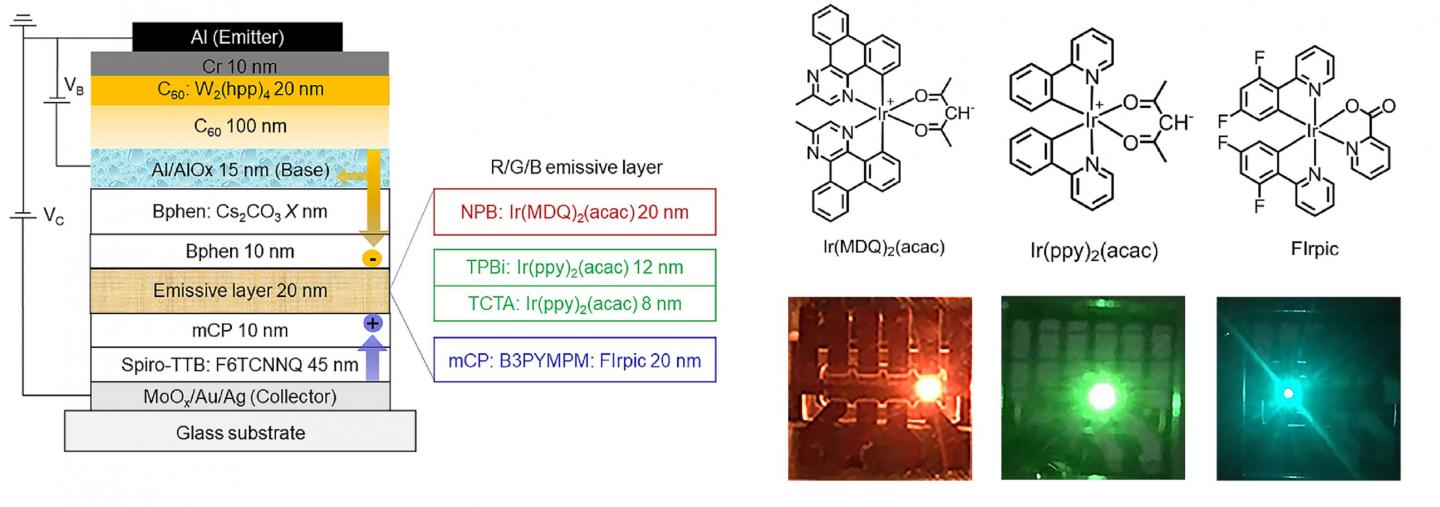
Now Dr. Zhongbin Wu, Dr. Yuan Liu, and PhD student Erjuan Guo present the first electronic device that combines a vertical organic permeable base transistor (OPBT) and an OLED. With this novel device concept of an organic permeable base light-emitting transistor (OPB-LET), the researchers succeeded in combining the function of a highly efficient switching transistor and an organic light-emitting diode as commonly employed in active matrix displays. Active matrix liquid crystal displays (AMLCD) usually contain a matrix of thin-film transistors to drive LCD pixels. Each individual pixel has a circuit with active components (mostly transistors). In this context, organic light-emitting transistors, three-terminal devices combining a thin-film transistor with a light-emitting diode, have generated increasing interest. However, increasing their efficiency while keeping the operating voltage low remains a key challenge. “The key to construct the high performance OPB-LETs is the permeable base electrode located at the center of the device, forming a distinctive optical microcavity and regulating charge carrier injection and transport. The thus designed three-terminal vertical optoelectronic devices can simultaneously high efficiencies (up to 24.6%), high luminance (up to 12,513 cd m-2), and low driving voltages (

The performance of OPB-LETs demonstrated in this work is comparable to state-of-the-art OLEDs and cutting-edge, low-voltage organic transistors. Prof. Karl Leo explains: “We expect that this novel device principle will pave the way for highly-efficient flexible displays with a rather simple pixel design.”

###

Media Contact
Erjuan Guo
[email protected]

Related Journal Article

http://dx.doi.org/10.1038/s41563-021-00937-0

Tags: Chemistry/Physics/Materials SciencesMaterialsOptics
Share12Tweet8Share2ShareShareShare2

Related Posts

Scientists Achieve Breakthrough in Molecular ‘Sandwich’ Assembly — Chemistry

Scientists Achieve Breakthrough in Molecular ‘Sandwich’ Assembly

May 21, 2026
Advancing In Vivo and In Situ Monitoring: Science Bulletin Highlights Host-Based Antifouling Gold Nanotube Sensor for Selective Detection of Mechanically Sensitive Serotonin Release in Intestinal Mucosa — Chemistry

Advancing In Vivo and In Situ Monitoring: Science Bulletin Highlights Host-Based Antifouling Gold Nanotube Sensor for Selective Detection of Mechanically Sensitive Serotonin Release in Intestinal Mucosa

May 20, 2026

How Magnetic Orientation Could Influence the Building Blocks of Life

May 20, 2026

Breaking a 200-Year-Old Belief: Novel Surface Design Achieves Two Distinct Wetting States on One Substrate

May 20, 2026
Please login to join discussion

POPULAR NEWS

  • blank

    New Study Reveals Plants Can Detect the Sound of Rain

    733 shares
    Share 292 Tweet 183
  • ESMO 2025: mRNA COVID Vaccines Enhance Efficacy of Cancer Immunotherapy

    304 shares
    Share 122 Tweet 76
  • Research Indicates Potential Connection Between Prenatal Medication Exposure and Elevated Autism Risk

    846 shares
    Share 338 Tweet 212
  • Breastmilk Balances E. coli and Beneficial Bacteria in Infant Gut Microbiomes

    58 shares
    Share 23 Tweet 15

About

We bring you the latest biotechnology news from best research centers and universities around the world. Check our website.

Follow us

Recent News

Innovative Reusable Brick Walls Revolutionize Construction Industry

Nonlinear Atomic Tunneling Enhanced by Bright Squeezed Vacuum

Label-Free Super-Resolution Imaging of Live Cells

Subscribe to Blog via Email

Enter your email address to subscribe to this blog and receive notifications of new posts by email.

Join 82 other subscribers
  • Contact Us

Bioengineer.org © Copyright 2023 All Rights Reserved.

Welcome Back!

Login to your account below

Forgotten Password?

Retrieve your password

Please enter your username or email address to reset your password.

Log In
No Result
View All Result
  • Homepages
    • Home Page 1
    • Home Page 2
  • News
  • National
  • Business
  • Health
  • Lifestyle
  • Science

Bioengineer.org © Copyright 2023 All Rights Reserved.