• HOME
  • NEWS
  • EXPLORE
    • CAREER
      • Companies
      • Jobs
    • EVENTS
    • iGEM
      • News
      • Team
    • PHOTOS
    • VIDEO
    • WIKI
  • BLOG
  • COMMUNITY
    • FACEBOOK
    • INSTAGRAM
    • TWITTER
Friday, October 9, 2026
BIOENGINEER.ORG
No Result
View All Result
  • Login
  • HOME
  • NEWS
  • EXPLORE
    • CAREER
      • Companies
      • Jobs
        • Lecturer
        • PhD Studentship
        • Postdoc
        • Research Assistant
    • EVENTS
    • iGEM
      • News
      • Team
    • PHOTOS
    • VIDEO
    • WIKI
  • BLOG
  • COMMUNITY
    • FACEBOOK
    • INSTAGRAM
    • TWITTER
  • HOME
  • NEWS
  • EXPLORE
    • CAREER
      • Companies
      • Jobs
        • Lecturer
        • PhD Studentship
        • Postdoc
        • Research Assistant
    • EVENTS
    • iGEM
      • News
      • Team
    • PHOTOS
    • VIDEO
    • WIKI
  • BLOG
  • COMMUNITY
    • FACEBOOK
    • INSTAGRAM
    • TWITTER
No Result
View All Result
Bioengineer.org
No Result
View All Result
Home NEWS Science News Chemistry

Dresden physicists use nanostructures to free photons for highly efficient white OLEDs

Bioengineer by Bioengineer
July 11, 2019
in Chemistry
Reading Time: 2 mins read
0
IMAGE
Share on FacebookShare on TwitterShare on LinkedinShare on RedditShare on Telegram

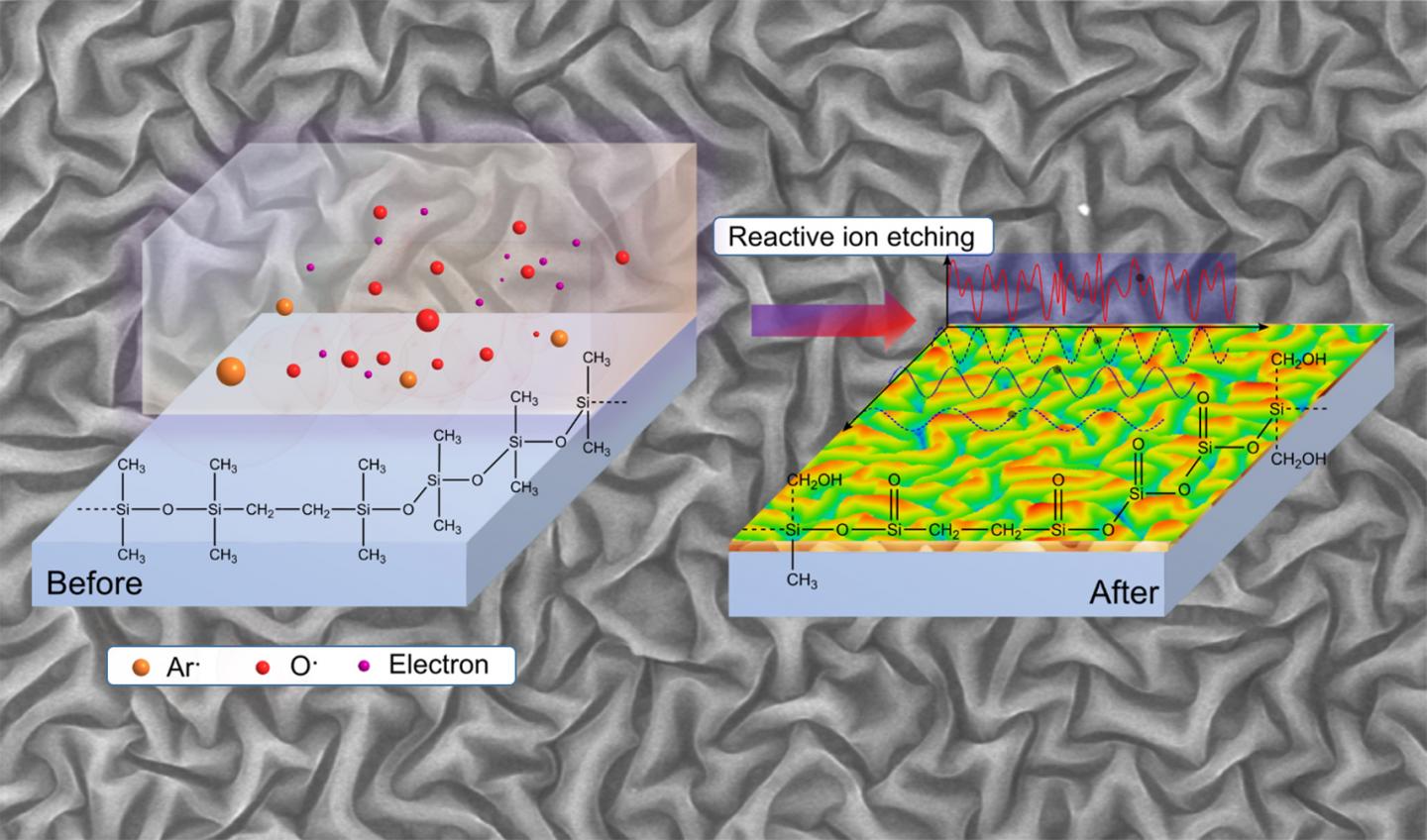
Trapped light particles
IMAGE

Credit: (c) Sebastian Reineke et al., Nature Communications: CC BY 4.0

Since light-emitting diodes only produce monochrome light, manufacturers use various additive colour-mixing processes to produce white light.

Since the first development of white OLEDs in the 1990s, numerous efforts have been made to achieve a balanced white spectrum and high luminous efficacy at a practical luminance level. However, the external quantum efficiency (EQE) for white OLEDs without additional outcoupling techniques can only reach 20 to 40 percent today. About 20 percent of the generated light particles (photons) remain trapped in the glass layer of the device. The reason for this is the total internal reflection of the particles at the interface between glass and air.

Further photons are waveguided in the organic layers, while others get ultimately lost at the interface to the top metal electrode.

Numerous approaches have been investigated to extract the trapped photons from OLEDs. An international research team led by Dr. Simone Lenk and Prof. Sebastian Reineke from the TU Dresden has now presented a new method for freeing the light particles in the renowned journal Nature Communications.

The physicists introduce a facile, scalable and especially lithography-free method for the generation of controllable nanostructures with directional randomness and dimensional order, significantly boosting the efficiency of white OLEDs. The nanostructures are produced by reactive ion etching. This has the advantage that the topography of the nanostructures can be specifically controlled by adjusting the process parameters.

In order to understand the results obtained, the scientists have developed an optical model that can be used to explain the increased efficiency of OLEDs. By integrating these nanostructures into white OLEDs, an external quantum efficiency of up to 76.3% can be achieved.

For Dr. Simone Lenk, the new method opens up numerous new avenues: “We had been looking for a way to specifically manipulate nanostructures for a long time already. With reactive ion etching, we have found a cost-effective process that can be used for large surfaces and is also suitable for industrial use. The advantage lies in the fact that the periodicity and height of the nanostructures can be completely adjusted via the process parameters and that thus an optimal outcoupling structure for white OLEDs could be found. These quasi-periodic nanostructures are not only suitable as outcoupling structures for OLEDs, but also have the potential for further applications in optics, biology and mechanics”.

###

Original publication:

Yungui Li, Milan Kovačič, Jasper Westphalen, Steffen Oswald, Zaifei Ma, Christian Hänisch, Paul-Anton Will, Lihui Jiang, Manuela Junghaehnel, Reinhard Scholz, Simone Lenk & Sebastian Reineke: “Tailor-made nanostructures bridging chaos and order for highly efficient white organic light-emitting diodes” Nature Communications 10, http://dx.doi.org/10.1038/s41467-019-11032-z

Media Contact
Dr. Sebastian Reineke
[email protected]

Related Journal Article

http://dx.doi.org/10.1038/s41467-019-11032-z

Tags: Chemistry/Physics/Materials Sciences
Share12Tweet8Share2ShareShareShare2

Related Posts

Flexible forest molecules turbocharge the birth of atmospheric particles

Flexible forest molecules turbocharge the birth of atmospheric particles

October 9, 2026
Thirteen New Minerals Officially Recognized, Including One Found Inside a Meteorite

Thirteen New Minerals Officially Recognized, Including One Found Inside a Meteorite

October 9, 2026

The Hidden Rivers of Sinking Air That Wrap Every Thunderstorm

October 9, 2026

A Bacterial Toxin’s Random Flickers Reveal Hidden Complexity in Nanopore Sensing

October 9, 2026
Please login to join discussion

POPULAR NEWS

  • Alloys That Shrink Their Own Grains: New PIX Mechanism Refines Metals With Heat Alone

    Alloys That Shrink Their Own Grains: New PIX Mechanism Refines Metals With Heat Alone

    29 shares
    Share 12 Tweet 7
  • Endurance Exercise Reshapes the Liver in Males and Females Through Distinct Molecular Routes

    29 shares
    Share 12 Tweet 7
  • Single Transcription Factor PU.1 Rapidly Converts Fibroblasts into Macrophage-Lineage Cells

    29 shares
    Share 12 Tweet 7
  • New Scale Measures How Ready Nurse Educators Really Are for the AI Era

    29 shares
    Share 12 Tweet 7

About

We bring you the latest biotechnology news from best research centers and universities around the world. Check our website.

Follow us

Recent News

Alloys That Shrink Their Own Grains: New PIX Mechanism Refines Metals With Heat Alone

Endurance Exercise Reshapes the Liver in Males and Females Through Distinct Molecular Routes

Single Transcription Factor PU.1 Rapidly Converts Fibroblasts into Macrophage-Lineage Cells

Subscribe to Blog via Email

Success! An email was just sent to confirm your subscription. Please find the email now and click 'Confirm' to start subscribing.

Join 85 other subscribers
  • Contact Us

Bioengineer.org © Copyright 2023 All Rights Reserved.

Welcome Back!

Login to your account below

Forgotten Password?

Retrieve your password

Please enter your username or email address to reset your password.

Log In
No Result
View All Result
  • Homepages
    • Home Page 1
    • Home Page 2
  • News
  • National
  • Business
  • Health
  • Lifestyle
  • Science

Bioengineer.org © Copyright 2023 All Rights Reserved.