Credit: Authors
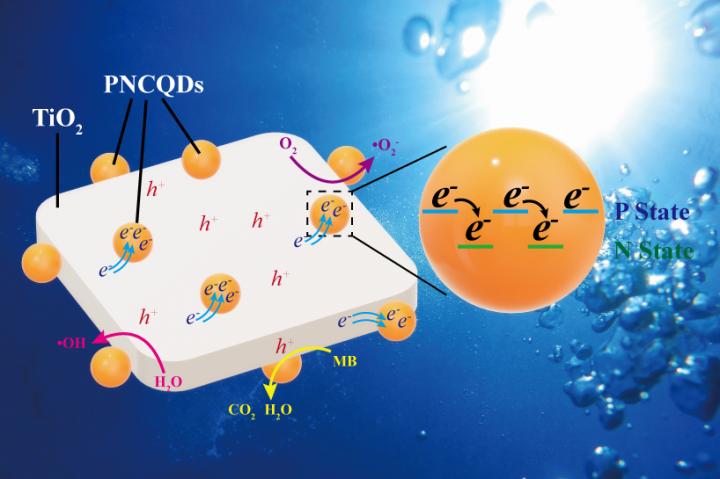
In a paper published in NANO, researchers from Nanjing Tech University proposed a theory which attributes the photocatalytic efficiency enhancement of Phosphorus and Nitrogen co-doped CQDs (PNCQDs)/TiO2 nanosheets composite photocatalyst to the quantum wells of PNCQDs.
Doped carbon quantum dots (CQDs) have been popular nanomaterials to enhance the performance of composite semiconductor photocatalyst in recent years, since their excellent optical and electronic characteristics. In the field of fluorescence, it is commonly known that double element co-doping can effectively increase the quantum yield of CQDs because of the synergy between doping elements, but the specific mechanism is still unclear.
This study found the difference of surface states and bandgaps between PNCQDs and nitrogen doped CQDs (NCQDs). The potential barriers produced by energy level difference of P and N element created numerous well-like electron traps, which can effectively capture photogenerated electrons. Moreover, the PNCQDs can reduce the fluorescence of composite photocatalyst, which reflects the capability of photogenerated carrier separation. PNCQDs also enhanced the UV absorption performance of the catalyst. The kinetic constant of PNCQDs/TiO2 sample for Methylene Blue (MB) photodegradation under simulated sunlight reached 3.4 times of pure TiO2, with a Z-scheme mechanism.
Compared with traditional Nitrogen doped carbon quantum dots (NCQDs), Phosphorus and Nitrogen co-doped carbon quantum dots (PNCQDs) show unique characteristic of carrier separation and electron localization due to the structure of quantum wells created by synergistic effect of doping elements. In this work, double element co-doped CQDs are proved to have potential in the field of photocatalysis, and the theory of quantum wells provides reference for designing CQDs photocatalyst system with better performance.
###
This research was supported by Advantage Discipline Construction Foundation of Jiangsu, the Priority Academic Program Development of Jiangsu Higher Education Institutions (PAPD).
Additional co-authors of the paper are Kailai Liu, Fanmin Kong and Chaoqun Zhu. Corresponding author for this study is Guodong Jiang ([email protected]).
For more insight into the research described, readers are invited to access the paper on NANO.
IMAGE
Caption: Photocatalytic process of phosphorus and nitrogen co-doped carbon quantum dots (PNCQDs)/TiO2 nanosheets. Due to the quantum wells created by synergy between N and P elements, photogenerated electrons can be localized to the dopant sites of PNCQDs, improving the quantum efficiency.
NANO is an international peer-reviewed monthly journal for nanoscience and nanotechnology that presents forefront fundamental research and new emerging topics. It features timely scientific reports of new results and technical breakthroughs and publishes interesting review articles about recent hot issues.
About World Scientific Publishing Co.
World Scientific Publishing is a leading independent publisher of books and journals for the scholarly, research, professional and educational communities. The company publishes about 600 books annually and about 140 journals in various fields. World Scientific collaborates with prestigious organizations like the Nobel Foundation and US National Academies Press to bring high quality academic and professional content to researchers and academics worldwide. To find out more about World Scientific, please visit http://www.
For more information, contact Tay Yu Shan at [email protected].
Media Contact
Tay Yu Shan
[email protected]
Original Source
https:/
Related Journal Article
http://dx.