


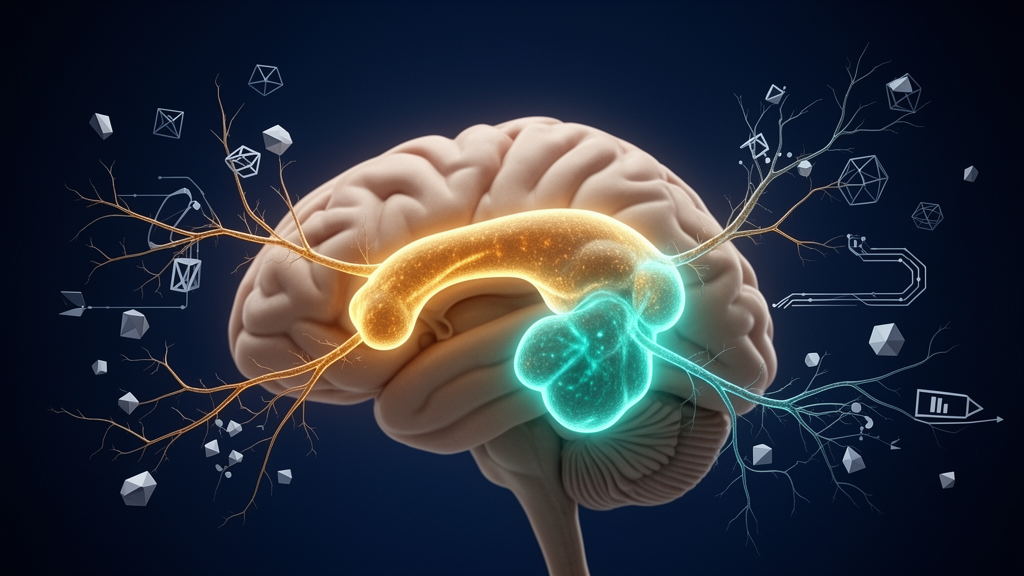
A new mouse study, published in Behavioral and Brain Functions, maps that transition onto the hippocampus and finds that different regions along the organ’s long axis make distinct contributions to memory span and to performance beyond it.
Memory span defines the number of items that can be maintained over a short time interval before performance deteriorates. When this limit is exceeded, performance enters what researchers call a supraspan condition. Human studies have implicated the medial temporal lobe, and particularly the hippocampus, in supraspan performance, but no animal model had explicitly captured this transition before.
In the new work, researchers led by Filomena Grazia Alvino and Elvira De Leonibus investigated the contribution of the dorsal and intermediate-ventral hippocampus to span and supraspan-like performance in mice. They used selective N-methyl-D-aspartate (NMDA) lesions combined with modified versions of the object recognition task and the radial arm maze (RAM), manipulating memory load and strategy constraints to dissociate subregion-specific contributions.
The results reveal a clear functional dissociation along the hippocampal axis. Dorsal hippocampus lesions impaired object memory under high memory load, whereas intermediate-ventral hippocampus lesions did not. This suggests that the dorsal portion of the structure is specifically required when object recognition demands exceed ordinary capacity.
In the radial arm maze under allocentric conditions, neither lesion significantly affected span, which the team operationally defined as the number of correct choices before the first error within a trial. However, both lesions increased supraspan errors, defined as the mean number of errors committed after span had been exceeded. Sustaining performance beyond the span limit therefore appears to depend on both hippocampal regions working together.
The picture changed when egocentric strategies were permitted. Under those conditions, intermediate-ventral hippocampus lesions selectively reduced the span, increased errors, and disrupted sequential choice strategies. The intermediate-ventral region thus supports egocentric spatial strategies, while the dorsal region supports high-load object memory, and both share a role in sustaining performance beyond span limits.
The authors are careful to note a limitation of the translational claim. The mouse paradigm is not directly homologous to human supraspan memory, since the tasks and the operational definitions of span differ from those used in human neuropsychology. Nevertheless, they argue that the paradigm provides a translational framework to investigate memory deficits associated with medial temporal lobe dysfunction, including Alzheimer’s disease.
Methodologically, the study stands out for combining lesion techniques with task designs that manipulate memory load and strategy constraints simultaneously. By dissociating what each hippocampal subregion contributes under different conditions, the work avoids attributing all memory functions to the structure as a whole.
The article was published on 10 September 2026 as an open access research paper, with the accepted version shared early to provide faster access; it is citable and carries a permanent DOI, subject to further edits before the final version of record.
Subject of Research: Functional specialization of the dorsal and intermediate-ventral hippocampus in memory span and supraspan performance in mice
Article Title: Functional specialization of the hippocampus along its dorso–ventral axis: from span to supraspan in memory capacity
Article References: Alvino, F. G., Carboncino, A., Carrella, D., Crain, J., Iemolo, A., Giordano, N. C., Olivito, L., Cavezza, D., De Risi, M., Treves, A., & De Leonibus, E. (2026). Functional specialization of the hippocampus along its dorso–ventral axis: from span to supraspan in memory capacity. Behavioral and Brain Functions. https://doi.org/10.1186/s12993-026-00368-4
Image Credits: AI Generated
DOI: 10.1186/s12993-026-00368-4
Keywords: hippocampus, memory span, supraspan, dorsal hippocampus, ventral hippocampus, NMDA lesion, radial arm maze, object recognition, allocentric, egocentric, medial temporal lobe, Alzheimer's disease
News Source: Cassandra Pierce. (October 28, 2026). Dorsal and ventral hippocampus play distinct roles in memory span and supraspan performance in mice. Scienmag.



