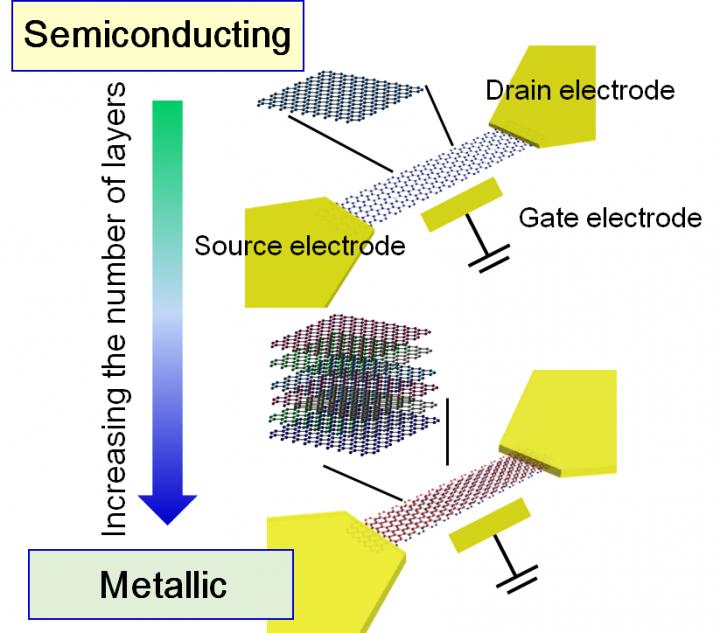
Researchers precisely set the number of layers in multilayer graphene nanoribbons, controlling the semiconducting and metallic properties of field effect transistors and establishing a design guideline for the practical applications of graphene devices
Researchers from Osaka University, Toyo University, and Kyushu Institute of Technology clarified the expression mechanism of semiconducting and metallic properties in graphene nanoribbons (GNRs) by analyzing the carrier transport properties in the field effect transistor (FET) with a multilayer GNR channel (Fig. 1).
The study shows that the carrier transport behavior of the FET-GNR changes from semiconducting to metallic properties as the effect of the charged impurities on the device substrate (SiO2/Si) is reduced, namely semiconducting behavior for few layers (1-3 layers) and metallic behavior for multilayers (6-8 layers) as shown in Fig. 2.
Fig 3(a) and 3(b) show the surface potential map of the monolayer and multilayer graphene calculated by the device simulation. In the case of monolayer GNR, the local high potential barriers are formed by the charged impurities on the substrate; however, in the case of multilayer GNRs, the surface potential becomes flat due to the field screening effect between layers.
Fig 3(c) and 3(d) schematically show the surface potential of monolayer and multilayer GNRs, respectively. The carrier transport of the monolayer GNR on the device substrate is affected by the local high potential barriers due to the charged impurities and hence shows hopping conduction over the barriers assisted by thermal energy. In particular, in a thin one-dimensional structure such as a monolayer GNR, the conduction electrons are localized and exhibit semiconducting-like properties because the locally formed potential barriers divides the current pass of the thin GNR channel. On the other hand, in a multilayer GNR, the electric field of the charged impurities is dramatically reduced as the number of layers increases due to the screening effect between layers, and the potential near the top layer becomes flat and shows the metallic characteristics with high conductivity.
Fig 3(e) shows the observed carrier transport properties of the FET with GNR channel as a function of the number of layers. After the number of layers reaches around five, the carrier transport characteristics change from semiconducting to metallic properties. A film thickness of five layers is in good agreement with the screening length (~1.5 nm) of the electric field due to the charged impurities that exist on the substrate. This indicates that carrier transport characteristics (i.e. semiconducting and metallic properties) in actual GNR devices are decided by the presence or absence of environmental effects.
“We have succeeded in controlling semiconducting and metallic properties of FETs using multilayer GNRs by modulating the number of layers,” says Ryota Negishi. “GNRs with excellent carrier transport properties are attracting attention as next-generation electronic device materials. This study provides design guidelines for GNRs that incorporate actual device structures. This achievement is an important milestone that will accelerate the application of GNR materials for purposes such as high-speed transistors and ultra-thin wiring.”
###
The article, “Crossover point of the field effect transistor and interconnection applications in turbostratic multilayer graphene nanoribbon channel” was published in Scientific Reports at DOI: https:/
About Osaka University
Osaka University was founded in 1931 as one of the seven imperial universities of Japan and is now one of Japan’s leading comprehensive universities with a broad disciplinary spectrum. This strength is coupled with a singular drive for innovation that extends throughout the scientific process, from fundamental research to the creation of applied technology with positive economic impacts. Its commitment to innovation has been recognized in Japan and around the world, being named Japan’s most innovative university in 2015 (Reuters 2015 Top 100) and one of the most innovative institutions in the world in 2017 (Innovative Universities and the Nature Index Innovation 2017). Now, Osaka University is leveraging its role as a Designated National University Corporation selected by the Ministry of Education, Culture, Sports, Science and Technology to contribute to innovation for human welfare, sustainable development of society, and social transformation.
Website: https:/
Media Contact
Saori Obayashi
[email protected]
Related Journal Article
http://dx.