• HOME
  • NEWS
  • EXPLORE
    • CAREER
      • Companies
      • Jobs
    • EVENTS
    • iGEM
      • News
      • Team
    • PHOTOS
    • VIDEO
    • WIKI
  • BLOG
  • COMMUNITY
    • FACEBOOK
    • INSTAGRAM
    • TWITTER
Saturday, May 16, 2026
BIOENGINEER.ORG
No Result
View All Result
  • Login
  • HOME
  • NEWS
  • EXPLORE
    • CAREER
      • Companies
      • Jobs
        • Lecturer
        • PhD Studentship
        • Postdoc
        • Research Assistant
    • EVENTS
    • iGEM
      • News
      • Team
    • PHOTOS
    • VIDEO
    • WIKI
  • BLOG
  • COMMUNITY
    • FACEBOOK
    • INSTAGRAM
    • TWITTER
  • HOME
  • NEWS
  • EXPLORE
    • CAREER
      • Companies
      • Jobs
        • Lecturer
        • PhD Studentship
        • Postdoc
        • Research Assistant
    • EVENTS
    • iGEM
      • News
      • Team
    • PHOTOS
    • VIDEO
    • WIKI
  • BLOG
  • COMMUNITY
    • FACEBOOK
    • INSTAGRAM
    • TWITTER
No Result
View All Result
Bioengineer.org
No Result
View All Result
Home NEWS Science News

DOE NETL commissions SwRI to develop methane quantification technology

Bioengineer by Bioengineer
June 9, 2020
in Science News
Reading Time: 2 mins read
0
IMAGE
Share on FacebookShare on TwitterShare on LinkedinShare on RedditShare on Telegram

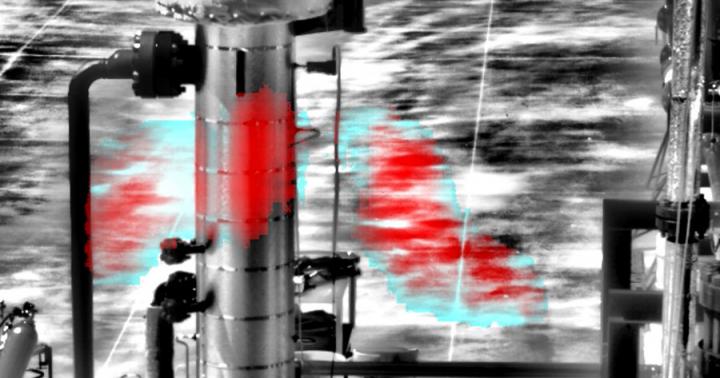
Project builds upon previous DOE-funded research using machine learning to detect methane leaks
IMAGE

Credit: Southwest Research Institute

SAN ANTONIO — June 9, 2020 — Southwest Research Institute is developing machine learning algorithms to measure fugitive methane emissions through a project funded by the U.S. Department of Energy through the Office of Fossil Energy and managed at the National Energy Technology Laboratory (NETL).

The project leverages an SwRI technology previously funded by DOE, Smart Methane Leak Detection, or SLED/M — a computer vision system that accurately detects small methane leaks that typically go unnoticed along natural gas pipelines and in compressor stations.

Over the next year, SwRI will enhance algorithms to quantify leaks using a low-cost longwave infrared thermal imager and a lightweight lidar (light detection and ranging) system. Natural gas leaks are typically measured from a single point using a diode laser absorption spectroscopy instrument, which must be moved to several positions to gather data.

“Conventional methods can be costly and time-consuming, and they often fail to pinpoint leak sources,” said Heath Spidle, a research engineer leading the project for SwRI. “This new technology will enhance SLED/M’s proven methane detection algorithms with a physics model using 3D visuals to measure the volume of fugitive methane emissions.”

The DOE is particularly interested in developing new scalable quantification technologies, partly in response to a recent Stanford study that found only one in nine methane detection technologies are reliable.

“This newly added task will continue the important research being done at SwRI,” said Joe Renk, the DOE NETL senior federal project manager overseeing the work. “The use of gas imagers and lidar with machine learning presents an opportunity to develop cost-effective solutions to accurately quantify natural gas flow rates.”

SwRI’s Critical Systems Department will develop algorithms and integrate sensors with computational fluid dynamics, with support from the Institute’s Fluids Engineering Department.

“Having computer scientists who can work in-house with sensing experts and fluids engineers is a major advantage in developing a quantification solution with machine learning technology,” added Dr. Steve Dellenback, vice president of SwRI’s Intelligent Systems Division.

Fusing computer vision and machine learning, SwRI’s SLED technology has been adapted to autonomously detect methane, liquid hazardous leaks and even crude oil on water surfaces. SwRI is working with government and industry to apply smart leak detection algorithms on aerial drones, aircraft and stationary devices.

Conventional methane detection systems, designed to locate larger leaks, suffer from false positives and missed detections, which hamper effectiveness and utilization by industry. SLED/M substantially reduces false positives by optimizing algorithms to reliably detect smaller leaks under a variety of conditions.

SwRI is a leader in the development of machine learning and computer vision solutions that help government and industry advance science and technology from deep sea to deep space.

For more information, visit https://www.swri.org/industries/machine-learning-technologies.

###

Media Contact
Robert Crowe
[email protected]

Original Source

https://www.swri.org/press-release/doe-netl-methane-quantification-technology-machine-learning-computer-vision

Tags: Climate ChangeComputer ScienceElectrical Engineering/ElectronicsMechanical EngineeringPollution/RemediationResearch/DevelopmentRobotry/Artificial IntelligenceTechnology/Engineering/Computer Science
Share12Tweet8Share2ShareShareShare2

Related Posts

Congenital Heart Disease’s Lasting Impact on Brain Health — Technology and Engineering

Congenital Heart Disease’s Lasting Impact on Brain Health

May 16, 2026

Metabolic Stress Worsens Parkinson’s via Mitochondrial Ferroptosis

May 16, 2026

Four New Hydroxyl Fatty Acids from Bacillus sp.

May 16, 2026

Validating B-IPQ Short Form for Older Colombians

May 16, 2026
Please login to join discussion

POPULAR NEWS

  • Research Indicates Potential Connection Between Prenatal Medication Exposure and Elevated Autism Risk

    844 shares
    Share 338 Tweet 211
  • New Study Reveals Plants Can Detect the Sound of Rain

    730 shares
    Share 291 Tweet 182
  • Salmonella Haem Blocks Macrophages, Boosts Infection

    62 shares
    Share 25 Tweet 16
  • Breastmilk Balances E. coli and Beneficial Bacteria in Infant Gut Microbiomes

    58 shares
    Share 23 Tweet 15

About

We bring you the latest biotechnology news from best research centers and universities around the world. Check our website.

Follow us

Recent News

Congenital Heart Disease’s Lasting Impact on Brain Health

Metabolic Stress Worsens Parkinson’s via Mitochondrial Ferroptosis

Four New Hydroxyl Fatty Acids from Bacillus sp.

Subscribe to Blog via Email

Enter your email address to subscribe to this blog and receive notifications of new posts by email.

Join 82 other subscribers
  • Contact Us

Bioengineer.org © Copyright 2023 All Rights Reserved.

Welcome Back!

Login to your account below

Forgotten Password?

Retrieve your password

Please enter your username or email address to reset your password.

Log In
No Result
View All Result
  • Homepages
    • Home Page 1
    • Home Page 2
  • News
  • National
  • Business
  • Health
  • Lifestyle
  • Science

Bioengineer.org © Copyright 2023 All Rights Reserved.