• HOME
  • NEWS
  • EXPLORE
    • CAREER
      • Companies
      • Jobs
    • EVENTS
    • iGEM
      • News
      • Team
    • PHOTOS
    • VIDEO
    • WIKI
  • BLOG
  • COMMUNITY
    • FACEBOOK
    • INSTAGRAM
    • TWITTER
Saturday, March 28, 2026
BIOENGINEER.ORG
No Result
View All Result
  • Login
  • HOME
  • NEWS
  • EXPLORE
    • CAREER
      • Companies
      • Jobs
        • Lecturer
        • PhD Studentship
        • Postdoc
        • Research Assistant
    • EVENTS
    • iGEM
      • News
      • Team
    • PHOTOS
    • VIDEO
    • WIKI
  • BLOG
  • COMMUNITY
    • FACEBOOK
    • INSTAGRAM
    • TWITTER
  • HOME
  • NEWS
  • EXPLORE
    • CAREER
      • Companies
      • Jobs
        • Lecturer
        • PhD Studentship
        • Postdoc
        • Research Assistant
    • EVENTS
    • iGEM
      • News
      • Team
    • PHOTOS
    • VIDEO
    • WIKI
  • BLOG
  • COMMUNITY
    • FACEBOOK
    • INSTAGRAM
    • TWITTER
No Result
View All Result
Bioengineer.org
No Result
View All Result
Home Headlines

Doctoral student’s research looks at cause of neurodegenerative…

Bioengineer.org by Bioengineer.org
January 28, 2018
in Headlines, Health, Science News
Reading Time: 2 mins read
0
Share on FacebookShare on TwitterShare on LinkedinShare on RedditShare on Telegram
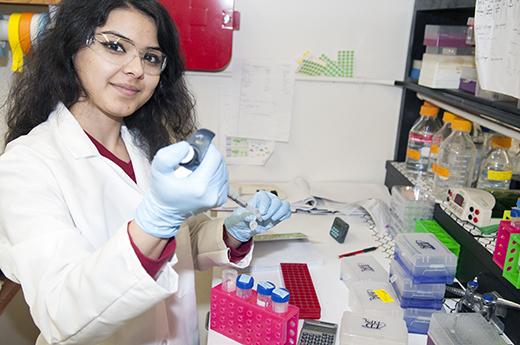
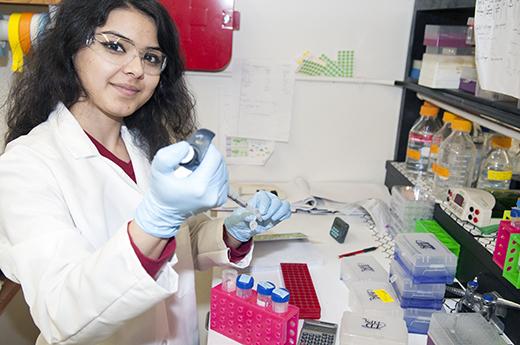
IMAGE

Credit: Kansas State University

MANHATTAN, Kan. — A Kansas State University student hopes her research on a currently untreatable and progressive neurodegenerative disease will one day lead to treatment options.

Babita Adhikari Dhungel, doctoral student in biology from Nepal, is researching the cause of CLN8 disease, which is a form of neuronal ceroid lipofuscinoses. This hereditary disease causes damage to the retina, which eventually leads to blindness, sleep problems, seizures, reduced intellectual ability and problems in coordinating movements, including eventual immobilization.

Adhikari Dhungel has found that levels of ceramide, a biochemical compound that is present in healthy human cells, is reduced by 60 percent in cells of people who have the disease. The next phase of her research will investigate why this reduction occurs.

"I hope that my research will lead to therapy options for this disease," said Adhikari Dhungel, who recently presented the research at Kansas State University's Three Minute Thesis Competition and the Division of Biology's Molecular Cellular Development Biology Forum.

Stella Yu-Chien Lee, assistant professor of biology and Adhikari Dhungel's adviser for this project, said the disease is most common in Finland, where 1 in 10,000 people are diagnosed. It also has been found in other populations, such as Turkey, Italy, Germany, Pakistan, Israel and recently in Japan. Though it is still rare worldwide, with just 10 published cases per 100,000 people, the disease is becoming more prevalent.

"With advanced genetic diagnosis, more CLN8 disease patients will most likely be identified, so the need for a treatment is growing," Lee said. "Babita is laying the foundation for research that could help the medical field to eventually develop a treatment."

Adhikari Dhungel also is working to find the link between two other problems present in cells of people who have the disease: a malfunctioning of the CLN8 protein and a glitch in the lysosome, which Adhikari Dhungel describes as the cell's garbage disposal.

"When the lysosome quits working, it's like waste management employees going on strike — trash accumulates," Adhikari Dhungel said. "In the same way, when lysosomes are unable to carry out their function, waste accumulates."

Previous research has shown a correlation between that process and the occurrence of CLN8 disease. Adhikari Dhungel wants to know how the malfunctioning protein is related to the lysosome because the protein and the lysosome are in different parts of the cell.

"The protein never reaches the region of the cell where the lysosome is located, but it appears that they are affecting each other, or possibly there are additional players involved," Adhikari Dhungel said. "We have some hints about the causes of this disease, and my research aims to connect the hints."

###

Media Contact

Stella Yu-Chien Lee
[email protected]
785-532-3446
@KStateNews​

http://www.k-state.edu

Share12Tweet8Share2ShareShareShare2

Related Posts

New Issue of International Journal of Disease Reversal and Prevention Features Clinicians’ Guide on Cutting-Edge Dietary Interventions for Cancer, Menopause, Alzheimer’s, and More

March 28, 2026

Cutaneous Lesion Location: Key to Head Injury Risk?

March 27, 2026

Biochar Boosts Forest Resilience Against Acid Rain by Restoring Essential Soil Nitrogen

March 27, 2026

Two Salk Scientists Honored as 2025 AAAS Fellows

March 27, 2026
Please login to join discussion

POPULAR NEWS

  • blank

    Revolutionary AI Model Enhances Precision in Detecting Food Contamination

    96 shares
    Share 38 Tweet 24
  • Imagine a Social Media Feed That Challenges Your Views Instead of Reinforcing Them

    1004 shares
    Share 397 Tweet 248
  • Uncovering Functions of Cavernous Malformation Proteins in Organoids

    54 shares
    Share 22 Tweet 14
  • Promising Outcomes from First Clinical Trials of Gene Regulation in Epilepsy

    51 shares
    Share 20 Tweet 13

About

We bring you the latest biotechnology news from best research centers and universities around the world. Check our website.

Follow us

Recent News

In-Sensor Cryptography Links Physical Process to Digital Identity

Can Psychosocial Factors Influence Cancer Risk?

Depression Factors in Elderly: Pre vs. Post-COVID Analysis

Subscribe to Blog via Email

Enter your email address to subscribe to this blog and receive notifications of new posts by email.

Join 78 other subscribers
  • Contact Us

Bioengineer.org © Copyright 2023 All Rights Reserved.

Welcome Back!

Login to your account below

Forgotten Password?

Retrieve your password

Please enter your username or email address to reset your password.

Log In
No Result
View All Result
  • Homepages
    • Home Page 1
    • Home Page 2
  • News
  • National
  • Business
  • Health
  • Lifestyle
  • Science

Bioengineer.org © Copyright 2023 All Rights Reserved.