Credit: The Armed Forces Institute of Pathology (AFIP) via Wikimedia Commons
A group of Canadian and Korean scientists and physicians have developed the first DNA-based test that allows them to tell which patients will relapse after receiving chemotherapy and a bone marrow transplant, for their acute myeloid leukemia, or AML. The findings, published recently in the journal Blood, could help doctors improve patient outcome by changing the treatment before cancer has returned in full force.
"We can detect mutations in patients' bone marrow cells three weeks after the transplant and based on that predict the likelihood of their relapse," says Zhaolei Zhang, Principal Investigator in the University of Toronto's Donnelly Centre for Cellular and Biomolecular Research and a professor in the Departments of Molecular Genetics and Computer Science, who co-led the study.
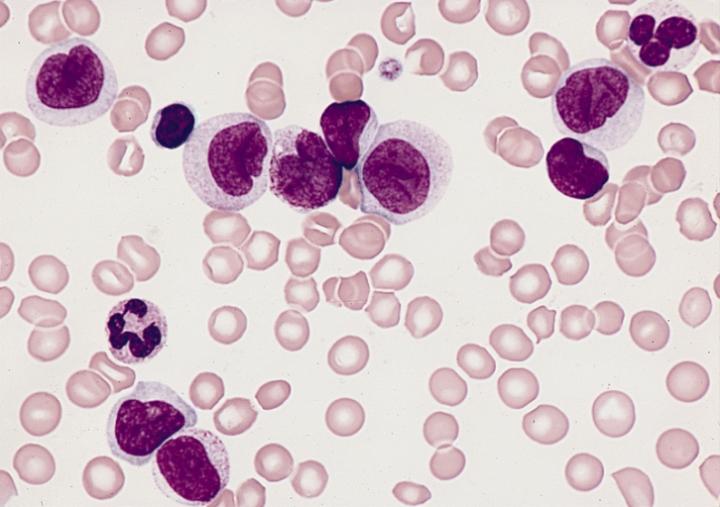
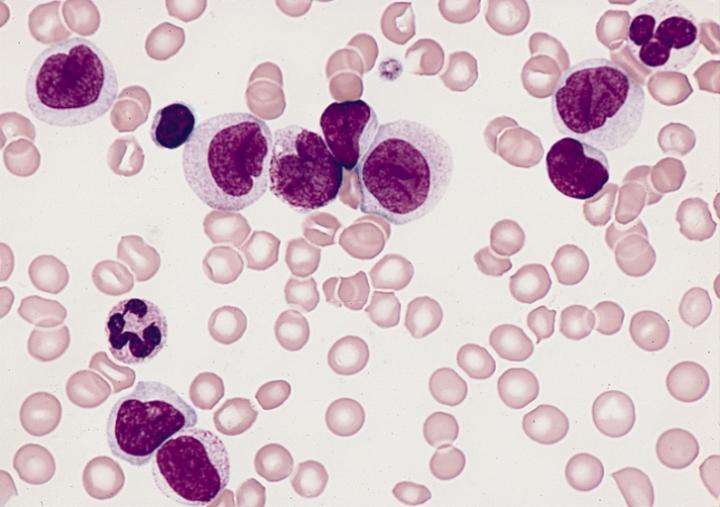
AML is the most common type of leukemia in adults, comprising about one quarter of all cases. It affects the bone marrow, the spongy tissue inside the bone where all blood cells are made. The disease stems from an overproduction of immature blood cells which over time outgrow normal blood cells. It's a type of cancer which starts suddenly and progresses quickly, requiring urgent treatment.
Treatment involves chemotherapy to wipe out the diseased bone marrow, followed by a bone marrow transplant to reconstitute the patient's blood with cells from a healthy donor. While most patients go into remission after chemotherapy, about one third will relapse three to six months after receiving the transplant.
"In AML, it is very important to predict who is going to relapse, "says Dennis Kim, of the Princess Margaret Cancer Centre, at the University Health Network (UHN) and Associate Professor in U of T's Department of Medicine and a co-leader of the study. "If we are able to identify someone who is at high risk of relapse then we can do therapeutic intervention earlier which can improve their outcome in the long run."
Until now, there was no good way to detect the trace amounts of leukemia cells which resisted the treatment and which drive relapse. By the time these cells are picked up by available methods, the cancer is usually already at an advanced stage.
Using new DNA sequencing technology called next generation sequencing, or NGS, the team was able to identify the treatment-resistant leukemia cells, or clones, even when they make up a tiny proportion of all cells in the bone marrow. The nature of mutations reveals further clues about how best to target the disease with drugs.
"With our method, not only can we say that this patient will relapse, but we can also say their relapsing clone contains certain mutations which can be a target for therapeutic compounds that can be used to treat the patient," says Kim.
For the study, the researchers collected 529 bone marrow samples from 104 AML patients who underwent chemotherapy and bone marrow transplant. The samples were collected at different time points: at the time of diagnosis, during the chemotherapy-induced remission, and three weeks after the bone marrow transplant. A subset of patients also gave samples three, six and twelve months after the transplant. Some samples were also taken from bone marrow donors to rule out the possibility that the leukemia cells were introduced by the transplant.
The researchers then identified DNA mutations which were present at the time of diagnosis and looked for those same mutations at each sampling point. They found that while chemotherapy and bone marrow transplant eliminated most leukemia cells, leading to a reduction in mutation frequency, some initial mutations could still be detected three weeks after the transplant, indicating the presence of treatment-resistant cancer cells. As these same mutations expand in frequency upon relapse, the data suggest that the same cancerous cells that started the leukemia are also responsible for the disease comeback.
Data analysis required Zhang's team to develop new computational tools to parse the leukemia-driving mutations from the sea of sequence data. This allowed them to identify low residual mutation frequency of 0.2 per cent to use as a surrogate marker for giving a personal chance of relapse.
"Patients who had a mutation burden greater than 0.2 per cent were four times more likely to relapse than patients who had a lower burden or no mutation burden," says TaeHyung (Simon) Kim, a computer science graduate student in Zhang's lab who analyzed the data along with Joon Ho Moon, from Kyungpook National University Hospital in Korea, and Jae-Sook Ahn, from Chonnam National University Hwasun Hospital in Korea, who is visiting Zhang's lab as visiting professor.
The researchers hope their DNA-based test will become routine for monitoring disease prognosis although they say this could take five to ten years. In some hospitals, DNA tests are becoming routine for diagnosis of AML, but not for predicting prognosis nor guiding treatment plan.
###
The research was done as a three-sided collaboration between U of T, UHN and the team led by Hyeoung-Joon Kim, President of the Korean Society of Haematology and a professor in the Department of Hematology-Oncology at the Chonnam National University Hwasun Hospital in the Republic of Korea, who oversaw collection and sequencing of patient samples.
The study was supported by research grants from the Natural Science and Engineering Council of Canada, Leukemia and Lymphoma Society of Canada, Princess Margaret Foundation and National Research Foundation of Korea.
Media Contact
Jovana Drinjakovic
[email protected]
416-543-7820
@UofTNews
http://www.utoronto.ca
Related Journal Article
http://dx.doi.org/10.1182/blood-2018-04-848028