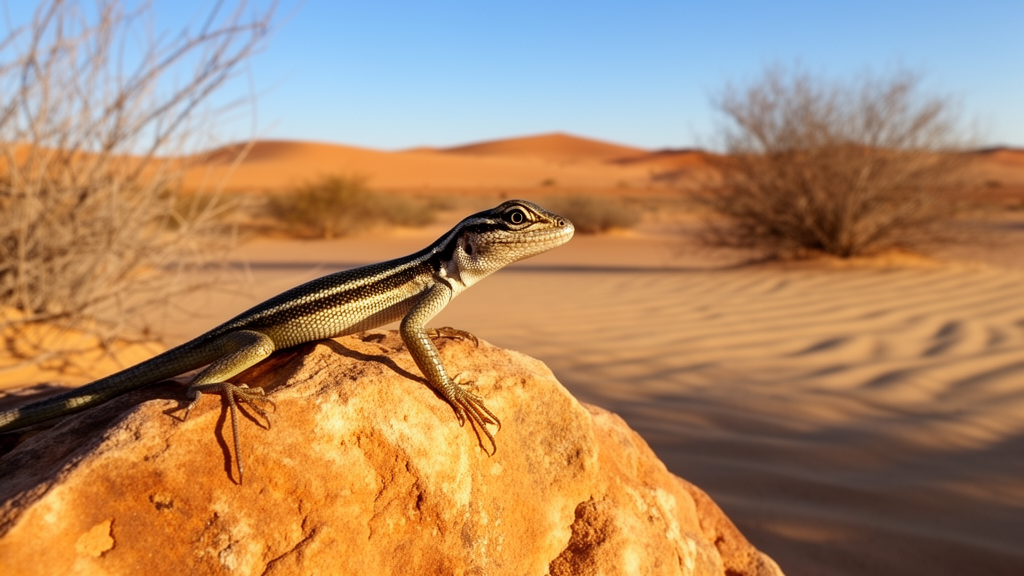
A genetic study of snake-eyed lizards in the genus Ophisops identified six mitochondrial sublineages within the North African and Israeli lineage, or Clade B, adding evidence of geographic structure among populations from Morocco, Algeria, Tunisia, Libya and Israel. The researchers also found that the two recognized morphotypes did not align consistently with the genetic lineages and concluded that current evidence favors recognition of a single North African taxon, O. occidentalis.
The phylogeographic study focused on O. occidentalis from Morocco, Algeria and Tunisia and isolated populations attributed to O. elegans in Algeria. Ten specimens were collected in the field across Morocco, Tunisia and Algeria. O. occidentalis was the only species present across most of the surveyed region, while both species can occur together in Algeria. Field identifications in Algeria used the number of supraciliary granular scales: fewer than 17 corresponded to O. occidentalis, while 17 or more corresponded to O. elegans. A small piece of tail tissue from each specimen was preserved in 96% ethanol for genetic analysis.
The investigators sequenced a mitochondrial 16S ribosomal RNA marker and obtained seven new sequences for the nuclear MC1R gene. The 16S dataset comprised 21 specimens and 485 base pairs, including new and published sequences and specimens from Greece and Syria used for rooting. The MC1R dataset contained 16 taxa and 584 base pairs, with seven new North African sequences, published data and two Mesalina species as outgroups. Relationships in the 16S data were estimated with a maximum-likelihood analysis in PhyML 3.0 under the GTR+I+G model, with node support evaluated through 1,000 bootstrap replicates. Because variation in MC1R was extremely low, the researchers also constructed a statistical-parsimony haplotype network. The new sequences were deposited in GenBank as PV810783–PV810792.
The maximum-likelihood analysis resolved six sublineages within Clade B. These consisted of O. occidentalis from Morocco and Tunisia; O. occidentalis from Tunisia and Algeria; a separate O. occidentalis lineage from Tunisia; O. elegans from Algeria; a Libyan lineage containing specimens identified as both O. elegans and O. occidentalis; and O. elegans from Israel. Thus, five sublineages were represented by North African populations and the sixth by Israeli specimens. Three of the six had been identified in earlier mitochondrial research.
Relationships among the six sublineages were not strongly supported by the single mitochondrial fragment. The Israeli samples appeared sister to all of the North African lineages, while within the region the Libyan lineage appeared sister to the four Maghreb lineages. The study therefore documented additional structure but did not establish strong phylogenetic relationships among every mitochondrial sublineage.
The nuclear MC1R results differed from the mitochondrial pattern. All seven North African individuals, representing both named species, shared only two haplotypes, and the two species shared one of them. Relationships among the major mitochondrial groups were weakly supported in the nuclear analysis. The North African haplotypes were more closely related to specimens from Turkey and Azerbaijan, assigned to mitochondrial Clade A, than to specimens from Iran, assigned to Clade C.
Neither O. elegans nor O. occidentalis was monophyletic in the present study, consistent with earlier mitochondrial assessments. Individuals with the O. occidentalis morphotype from the Maghreb were not closely related to morphologically similar specimens from Libya, while Moroccan and Tunisian O. occidentalis occupied separate mitochondrial sublineages. The pattern associated population origin, rather than morphology alone, with mitochondrial diversity. Published observations that hemipenial characters are similar in Libyan O. elegans and O. occidentalis but differ from those of other O. elegans populations also supported the authors’ interpretation of one geographically variable species rather than two species connected by introgression.
The geographic pattern was consistent with an east-to-west expansion across North Africa. Moroccan 16S sequences were very similar to some Tunisian sequences, which the authors interpreted as indicating relatively recent expansion across western Algeria. O. occidentalis was not found across the Moulouya River valley but occurred at its eastern margin, where the valley is a known barrier for various reptile and amphibian species. The authors associated the estimated separation of Algerian and Tunisian populations with the Plio-Pleistocene, a period of major climatic fluctuations and expansions and contractions of the Sahara in the region.
The study was limited by its small number of newly collected animals: 10 for the mitochondrial analysis and seven North African MC1R sequences. The 16S fragment provided weak support for relationships among sublineages, while low nuclear variation yielded only two North African haplotypes and weak support among major groups. The proposed recognition of a single North African taxon was therefore the authors’ taxonomic interpretation of the combined evidence, not a definitive species delimitation. They noted that deeply divergent sublineages could correspond to additional species and that the identity of the Israeli specimens required confirmation with nuclear markers.
Subject of Research: Phylogeographic analysis of Ophisops genetic diversity across North Africa and Israel
Article Title: Genetic diversity within species of Ophisops ( Reptilia , Lacertidae ) from the Maghreb
Article References: Harris, D. J., Bouam, I., & Ferreira, A. I. (2025). Genetic diversity within species of Ophisops (Reptilia, Lacertidae) from the Maghreb. Herpetozoa, 38, 205-210. https://doi.org/10.3897/herpetozoa.38.e153941
Image Credits: AI Generated
DOI: 10.3897/herpetozoa.38.e153941
Keywords: Ophisops, snake-eyed lizards, genetic diversity, phylogeography, mitochondrial DNA, MC1R, North Africa, Maghreb, taxonomy, Genetic, diversity, within
News Source: Drew Townsend. (October 20, 2026). DNA study finds six mitochondrial sublineages in North African and Israeli Ophisops. Scienmag.