• HOME
  • NEWS
  • EXPLORE
    • CAREER
      • Companies
      • Jobs
    • EVENTS
    • iGEM
      • News
      • Team
    • PHOTOS
    • VIDEO
    • WIKI
  • BLOG
  • COMMUNITY
    • FACEBOOK
    • INSTAGRAM
    • TWITTER
Friday, May 15, 2026
BIOENGINEER.ORG
No Result
View All Result
  • Login
  • HOME
  • NEWS
  • EXPLORE
    • CAREER
      • Companies
      • Jobs
        • Lecturer
        • PhD Studentship
        • Postdoc
        • Research Assistant
    • EVENTS
    • iGEM
      • News
      • Team
    • PHOTOS
    • VIDEO
    • WIKI
  • BLOG
  • COMMUNITY
    • FACEBOOK
    • INSTAGRAM
    • TWITTER
  • HOME
  • NEWS
  • EXPLORE
    • CAREER
      • Companies
      • Jobs
        • Lecturer
        • PhD Studentship
        • Postdoc
        • Research Assistant
    • EVENTS
    • iGEM
      • News
      • Team
    • PHOTOS
    • VIDEO
    • WIKI
  • BLOG
  • COMMUNITY
    • FACEBOOK
    • INSTAGRAM
    • TWITTER
No Result
View All Result
Bioengineer.org
No Result
View All Result
Home NEWS Science News

DNA extracted in museum samples can reveal genetic secrets

Bioengineer by Bioengineer
January 31, 2020
in Science News
Reading Time: 2 mins read
0
IMAGE
Share on FacebookShare on TwitterShare on LinkedinShare on RedditShare on Telegram

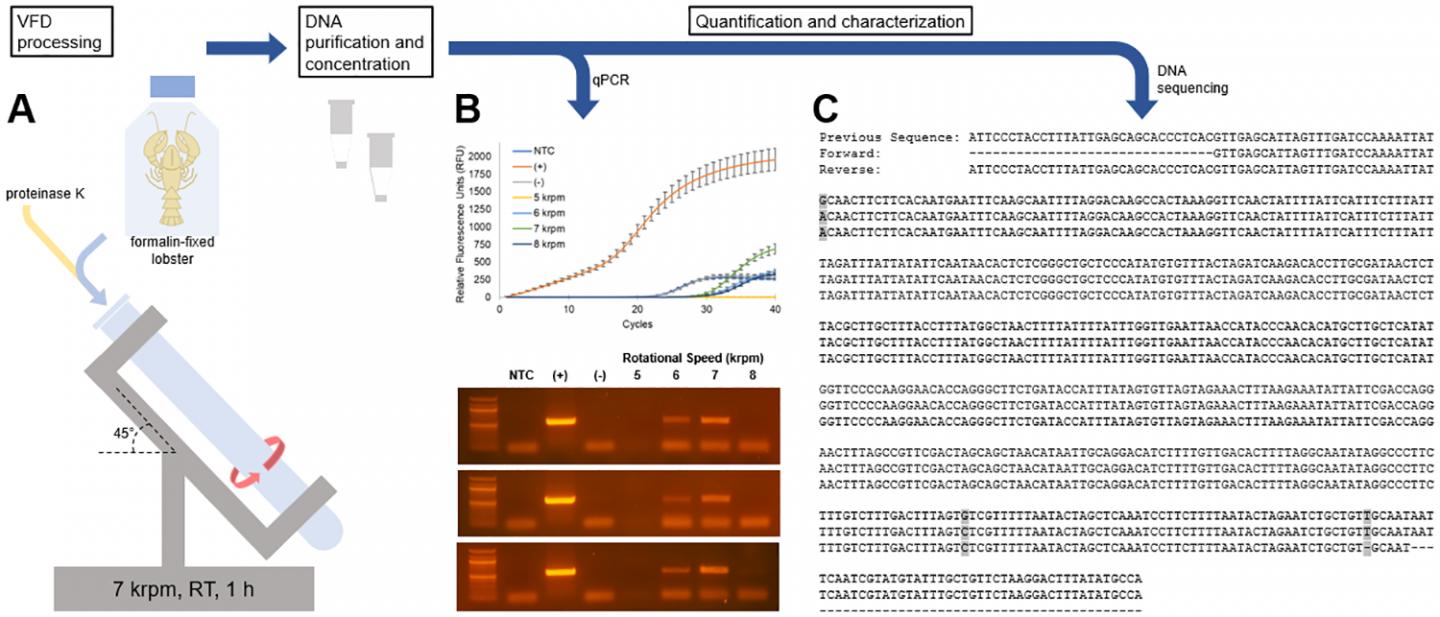
DNA proteins extracted using a vortex fluidic device (VFD) could help answer important questions about extinct and ancient museum specimens
IMAGE

Credit: PLOS ONE


DNA in preserved museum specimens can allow scientists to explore the history of species and humanities impact on the ecosystem, but samples are typically preserved in formaldehyde which can damage DNA and make very difficult to recover.

Researchers have used a vortex fluidic device (VFD) to speed up DNA extraction from an American lobster preserved in formaldehyde – with the results providing a roadmap for exploring DNA from millions of valuable and even extinct species in museums worldwide.

Flinders PHD candidate Jessica Phillips says processing the preserved tissue from museum specimens in the VFD breaks apart proteins, releasing DNA which offers important historical genetic information.

“DNA extraction is achieved by processing the preserved tissue in an enzyme solution in the VFD. This enzyme breaks apart the proteins, releasing the DNA which can be analysed. By using the VFD we are able to accelerate this process from days to hours,” says Ms Phillips.

“For 150 years these samples have been preserved in formaldehyde which can damage the DNA and also make DNA difficult to recover. We used mechanical energy in a vortex fluidic device (VFD) to accelerate the extraction by processing the preserved tissue in an enzyme solution in the VFD.”

This work is a collaboration between University of California, Irvine (UCI), The Department of Organismic and Evolutionary Biology at Harvard University, and Flinders University.

Researchers say the results provide a roadmap for exploring DNA from millions of historical and even extinct species in museums worldwide.

Research Chair of Clean Technology Research Professor Colin Raston says the work builds on the body of about 80 papers that his research group has published about the vortex fluidic device.

“Applications of the VFD are rapidly expanding, but this has only been possibly by internal collaboration. The DNA extraction application involved collaboration with two other research laboratories headed by Professor Greg Weiss at UCI and Professor Peter Girguis at Harvard.”

“We have only scratched the surface about what is possible for this device,” says Professor Raston.”

###

Media Contact
Jessica Phillips
[email protected]
61-435-108-585

Related Journal Article

http://dx.doi.org/10.1371/journal.pone.0225807

Tags: Chemistry/Physics/Materials SciencesMolecular PhysicsNanotechnology/MicromachinesNeurochemistry
Share12Tweet8Share2ShareShareShare2

Related Posts

Transitional Urology: Navigating Comprehensive Care Processes

May 15, 2026

Tracking Frailty Patterns in Elderly Heart Attack Patients

May 15, 2026

Precision Therapies Offer New Hope Against Drug-Resistant Bacteria

May 15, 2026

UCLA to Head $9M Study Investigating the Connection Between Pesticides, Air Pollutants, and Parkinson’s Disease Risk

May 14, 2026
Please login to join discussion

POPULAR NEWS

  • Research Indicates Potential Connection Between Prenatal Medication Exposure and Elevated Autism Risk

    842 shares
    Share 337 Tweet 211
  • New Study Reveals Plants Can Detect the Sound of Rain

    729 shares
    Share 291 Tweet 182
  • Salmonella Haem Blocks Macrophages, Boosts Infection

    62 shares
    Share 25 Tweet 16
  • Breastmilk Balances E. coli and Beneficial Bacteria in Infant Gut Microbiomes

    58 shares
    Share 23 Tweet 15

About

We bring you the latest biotechnology news from best research centers and universities around the world. Check our website.

Follow us

Recent News

Transitional Urology: Navigating Comprehensive Care Processes

Tracking Frailty Patterns in Elderly Heart Attack Patients

Precision Therapies Offer New Hope Against Drug-Resistant Bacteria

Subscribe to Blog via Email

Enter your email address to subscribe to this blog and receive notifications of new posts by email.

Join 82 other subscribers
  • Contact Us

Bioengineer.org © Copyright 2023 All Rights Reserved.

Welcome Back!

Login to your account below

Forgotten Password?

Retrieve your password

Please enter your username or email address to reset your password.

Log In
No Result
View All Result
  • Homepages
    • Home Page 1
    • Home Page 2
  • News
  • National
  • Business
  • Health
  • Lifestyle
  • Science

Bioengineer.org © Copyright 2023 All Rights Reserved.